

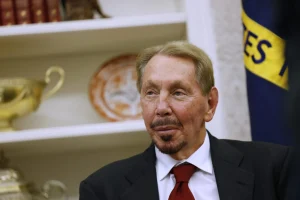
The history of American industry is punctuated by towering figures—the so-called “robber barons”—who amassed fortunes by seizing control over the nation’s essential infrastructures. In the Gilded Age, it was John D. Rockefeller and oil, or J.P. Morgan and finance. Today, the landscape has changed, but the ambition remains startlingly familiar. If the current era has a quintessential robber baron, many would argue it is Larry Ellison, co-founder and former CEO of Oracle Corporation, whose immense wealth and ceaseless drive are now focused on controlling the essential commodity of the 21st century: data.
Ellison is not merely a successful businessman; he is the architect of a sprawling digital domain, aiming for maximum power and “pure monetization”. His corporate strategy, predicated on absorbing rivals and embedding proprietary technology deep within governmental and private systems, has paved the way for a highly centralized infrastructure that some critics describe as a digital surveillance state.
The recent maneuvers regarding the social media platform TikTok only underscore Ellison’s escalating quest for dominion, highlighting how a handful of billionaires are actively shaping political outcomes and cementing their role as “digital landlords”.
The Blueprint for Digital Hostage-Taking
Larry Ellison, whose net worth in 2024 was estimated to be in excess of $230 billion, has built Oracle into a company that is foundational to global digital infrastructure. Interestingly, the company’s roots trace back to a CIA project in the 1970s, which gave the company its name. The database technology that formed Oracle’s core, the relational database, was based on a “free idea” published by an IBM team, which Oracle programmers reassembled and sold.
From these opportunistic beginnings, Oracle developed a business model centered on domination. The company has aggressively acquired other software companies, shifting its focus toward absorbing the necessary, if “boring,” behind-the-scenes technologies that keep the internet and large corporations running. Oracle runs ten of the ten top banks, and they are described as dominant within the Fortune 500.
Crucially, Oracle is characterized as a company that fundamentally “hates competition” and does everything possible to “asphyxiate” rivals. This market concentration has made its software virtually impossible to replace. The government, for instance, finds that migrating massive datasets—like everyone’s tax information—is prohibitively difficult and expensive. Consequently, Oracle’s customers, including vital government departments, are essentially its “hostages”. By establishing this proprietary, critical infrastructure, Ellison has locked the government into rental agreements perpetually, gaining constant access to taxpayer dollars.
Wealth as a Scorecard and Political Leverage
Ellison’s personal life reflects his grand industrial ambition. He treats wealth as “a single score for all of humanity,” aiming to be at the top of a numbered list. Like other ultra-wealthy individuals such as Elon Musk and Mark Zuckerberg, Ellison has famously avoided taking a traditional salary ($1 a year), relying instead on the growth of his stock holdings to build wealth, thereby avoiding significant income taxes. He then funds his lavish lifestyle by “borrowing” against his Oracle stock—having pledged over $30 billion worth of shares as collateral for private loans.
This debt-financed opulence includes the acquisition of most of the Hawaiian island of Lanai, transforming it into a modern-day company town. Ellison owns virtually all the island’s businesses, including resorts, the main grocery store, and the only gas station, positioning himself as the primary boss and landlord to its 3,000 residents. Residents face unique vulnerabilities; reports indicate that a provision in some residential leases states that termination from a job with any of his companies can result in eviction from their home.
Ellison’s influence extends directly into international policy and conflict. His most firmly held political belief is his staunch support for the state of Israel. He is connected to groups like the Tony Blair Institute (TBI), which acts as a sales company for Oracle, offering consulting services to global south countries and then locking them into predatory contracts for Oracle’s software. Furthermore, Ellison has reportedly used his money and power to exploit geopolitical upheaval, aiming to build a tax haven in a warzone by proposing to turn Gaza City into a tax-free hub for startups and server farms.
The TikTok Gambit: Centralized Data, Centralized Power
The recent push to force the sale or ban of TikTok in the U.S., originally championed by Donald Trump, illustrates the confluence of corporate ambition, political ideology, and the increasing centralization of information control.
Oracle is slated to play a massive role in the resulting corporate structure. Ellison’s company would largely manage the operations of the new U.S.-based TikTok entity, controlling its algorithm and user data. While TikTok had already moved U.S. user data to Oracle servers in Texas, the new deal suggests the government will have extensive access to this information, potentially allowing “trusted security partners” to share data with other U.S. government officials.
This arrangement solidifies Oracle’s position as a governing power over critical infrastructure. By adding TikTok to the list of government and private enterprises already renting space on Oracle’s servers, Ellison gains increasing control over the information that passes through American feeds and into American brains. When paired with the Ellisons’ growing media empire—Larry’s son, David Ellison, now controls Paramount/Skydance, which owns CBS and is attempting to acquire Warner Brothers (CNN)—the concentration of audience access under a tiny club of billionaires becomes increasingly stark.
The Goal: Control and Monetization
Larry Ellison’s ambition, and the answer to what he wants from us, is clear: complete control over the infrastructure of modern life, paving the way for maximum profit and unchecked influence. His companies, which already supply software to agencies like the NSA and build body cams and drones, are embedding themselves deeper into the apparatus of data collection and surveillance.
As historical robber barons centralized industries like oil and steel, the current generation of technology giants—Amazon, Google, Facebook, and Oracle—have centralized the infrastructure of information, commerce, and communication. This extreme concentration of power is new and dangerous. As the CEO of Facebook, Mark Zuckerberg, once noted, these corporations operate “more like a government than a traditional company”.
Ellison’s strategy is not about revolutionary innovation; his stated philosophy centers on productivity, efficiency, and margins. It is about transforming human creativity and essential technological networks into a rent-based economy where he acts as the ultimate digital landlord. The fight against such monopolistic control is, therefore, a fundamental struggle to retain democratic influence over the vital arteries of modern society.