

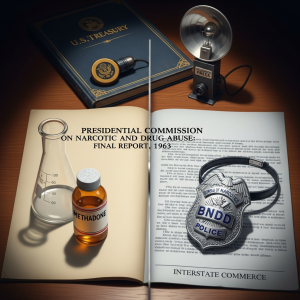
The year 1963 marked a significant turning point in the United States’ approach to drug abuse, driven by evolving public attitudes and a landmark set of recommendations from the Presidential Commission on Narcotic and Drug Abuse. This period signaled a critical shift away from solely punitive measures towards a more complex strategy that acknowledged both the medical and law enforcement dimensions of the problem.
Prior to this, federal drug control policy had largely been characterized by stringent, mandatory prison sentences, established by legislation such as the Boggs Act in 1951 and the Narcotic Control Act in 1956, which even introduced the death penalty for certain drug offenses. Enforcement was primarily handled by the Federal Bureau of Narcotics (FBN), which had been created in 1930 as a spin-off from the Bureau of Prohibition. For over three decades, under the leadership of Harry J. Anslinger, the FBN focused intently on targeting international drug traffickers, believing that cutting supply was the most effective way to end drug abuse in the U.S., and engaged in extensive public relations campaigns to suppress demand. International interdiction was, in fact, the cornerstone of federal drug enforcement efforts during this era.
However, by the 1960s, a notable shift in public sentiment began to emerge. Organizations, including the American Bar Association, started to voice opposition to the harshness of existing punishments for drug offenders. Concurrently, there was a growing federal endorsement for a more medical approach to drug abuse, epitomized by the acceptance and increased commonality of methadone maintenance as a treatment for heroin dependence. This internal re-evaluation of drug policy occurred amidst a broader international context, with the United Nations’ 1961 Single Convention on Narcotic Drugs establishing the world’s first coordinated prohibition regime and unequivocally advocating for total cannabis prohibition. This convention was later amended in 1972 to allow signatories to rehabilitate and treat drug users, differentiating them from suppliers who were to be severely punished.
It was within this evolving landscape that the 1963 Presidential Commission on Narcotic and Drug Abuse issued its final report in November of that year. The Commission’s recommendations were comprehensive and pointed towards a significant restructuring of federal efforts. Specifically, it advised:
- Increasing federal drug enforcement personnel to strengthen the nation’s capacity to combat drug abuse.
- Transferring drug enforcement functions from the Treasury Department, where the FBN was housed, to the Department of Justice (DOJ).
- Allocating more funds for narcotic research to deepen understanding and develop more effective interventions.
- Advocating for less strict punishment for drug offenses, reflecting the growing support for a medical, rather than purely carceral, approach.
- Dismantling the existing Federal Bureau of Narcotics (FBN), suggesting a need for a fresh start or a different organizational structure.
Congress, indeed, paid heed to these recommendations. In response, it took steps to support the medical approach by creating the Bureau of Drug Abuse Control within the Department of Health, Education, and Welfare, and by providing for the civil commitment of some federal detainees who were drug addicted, with the explicit policy goal of rehabilitation and their return to society as useful members. Furthermore, a crucial shift occurred in the constitutional basis for federal drug control, moving from the government’s taxing authority to its power to regulate interstate commerce. This change provided a broader and more robust legal foundation for federal intervention in drug-related matters nationwide.
The recommendations regarding the transfer of enforcement functions were also implemented. In 1968, the FBN merged with the Bureau of Drug Abuse Control, and their combined functions were transferred to the Department of Justice. This move was part of a “law-and-order push” by President Lyndon Johnson as the 1968 election neared, resulting in the formation of the Bureau of Narcotics and Dangerous Drugs (BNDD) within the DOJ.
Upon assuming office in 1969, President Richard Nixon intensified these efforts, making the reduction of drug use a top priority and fulfilling a campaign promise to undermine illegal drug use and crush the criminal drug trade. The BNDD was subsequently expanded and reorganized, leading to the creation of the Drug Enforcement Administration (DEA) in July 1973. Both Nixon and the Senate Committee on Government Operations emphasized the DEA’s critical role in fostering cooperation and coordination among the DEA, Federal Bureau of Investigation (FBI), and other DOJ agencies involved in counterdrug operations. This new agency quickly established an international presence, with offices and agents in Mexico by 1974, where they worked to train Mexican authorities in drug enforcement procedures.
In essence, the 1963 Presidential Commission’s recommendations initiated a fundamental reorientation of U.S. drug policy, pushing it towards a dual approach that integrated public health concerns with a strengthened, centralized law enforcement apparatus. This pivotal moment set the stage for the escalating “War on Drugs” that would define subsequent administrations, demonstrating a commitment to addressing both domestic drug use and its international sources through increasingly assertive federal action.