

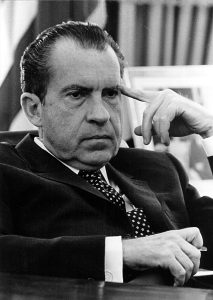
The year 1971 plunged the United States deeper into an economic maelstrom, compelling President Richard Nixon to implement a series of radical measures that would dramatically reshape both domestic and international financial policies. This period was characterized by escalating inflation coupled with rising unemployment—a phenomenon known as “stagflation”—a “lethal combination” policymakers had not effectively encountered before. Compounding these domestic woes was a precarious international monetary situation, threatening the dollar’s stability and America’s global economic standing.
The economic climate was undeniably challenging as 1971 began. The Council of Economic Advisers (CEA) acknowledged that the economy’s performance in 1970 “disappointed many expectations and intentions,” with lower-than-expected Gross National Product (GNP) and higher inflation and unemployment rates. The congressional Joint Economic Committee echoed these concerns, noting that “events during 1970 had justified these fears” of continued inflation and a stagnant economy. President Nixon, with the 1972 election looming, was acutely aware of the political ramifications of an economic slowdown, particularly rising unemployment, which he believed was “dynamite” for his reelection prospects. Newsweek even suggested in early 1971 that “the economy could turn out to be Nixon’s Vietnam”.
A significant concern was the deteriorating U.S. trade position. The nation, which had maintained a merchandise trade surplus since 1893, saw this surplus begin to shrink in 1969 and turn into a deficit by the summer of 1971. This “major negative structural change” fueled fears that the U.S. was losing its basic competitiveness and “bleeding dollars into the world economy with no end in sight”. Foreign holders of dollars were increasingly nervous, anticipating that looser monetary policies to stimulate the U.S. economy would lead to more inflation and larger balance-of-payments deficits.
Against this backdrop, the international monetary system, pegged to gold at $35 an ounce under the Bretton Woods agreement, faced immense strain. Low U.S. interest rates relative to other countries spurred massive outflows of short-term capital—from $10 billion in 1970 to $30 billion in 1971—forcing U.S. allies to absorb more dollars and raising serious questions about the dollar-gold link’s viability. Charles Coombs, head of foreign trading at the Federal Reserve Bank of New York, noted that “traders all over the world sensed a total breakdown of policy coordination between the United States and its trading partners”.
The Road to Camp David: A “War of Nerves”
The crisis escalated dramatically in early May 1971 when West Germany faced a surge of dollar inflows, compelling it to float the Deutschmark temporarily. The Netherlands, France, and Belgium also began demanding to exchange dollars for gold, further depleting dwindling U.S. gold reserves and creating “additional anxieties of a gold rush and a subsequent forced closing of the U.S. gold window”. Calls for action mounted, with Senator Jacob Javits publicly suggesting the U.S. suspend gold sales and convene a world monetary conference to establish a new system where the dollar wasn’t tied to gold.
Amidst these pressures, President Nixon’s economic team was deeply divided. While he had initially opposed any direct intervention in the economy, viewing mandatory controls as “anathema” to his conservative principles, calls for wage and price controls grew louder, even from within his cabinet. Federal Reserve Chairman Arthur Burns, despite his commitment to protecting the dollar’s integrity, increasingly advocated for mandatory wage and price controls as the “only solution to combatting inflation,” creating a “major rift” with the president. Their contentious relationship, marked by Nixon’s public pressure for lower interest rates and Burns’s insistence on fiscal restraint and controls, set a tense stage.
The pivotal shift in Nixon’s approach began to solidify in July 1971. His dramatic July 15 announcement of a secret trip to China, while a foreign policy triumph, inadvertently highlighted his administration’s perceived inaction on domestic economic issues. Reporters and members of Congress seized the opportunity to express “concern about our domestic policies and to urge new actions to deal with the problems of unemployment and inflation”. Treasury Secretary John Connally, a formidable and nationalistic figure whom Nixon trusted implicitly on economic matters, seized the moment. Connally’s “screw the foreigners” mentality perfectly aligned with Nixon’s desire for an aggressive stance in international economics.
Paul Volcker, then Treasury Undersecretary for International Monetary Affairs, had been meticulously developing contingency plans for the dollar crisis for over two years. These plans included options such as suspending gold convertibility and imposing import surtaxes. Connally, with his penchant for “the big play”, took Volcker’s detailed work and transformed it into a bold, comprehensive package, convinced that “anything else would not work”. Paul McCracken, Chairman of the Council of Economic Advisers, also shifted his stance, acknowledging the need for “radical policy changes” and supporting measures like a dollar float, a wage and price freeze, and even closing the gold window, despite his initial ideological opposition.
August 12, 1971: The Brink of Panic
The crisis reached its peak on August 12, 1971. Speculation against the dollar intensified, leading to a palpable “air of panic” in financial markets. A staggering $4 billion in speculative money fled the U.S. during the week of August 9, and an additional $1 billion was absorbed by foreign central banks on August 12 and 13 alone. The West German mark, already floating, rose to a twenty-year high against the dollar.
That evening, President Nixon, Secretary Connally, and Office of Management and Budget (OMB) Director George Shultz met in Nixon’s hideaway office. Connally, recently back from his ranch, forcefully argued that the administration was “in danger of losing the initiative” and needed a decisive, comprehensive plan. Nixon, initially leaning towards a “piecemeal approach,” was persuaded by Connally’s insistence on a bold, unified package to maximize impact and prevent further market turmoil or congressional preemption. Connally emphasized that the primary concern should be “how effectively you convince the American people” of the president’s awareness and courage in addressing economic problems.
August 13, 1971: An “Earthshattering Operation”
The next day, August 13, 1971, Nixon confirmed his commitment to Connally’s vision. Nixon “lauded the import surtax” and embraced the idea of a comprehensive plan. Haldeman, Nixon’s Chief of Staff, noted in his diary that they would “cover the [whole gamut of policies]” in what was expected to be “quite an earthshattering operation”. This meeting effectively sealed the radical shift in U.S. economic policy.
August 15, 1971: The “Nixon Shock”
On Sunday, August 15, 1971, at 9:00 p.m. EDT, President Nixon addressed the nation from the Oval Office, announcing his “New Economic Policy” (NEP). The announcement contained several shocking, unilateral measures designed to combat inflation, reduce unemployment, and strengthen the dollar:
- Suspension of Gold Convertibility (“Closing the Gold Window”): Nixon unilaterally “severed America’s long-standing commitment to the dollar–gold link at $35 an ounce”. This meant the U.S. Treasury would no longer freely exchange dollars held by foreign central banks for gold. This move marked a radical reform of the Bretton Woods system. Arthur Burns, while disagreeing with closing the gold window and preferring a negotiated depreciation, ultimately went along with the decision.
- 10% Import Surtax: A temporary 10% surtax was imposed on all imports. This was intended to force currency realignments and gain leverage in trade negotiations.
- 90-Day Wage-Price Freeze: A 90-day freeze on all wages and prices was implemented to curb inflation. Nixon, who had long opposed such controls, presented this as a temporary measure to demonstrate his commitment to fighting inflation. He also established a Cost of Living Council to oversee continued price and wage stability after the freeze.
Nixon framed these actions as a “challenge of peace,” aiming for “new prosperity without war” and emphasizing the sheer scope and interconnectedness of the initiatives. He notably blamed “international money speculators” for the dollar’s instability, a phrase Burns had unsuccessfully tried to have removed from the speech. The president also sought to downplay any negative implications of “devaluation” for the average American, emphasizing that it affected only those buying foreign cars or traveling abroad.
The immediate public reaction was overwhelmingly positive, with the Dow Jones average experiencing its largest one-day increase in dollar value to that time. Media outlets like The New York Times “unhesitatingly applaud[ed] the boldness with which the President had moved on all economic fronts”. Many economists were also laudatory. Democrats, while grateful that Nixon had adopted many of their ideas, were frustrated that he was getting all the credit.
However, international reaction was largely one of anger and concern over the abrupt, unilateral nature of the U.S. decision. U.S. allies, particularly Japan and European nations, were “stunned and flabbergasted and appalled by his crafty methods”. The Japanese, who had held off overtures to China out of deference to Washington, were “shocked” by the sudden abandonment of the Bretton Woods system and the import tax. Foreign central banks, left with large dollar reserves of uncertain value, found themselves in a difficult position. The import surcharge was also seen as a significant threat to global trade and alliances, with Europe fearing a large drop in exports and job losses.
The “Nixon Shock,” as it came to be known, was primarily a political decision aimed at ensuring Nixon’s reelection in 1972. And in that, it succeeded: the stimulus program “worked,” with industrial production and real GNP surging, and the unemployment rate falling, leading to Nixon’s landslide victory in 1972. However, the economic consequences in the longer term were less favorable. When the wage and price controls were eventually lifted in 1974, repressed prices were unleashed, and inflation “returned, eventually with a vengeance”. The abandonment of the gold standard, while not the sole cause, was certainly a contributing factor to the “Great Inflation” of the 1970s.