

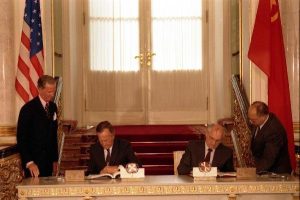
Following up on the significant shift inaugurated by the 1981 tax cuts, the mid-1980s continued to unfold within President Ronald Reagan’s vision for reshaping America’s role, both domestically and internationally. A key component of this ambitious agenda was a transformed approach to the Cold War, often articulated as “peace through strength”. This philosophy asserted that a robust military posture was not a precursor to war, but rather a necessary foundation for meaningful negotiation and, ultimately, arms reduction. It was against this backdrop that the Strategic Arms Reduction Talks (START) commenced in Geneva in mid-1982, an initiative directly supported by this administration’s firm resolve.
These START negotiations were designed to achieve deep cuts, even the elimination of, the most dangerous nuclear arms. Indeed, Reagan harbored a profound personal abhorrence for nuclear weapons, viewing them as a “sad commentary on the human condition,” and he yearned for a world without them. His administration’s initial proposal, often termed the “zero-zero option,” called for the United States to forgo scheduled missile deployments in Western Europe if the Soviet Union, in turn, removed its intermediate-range missiles aimed at Europe. This ambitious goal, however, was met with skepticism by many arms control experts.
The commitment to “peace through strength” was not merely rhetorical; it manifested in a substantial military buildup during Reagan’s first term. This included the planned deployment of intermediate-range Pershing II and cruise missiles in Europe. This European deployment was a crucial part of NATO’s “dual track” diplomacy, a strategy agreed upon in 1979 during the Carter administration, which aimed to build up Western missile capabilities as leverage to persuade the Soviets to negotiate their own arsenal reductions.
However, these plans were met with considerable anxiety and protest across Europe and within the United States. Europeans, fearing their continent would become a nuclear battleground, mobilized in large-scale demonstrations against the dangers of nuclear weapons. Reagan’s more “strident Cold Warrior rhetoric” and statements by his Secretary of State, Alexander Haig, about the possibility of a “limited exchange of tactical weapons” or even a “warning Atom Blast”, further alarmed European publics. Such comments led West German Chancellor Helmut Schmidt to dub American foreign policy makers “nuclear cowboys”.
It was precisely this contentious issue that led to the breakdown of the START talks in November 1982. As the negotiations in Geneva struggled, NATO proceeded with the deployment of the Euromissiles. This action directly undermined the “zero-zero option” that formed the core of the U.S. proposal, as it signaled the U.S. and NATO’s intent to deploy new missiles regardless of Soviet concessions.
The Soviet reaction to these developments was, predictably, one of outrage and increased tension. Moscow had already been disturbed by Reagan’s strong anti-Soviet rhetoric, including his March 1983 declaration of the Soviet Union as an “evil empire”. Soviet Premier Yuri Andropov publicly labeled Reagan “irresponsible” and even “insane”. The atmosphere of suspicion was palpable, with events like the September 1983 shooting down of a Korean Air Lines passenger jet that had strayed into Soviet airspace, and the November 1983 “Able Archer” NATO exercise, which caused considerable alarm in Moscow due to its perceived resemblance to a preemptive U.S. nuclear attack. These incidents, though occurring shortly after the November 1982 breakdown, underscore the intensely strained relationship of the period.
Furthermore, the Reagan administration had solidified its hardline stance through secret policy directives such as National Security Decision Document (NSDD) 32, which committed the U.S. to weaken the Soviet Union’s economy and support dissident forces within the Soviet bloc. The administration also blocked the sale of American technology for a Siberian gas pipeline, further signaling its intent to exert economic pressure. These actions, combined with the U.S. proceeding with missile deployments, were designed to force the Soviets to a breaking point, a direct challenge to the previous era of détente.
Despite the immediate collapse of the talks in late 1982 and the heightened tensions, it’s important to understand Reagan’s long-term strategic intent. His belief was that an assertive military posture and unyielding stance would ultimately compel the Soviets to negotiate genuine reductions. This approach, while initially leading to increased confrontation, eventually paved the way for future breakthroughs. The “zero-zero option,” seemingly a non-starter in 1982, would later become a key component of the Intermediate-Range Nuclear Forces (INF) Treaty signed in 1987 under Gorbachev, leading to the elimination of an entire class of missiles. This illustrates how the pressure exerted in the early 1980s, despite its initial unsettling effects and the breakdown of talks like START, was indeed part of a broader strategy that aimed for, and eventually contributed to, significant arms reductions and a shift in Cold War dynamics. The nuclear freeze movement also played a role in pressuring the administration to engage in arms reduction talks, even if it didn’t immediately achieve its desired halt in production.