
Indeed, the period of the early to mid-1980s was characterized by a potent mix of assertive U.S. foreign policy and a re-evaluation of how such policy should be conducted, particularly in the shadow of past controversies. As you recall, the administration’s “peace through strength” doctrine was in full swing, and this included a robust, often clandestine, approach to perceived Soviet expansion in the Third World. It is against this backdrop that the highly significant revelation in March 1983 regarding the U.S. clandestine support for Nicaraguan Contras, including the CIA’s mining of Nicaraguan harbors, came to light, shining an uncomfortable spotlight on covert operations and accountability.
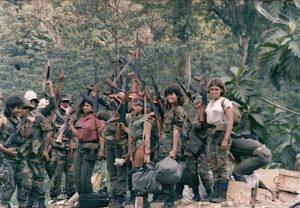
The Reagan administration viewed the 1979 Nicaraguan revolution, which saw the popular Sandinista movement overthrow the long-supported Somoza dynasty, as a “Communist” threat and a direct challenge to long-standing U.S. control over Central American governments. To counter this, the administration immediately began working to overthrow the Sandinista government, initiating a secret war. The Central Intelligence Agency (CIA) was tasked with organizing a counterrevolutionary force, known as the “Contras,” many of whose leaders were former members of the Somoza regime’s widely “hated National Guard”.
These Contras, lacking popular support within Nicaragua, operated from bases in neighboring Honduras, a country heavily influenced by the United States. From there, they conducted cross-border raids on farms and villages, engaging in brutal tactics. Testimony from a former Contra colonel, Edgar Chamorro, revealed that they were instructed by the CIA to use tactics attributed to Communist insurgencies—to “kill, kidnap, rob, and torture”. Chamorro stated that many civilians were “killed in cold blood,” and others were “tortured, mutilated, raped, robbed, or otherwise abused”. He ultimately concluded that the Contra organization “turned out to be an instrument of the U.S. government”.
This clandestine support, however, ran directly counter to American public opinion, which surveys consistently showed was opposed to military involvement in Nicaragua, perhaps still influenced by the “memory of Vietnam”. In response to growing public and congressional unease, Congress passed the Boland Amendment in 1984, which made it illegal for the U.S. to “directly or indirectly, military or paramilitary operations in Nicaragua,” largely due to concerns over the Contras’ widespread human rights abuses.
Yet, the Reagan administration chose to ignore this law, seeking ways to fund the Contras secretly. President Reagan himself “secretly push[ed] his aides to seek alternative means of financing the contras’ operations”. The administration’s argument, as put forth by CIA Director William Casey, was that the National Security Council (NSC) was not strictly an intelligence agency and could therefore “lawfully operate to aid the contras without disclosure to Congress”. This rationale, however, disregarded the NSC’s statutory functions of policy review and coordination, not direct implementation or operations. Reagan’s directive to his national security adviser, Robert McFarlane, was unambiguous: “I want you to do whatever you have to do to help these people keep body and soul together”. Funds were solicited from various countries, including Saudi Arabia (which became the largest donor), South Africa, Israel, Taiwan, and Brunei, and deposited into Swiss bank accounts.
The specific revelation that erupted in March 1983, however, was particularly damning: the CIA, with Reagan’s approval, had secretly mined Nicaraguan harbors. This act directly contradicted repeated public assurances from then-CIA Director Casey. The Wall Street Journal‘s exposure of this operation ignited significant outrage, extending beyond initial critics to figures like Senator Barry Goldwater, a staunch conservative, who wrote to Casey, “I am pissed off… This is an act violating international law. It is an act of war”. Senator Edward Kennedy subsequently led a successful resolution in the Republican-dominated Senate, by an overwhelming margin, calling for a ban on U.S. funds to mine Nicaraguan ports, describing it as “a first step… to halt President Reagan’s secret war in Nicaragua”.
This incident, and the administration’s subsequent efforts to deny or obscure the truth, served as a precursor to the larger “Iran-Contra affair”. The concept of “plausible deniability,” a long-standing government device, was heavily utilized, allowing top officials to deny direct involvement by shielding them with subordinates. The Iran-Contra affair later revealed “a massive abuse of covert action”, where proceeds from secret U.S. arms sales to Iran were illegally diverted to fund the Contra rebels in Nicaragua. This period was marked by officials like Assistant Secretary of State Elliot Abrams and Secretary of State Shultz making false statements to the public and Congress about U.S. involvement in Nicaragua. Lieutenant Colonel Oliver North, a central figure in the affair, explicitly admitted to shredding documents and lying to Congress and the CIA, believing his actions were necessary for a “glorious end”. The affair highlighted “the importance of accountability and official responsibility for faithful execution of laws”.
The broader context of these revelations points to a “post-Vietnam era” sentiment, where the public was hesitant to support direct military interventions abroad. The “Vietnam syndrome” created a “durable foreign policy opposition” that contested U.S. attempts to wage the Cold War in Third World nations through proxies. Movements like Witness for Peace played a crucial role, sending delegations to Central America to provide “alternate accounts of events on the ground” and “plant a seed of doubt with the American public about official praise for the contras as national liberators”. This public and congressional pressure significantly hindered the administration’s agenda, compelling it to fight through proxies and rely on covert military training and economic support.
Ultimately, the exposure of the CIA’s harbor mining and the subsequent Iran-Contra scandal significantly damaged the president’s popularity, at least temporarily, and discredited Contra aid with the American public. While many leading participants were indicted and some convicted (though several convictions were later overturned or pardoned), President Reagan largely “escaped scot-free”, praising North as a “national hero” even after firing him. This period underscores how the U.S. government, in pursuit of its foreign policy goals, sometimes “violated its own laws”, leading to a “constitutional struggle” over executive power that would continue long after the immediate events. The events of March 1983 were indeed a critical turning point, revealing the lengths to which the administration would go in its “roll back” strategy against communism and igniting a profound debate about executive accountability in covert operations.