

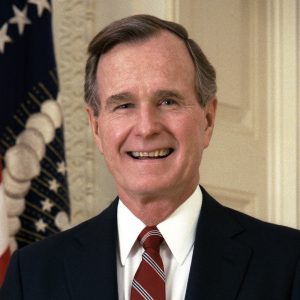
In 1988, as the “Age of Reagan” drew to a close, a distinct shift was underway in American politics, preparing the stage for George H. W. Bush to ascend to the presidency. This period was marked by a “significant reduction in Cold War tensions,” which many attributed to U.S. military strength and, implicitly, Reagan’s assertive foreign policy. With the Cold War seemingly winding down, the nation was ready for a new leader, and Ronald Reagan, a popular president who believed he had restored America’s pride and economic vitality, effectively designated his loyal Vice President, George Bush, as his successor.
Bush’s path to the nomination was not entirely clear-cut; despite Reagan’s endorsement and his own strong organizational and fundraising capabilities, he was “no shoo-in for the job”. Senator Bob Dole initially posed a challenge in the Republican primaries. During the early campaign, Bush notably ran television commercials that portrayed Dole as a “big spender” and a “tax-raiser,” a tactic that helped him win the New Hampshire primary. This also followed his earlier, memorable criticism of Reagan’s “supply-side economics” as “voodoo economics” during the 1980 primaries, where he had briefly edged out Reagan in the Iowa caucuses before eventually being chosen as Reagan’s running mate. By May 1980, Bush had effectively “given up” his challenge to Reagan, and when offered the Vice Presidency, he “leaped for joy,” subsequently refraining from any public disagreement with Reagan throughout his eight years as Vice President.
On the Democratic side, potential contenders like Colorado Senator Gary Hart and Jesse Jackson, a prominent African American leader, faced various challenges. Hart’s candidacy ended due to a public scandal after he challenged the press to find proof of an extramarital affair, while Jackson, despite aiming for broader national appeal, was ultimately “perceived as not strong enough to take on Bush”. This left the door open for Massachusetts Governor Michael Dukakis, who had gained recognition for an economic turnaround in his state, often dubbed the “Massachusetts miracle”. Dukakis selected Senator Lloyd Bentsen of Texas as his running mate.
The general election campaign of 1988 saw George Bush embrace a specific set of promises and images. He chose Indiana Senator Dan Quayle as his running mate. Bush famously reiterated his campaign pledge, “Read my lips: no new taxes!” at the Republican convention, a line ghostwritten by Peggy Noonan that placed him firmly in the “no-nonsense Reagan mold”. He also promised a “kinder, gentler” conservative America, a phrase that would define his promised approach to the nation. This promise extended to social initiatives like promoting “a thousand points of light” through private charity and volunteerism. However, the campaign itself was noted for its “malicious tone” and “almost total dissociation from the epochal events occurring all around it,” focusing instead on “tried-and-true themes and tactics of the past”. For instance, Bush’s campaign utilized ads featuring Willie Horton, a tactic considered “dirty work” left to his political staff.
On divisive social issues, Bush’s stance evolved during the campaign. He only “fully converted to ‘steadfast pro-lifer’ status on the campaign trail in 1988,” having previously supported federal funding for some abortions and opposed a constitutional amendment defining life from conception. The Republican platform in 1980 had already called for an abortion ban and restoration of school prayer, contributing to the “culture wars” that would continue through the decade.
In the end, George Bush secured a decisive victory in the 1988 election. He won 54 percent of the popular vote to Dukakis’s 45 percent, and his Electoral College victory was a landslide, 426 to 111. This marked the first time since 1928 that the Republican Party had won three successive presidential elections, and notably, the first time since 1836 that a sitting Vice President had been elected to the White House. Despite the clear win, the public’s response was characterized by “cold indifference,” with barely 50 percent of eligible voters participating. This outcome suggested that while Bush’s victory seemed overwhelming, he ran “far less strongly than Reagan four years earlier,” losing ten states and winning others by slim margins.
Upon entering office, George H. W. Bush’s presidency was expected to be driven by foreign affairs, given his extensive background as CIA director, U.S. ambassador to the United Nations, and U.S. representative to China. He assembled a seasoned foreign policy team, including James Baker III as Secretary of State, Brent Scowcroft as National Security Advisor, and Dick Cheney as Secretary of Defense, with General Colin Powell becoming Chairman of the Joint Chiefs of Staff. Early in his term, in December 1988, Bush met with Mikhail Gorbachev in New York Harbor, an event described as a “symbolic luncheon—a final get-together for the two costars and a handing of the torch to the incoming American president”. During this meeting, Bush pressed Gorbachev for assurances on the success of perestroika and glasnost, to which Gorbachev “snapped, ‘Even Jesus Christ couldn’t answer that question!'”.
Domestically, Bush was perceived as lacking a clear vision, particularly when compared to Reagan, with his style often labeled as “crisis management” rather than a proactive agenda. His physical presence was also noted, with some sources humorously suggesting that Americans tend to vote for politicians they perceive as “one of us” rather than those suspected of being smarter. One observer even mused that “George Bush’s reality tunnel probably dates from around 1925”. Nevertheless, his administration quickly took up the “War on Drugs,” which was a major public concern; a June 1989 Gallup poll indicated that Americans, by a three-to-one ratio, believed drugs were the nation’s number one problem.
In essence, George H. W. Bush’s election in 1988 represented a continuity of conservative leadership, yet also signaled a subtle shift in presidential style and national priorities as the Cold War era transitioned into a new global landscape.