

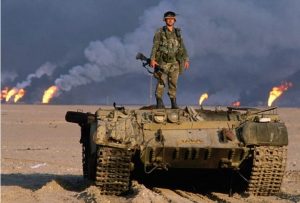
The 1991 Gulf War stands as a pivotal moment in American foreign policy, occurring at the dawn of a new global landscape following the Cold War’s end. This conflict, in which U.S. forces played a dominant role, was not merely a military response to aggression but a multifaceted event that deeply shaped American perceptions of its power, purpose, and military strategy in the post-Cold War era.
The origins of the conflict can be traced to August 1990, when Iraq, under the brutal dictatorship of Saddam Hussein, invaded its oil-rich neighbor, Kuwait. Saddam’s regime was characterized by corruption, brutality, and authoritarianism. He had previously led his country in an eight-year war against Iran, which had devastated Iraq’s economy, believing he had protected the Arab world from radical Islam and expecting aid that never materialized. Instead, other Arab nations continued to produce oil at record levels, driving down prices and further damaging Iraq’s economy, which was a serious betrayal to Saddam. Although the United States had previously supported Saddam as a counterbalance to radical Shiites in Iran, his seizure of Kuwait, which gave him control over 21 percent of the world’s oil supply, was deemed “totally unacceptable” by the West.
For President George H. W. Bush, who had just come into office in 1989, the situation presented a complex challenge. His popularity among American voters had plunged. Some within his own party reportedly worried he might be “forced to initiate combat” to prevent further erosion of domestic support. Indeed, a secret decision for war against Iraq was made on October 30, 1990. While the United Nations had responded to the invasion with sanctions, and secret CIA testimony suggested these were reducing Iraq’s imports and exports by over 90 percent, Bush, after discussions with British Prime Minister Margaret Thatcher, became convinced sanctions would not work. His aide, John Sununu, was reportedly telling people that “a short successful war would be pure political gold” for the President and would guarantee his re-election. This, along with the U.S.’s long-standing desire for a decisive voice in controlling Middle East oil resources, were crucial elements in the decision to go to war.
The military operation, initially named Operation Desert Shield to protect Saudi Arabia from further Iraqi aggression, rapidly escalated to Operation Desert Storm following UN Resolution 629, which set a January 15, 1991, deadline for Iraq’s withdrawal. Bush doubled American military forces in the Gulf to 500,000, creating a clear offensive force. The U.S. led an unprecedented international coalition of 35 countries, authorized by the UN Security Council. The air assault began on January 16, quickly overwhelming Iraqi air defenses. The coalition launched a massive aerial bombardment, utilizing advanced high-tech fighter jets, stealth bombers, and Tomahawk missiles. This campaign, lasting nearly six weeks, was followed by a swift ground assault on February 24, which encountered virtually no resistance. The Iraqi army, “burdened with a rigid and incompetent command, and reliant on obsolete Soviet-made weaponry,” was no match for the technologically superior American-led coalition. Within 100 hours, the ground war ended with a cease-fire, and U.S. forces kept bombing retreating Iraqi soldiers who clogged the highway out of Kuwait City, resulting in a “blazing hell”.
The minimal American casualties—148 killed in action and 458 wounded—contributed to the “mystique of technological warfare”. This swift and decisive victory was widely perceived as the moment the “specter of Vietnam” was “buried forever in the desert sands of the Arabian peninsula”. Unlike the Vietnam War, the Gulf War was characterized by overwhelming force, a rapid timeline, and a clear objective. Secretary of State James Baker later asserted that the operation helped change “the mindset of the American people about the use of force in the post-Vietnam era”. The Soviet Union’s decision not to join international condemnation of the invasion signaled a developing rapport between Bush and Mikhail Gorbachev. The war also set a new model for military strategy, emphasizing highly mobile, rapid-deployment forces and the exploitation of high-technology weaponry to minimize American casualties.
However, the outcomes of the invasion extended beyond the battlefield and came with significant costs and complex consequences. Despite depicting Saddam Hussein as “another Hitler” during the war, the U.S. stopped short of marching into Baghdad, leaving Hussein in power to serve as a balance against Iran. The United States also did not support Iraqi dissidents or the Kurdish and Shiite rebellions against Saddam, leading to catastrophic suppression by Hussein using helicopters he was permitted to retain. The bombings of Iraq caused starvation, disease, and the deaths of tens of thousands of children.
A particularly significant consequence was the decision to keep several thousand American troops stationed in Saudi Arabia. This continued military presence near Muslim holy sites became a “principal recruiting device” for anti-American Muslim terrorists, including Osama bin Laden, who had protested the presence of American troops and was subsequently banished from the kingdom. Bin Laden’s “Declaration of War Against the Americans Occupying the Land of the Two Holy Places” in 1996 underscored this resentment, viewing the U.S. presence as an occupation and theft of resources. The war also sparked an “ugly wave of anti-Arab racism” within the United States.
On the international front, the overwhelming success of U.S. conventional forces in the Gulf War ironically expanded the interest of potential foes in acquiring weapons of mass destruction. Domestically, while Bush’s public approval ratings soared immediately after the victory, they plummeted as the U.S. economy entered a recession in late 1990 and a slow recovery in 1992. The idea of a “peace dividend” following the Cold War, meant to shift military spending to human needs, was suppressed by the war.
Ultimately, the 1991 Gulf War, spearheaded by the United States, was a defining moment. It was seen as a triumphant assertion of American military might and a successful overcoming of the Vietnam-era reluctance towards foreign intervention. However, it also laid the groundwork for new challenges, including the rise of anti-American terrorism and a prolonged U.S. military engagement in the Middle East, while subtly reshaping the parameters of American power projection in a unipolar world. The war’s complexities—its motivations, conduct, and unintended consequences—reflect the enduring truth that even overwhelming victories do not automatically produce optimal diplomatic outcomes.