

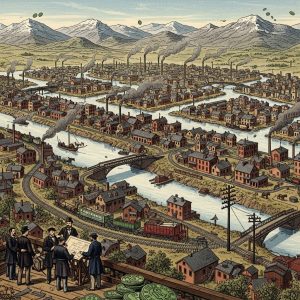
It is fascinating, and indeed quite telling, that our discussion of the Panic of 1873 naturally leads us to the audacious proposals that emerged from the economic turmoil of that period. We turn now to a particularly striking example from 1874: the entry of Wall Street stock speculator Richard Shell into Congress and his espousal of a “pre-Keynesian scheme” for massive federal infrastructure development.
In the immediate aftermath of the Civil War, the United States grappled with a depreciated, inconvertible greenback currency and a substantial public debt. The central monetary question revolved around the future of these greenbacks. A powerful faction of industrialists, particularly iron and steel manufacturers from Pennsylvania, vehemently advocated for the continuation of greenbacks and opposed any contraction of the money supply in preparation for specie resumption. Their intellectual guide, economist and iron master Henry C. Carey, argued that inflation, by causing the domestic currency to depreciate faster than domestic prices rose, acted as a “surrogate tariff,” making domestic prices cheaper and imported goods more expensive. This “cheap money inflationist policy” not only promised easy credit for manufacturing but also functioned as an additional tariff. The “Carey circle” was influential, spreading their doctrines of protection and paper money through groups like the American Industrial League.
It was within this charged atmosphere that Richard Shell, a flamboyant Wall Street stock speculator, became a member of Congress in 1874. Shell emerged as one of the most zealous proponents of greenback inflation in the post-Civil War era. He advanced what is indeed described as an “outrageous pre-Keynesian scheme”. This scheme was remarkably in line with John Maynard Keynes’s later dictum that the specific use of money—whether for pyramid building or digging holes in the ground—mattered less than the act of spending itself.
Specifically, Shell “seriously urged the federal government to dig a canal from New York to San Francisco, financed wholly by the issue of greenbacks”. This proposal was not an isolated sentiment. The Panic of 1873, which had severely impacted overbuilt railroads, led many railroad men themselves to clamor for more greenbacks to “stem the tide”. Figures such as Thomas Scott, C.P. Huntington (a leader of the Central Pacific Railroad), and Russell Sage joined this call. So profound was their influence that the Louisville Courier-Journal, in April 1874, candidly stated: “The strongest influence at work in Washington upon the currency proceeded from the railroads. The great inflationists after all are the great trunk railroads”. Shell’s enthusiasm for such large-scale greenback issues was matched by other economic adventurers like George Francis Train, who thundered in 1867: “Give us greenbacks, we say, and build cities, plant corn, open coal mines, control railways, Launch ships, grow cotton, establish factories, open gold and silver mines, erect rolling mills, carry my resolution, and there is sunshine in the sky”.
Shell’s proposal highlights a crucial, ongoing debate in American economic history: the role of government-issued currency and public works in stimulating economic activity, particularly in times of downturn. While the Panic of 1873 triggered widespread bankruptcies, especially among overinflated banks and railroads fueled by vast government subsidies and bank speculation, it also prompted these calls for significant monetary expansion and large-scale projects like Shell’s canal. This reveals the persistent tension between those who advocated for “hard money” (gold and silver) and limited government intervention, and those who believed in an “elastic” money supply and governmental action to “un-cramp” the economy and foster growth.
The Democrats, in the post-Civil War period, generally had a greater proportion of congressmen devoted to hard money and resumption, while Republicans were more divided, with many supporting expansionist policies. The Hazard Circular of 1862, prepared by an American agent of British financiers, had already outlined a strategy for capitalists to “control the volume of money” through government debt used as a banking basis, arguing that greenbacks, which could not be controlled, should not circulate for long. This further illustrates the backdrop of monetary control versus expansion that framed Shell’s bold canal proposal.