

The year 1898 marks a pivotal and undeniably “imperialist” turning point in American history, representing a dramatic and forceful expansion of U.S. power beyond its continental borders. This was not a sudden impulse, but rather the culmination of economic shifts, a sense of “manifest destiny,” and the strategic ambitions of key figures within the U.S. elite.
By the 1890s, with the internal frontier officially declared closed in 1890, the American profit system, with its natural tendency for expansion, began to “look overseas”. A severe economic depression that started in 1893 intensified the belief among the country’s political and financial elite that foreign markets for American goods could alleviate problems of underconsumption at home and prevent economic crises that had led to class conflict. A foreign adventure, it was theorized, might also deflect rebellious domestic energy from strikes and protest movements towards an external enemy, uniting the populace with the government and armed forces instead of against them. This expansion overseas was not entirely novel; the Monroe Doctrine of 1823 had already asserted Latin America as a U.S. sphere of influence, and American armed forces had undertaken over 100 interventions in other countries between 1798 and 1895.
A significant driver of this new imperial ambition was Theodore Roosevelt, then Assistant Secretary of the Navy, who “should welcome almost any war… for I think this country needs one”. Roosevelt was profoundly influenced by naval propagandist Captain A. T. Mahan, who argued that countries with the biggest navies would “inherit the earth” and that “Americans must now begin to look outward”. Mahan’s vision included U.S. naval domination of the Caribbean and a powerful presence in the Pacific to protect the nation’s west coast interests.
The immediate target for this burgeoning American ambition was Spain’s faltering empire, which in the Western Hemisphere had been reduced to Cuba and Puerto Rico, and in the Pacific, to the Philippines and some Micronesian islands. Spain’s grip on these territories was demonstrably slipping, evidenced by waves of rebellions, particularly in Cuba and the Philippines, that had been ongoing for years. The Cubans, for example, had been fighting their Spanish conquerors for three years by 1898.
American economic interests in Cuba were substantial, with estimates of $30 million to $50 million of U.S. capital invested in plantations, railroads, and mining, and trade between the two regions reaching about $103 million by 1893. While some business interests initially preferred “informal empire” or “open door” policies without war, this preference was always subject to change if peaceful expansion proved impossible. The idea was to gain access to markets without the administrative burden of direct colonialism.
The U.S. press, particularly the “millionaire press,” played a crucial role in shaping public opinion, portraying Cuba as a “damsel in distress” against “rapacious Catholics” and emphasizing Spanish atrocities. President William McKinley himself observed that Spain’s actions in Cuba amounted to “extermination” rather than “civilized warfare”.
The catalyst for direct U.S. intervention came on February 15, 1898, when the U.S. battleship USS Maine, stationed in Havana harbor as a show of American interest, mysteriously exploded, killing 262 men. Though later evidence suggested the explosion was likely due to spontaneous combustion in its coal bunkers, the newspapers, fueled by figures like Roosevelt, immediately blamed Spain, with “Remember the Maine!” becoming a national battle cry.
Initially, McKinley was hesitant, stating he would not “be swept off my feet by the catastrophe”. However, the mounting pressure from the press, and crucially, from the business community, proved decisive. By March 1898, even the New York Commercial Advertiser, initially against war, called for intervention for “humanity and love of freedom, and above all, the desire that the commerce and industry of every part of the world shall have full freedom of development”. Bankers like Russell Sage, John Jacob Astor, William Rockefeller, and J.P. Morgan expressed a “militant” sentiment, with Lodge reporting that “the most conservative classes” wanted the Cuban question “solved” because “for business one shock and then an end was better than a succession of spasms”. This clearly indicates that the war was desired by the nation’s financial and commercial elite as a means to restore stability and open new markets.
Congress eventually gave McKinley the power to intervene, passing the Teller Amendment, which pledged the United States would not annex Cuba. This amendment was supported by genuine anti-imperialists who sought Cuban independence, as well as by some business interests who felt the “open door” policy was sufficient without direct annexation. However, by the spring of 1898, the business community’s “hunger for action” was evident, and the Journal of Commerce noted that the Teller Amendment would “be interpreted in a sense somewhat different from that which its author intended”.
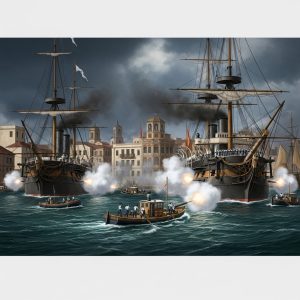
The war itself was swift, a “splendid little war” as the ambassador to Britain remarked. Commodore George Dewey, following Roosevelt’s earlier, unauthorized orders, sailed to Manila Bay in the Philippines and decisively defeated the Spanish fleet on May 1, 1898, without a single U.S. fatality. In Cuba, U.S. troops laid siege to Santiago, quickly defeating Spanish forces. Spanish resistance in Puerto Rico also collapsed swiftly.
It is critical to understand that the U.S. was a “latecomer” to these conflicts. Spain had already been severely weakened by years of ongoing rebellions waged by Cuban and Filipino nationalists. Leaders like Cuba’s Máximo Gómez had already predicted victory was in sight, and Filipino leader Emilio Aguinaldo had even established a government and declared independence prior to U.S. arrival. The U.S. benefited greatly from the rebels’ efforts, with Cuban forces, for instance, pinning down Spanish troops and preventing them from defending key landing sites. This was, in essence, “a war of the American elite against the Mexican elite, each side exhorting, using, killing its own population as well as the other,” though in this case, a Spanish elite being assailed by its colonial subjects, with the U.S. stepping in at a decisive moment.
The Treaty of Paris, signed in December 1898, formalized the outcome. Spain ceded Puerto Rico and Guam to the U.S. and sold the Philippines for $20 million. While the Teller Amendment prevented outright annexation of Cuba, the U.S. occupied it militarily and eventually imposed conditions through the Platt Amendment in 1901, which gave the U.S. the right to intervene for the “preservation of Cuban independence” and the protection of “property, and individual liberty”. This effectively brought Cuba into the American sphere of influence as a “colonial vassalage,” albeit not as a direct colony. In addition, the Hawaiian Islands, already penetrated by American missionaries and pineapple interests, were annexed by joint resolution of Congress in July 1898, and Wake Island was occupied around the same time.
However, the “splendid little war” quickly devolved into a far more brutal and protracted conflict in the Philippines. The Philippine-American War (1899-1902, with resistance continuing until 1913 in Moroland) was a direct result of the U.S. decision to acquire the archipelago. Filipinos, expecting independence, rose in revolt against American rule, and it took the U.S. three years and 70,000 troops (four times those used in Cuba) to crush the rebellion. The war was characterized by harsh tactics, including “reconcentration” camps which were ironically the same tactic Spain had used against Cubans. Disease, exacerbated by the conflict and displacement, was a major killer of Filipinos.
This conflict generated significant anti-imperialist opposition within the United States. Prominent figures like Mark Twain, William Jennings Bryan, and intellectuals formed the Anti-Imperialist League in 1898, publishing soldiers’ letters detailing atrocities and campaigning against annexation. They argued the war was “criminal aggression” born of “greedy commercialism” and warned that “imperialism abroad will lead quickly and inevitably to despotism at home”. Some labor unions, while sympathetic to Cuban rebels, opposed American expansionism, noting that workers at home would bear the costs and burdens of war while “speculators will make money out of it”. Black soldiers serving in the Philippines also expressed mixed feelings, some angered by the racism displayed towards Filipinos and pointing out the hypocrisy of fighting for freedom abroad while denying it to Black Americans at home.
Despite this opposition, McKinley won re-election in 1900, signaling public acquiescence, if not enthusiastic support, for empire. The sheer length and brutality of the Philippine War, however, led to a conscious effort to “hide” the empire from mainland view; maps returned to showing only the states, and attention shifted to “dollar diplomacy” in the Caribbean, where economic influence could be exerted without the direct costs and controversies of outright annexation.
In sum, the 1898 war against Spain was a forceful manifestation of American expansionism, driven by economic necessity, strategic ambition, and an ideology of racial superiority and “civilization”. It successfully established the United States as a global power with overseas possessions and laid the groundwork for a new form of “informal empire” that would define much of its foreign policy in the coming century.