

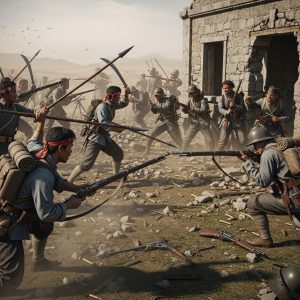
The Philippine-American War, from 1899 to 1902, was an inevitable and brutal consequence of the United States’ decision to acquire the Philippines following its victory in the Spanish-American War. While many Filipinos had been fighting for their independence from Spain for years and fully expected the U.S. to support their aspirations, America’s burgeoning imperial ambitions led to a direct and violent conflict against its former allies.
The immediate shift from the “splendid little war” against Spain to a protracted conflict against Filipino nationalists stemmed from a deep-seated American desire for overseas expansion, driven by economic and strategic interests. With the internal frontier declared closed in 1890, the American profit system naturally “looked overseas” for new markets and investment opportunities, especially intensified by the severe depression of 1893. Figures like Theodore Roosevelt, then Assistant Secretary of the Navy, explicitly stated that he “should welcome almost any war… for I think this country needs one”. Strategists like Captain A.T. Mahan propagated the idea that naval power would lead to global dominance, emphasizing the need for U.S. control in the Caribbean and a strong presence in the Pacific to secure west coast interests and access to the “great markets of China”.
President William McKinley’s rationale for annexing the Philippines, as he purportedly explained to a group of ministers, was presented as a divine revelation: returning the islands to Spain would be cowardly, handing them to commercial rivals (France or Germany) would be “bad business,” and leaving Filipinos to self-govern was deemed impossible due to their “unfitness,” which would lead to “anarchy and misrule.” Therefore, the only option was to “take them all and to educate the Filipinos, and uplift and civilize and Christianize them”. This blend of paternalism, racial ideology, and commercial calculation underpinned the U.S. policy.
The conflict ignited in February 1899, shortly after the Treaty of Paris formally transferred the Philippines from Spain to the U.S. for $20 million. Filipinos, led by Emilio Aguinaldo, who had already declared independence and established a government, expected the U.S. to honor their struggle for freedom. Instead, U.S. troops, having secured Manila from Spain in a staged surrender that excluded Filipino rebels, began to assert American authority. The spark that ignited the full-scale war came when Private William W. Grayson of the First Nebraska Volunteers shot Filipino soldiers near Manila, reportedly shouting, “The niggers are in here all through these yards”. U.S. soldiers later confirmed that American forces fired the first shot.
What followed was a brutal and protracted struggle, starkly contrasting with the “splendid little war” in Cuba. The U.S. employed 70,000 troops, four times the number used in Cuba, over three years to suppress the rebellion. Filipino forces, initially outmatched in arms and training, resorted to guerrilla warfare, which General Arthur MacArthur (father of Douglas MacArthur) reluctantly admitted depended on “almost complete unity of action of the entire native population”. Filipino fighters, facing a severe gun shortage, improvised weapons from tin cans, melted church bells for bullets, and used tree resins for gunpowder, even sending pearl divers to scavenge for ammunition.
The war was marked by intense racial hostility, with white American soldiers frequently using derogatory terms like “nigger” and “gugu” to describe Filipinos. Soldiers’ letters published by the Anti-Imperialist League detailed atrocities, such as a captain from Kansas reporting that after the Twentieth Kansas swept through Caloocan, it contained “not one living native”. One private boasted of setting fire to over fifty Filipino houses. Mark Twain, a prominent anti-imperialist, caustically remarked that the U.S. had “pacified some thousands of the islanders and buried them; destroyed their fields; burned their villages, and turned their widows and orphans out-of-doors”.
The U.S. military adopted “reconcentration” policies, forcing thousands of Filipinos into camps, a tactic ironically similar to what Spain had used against Cubans. While officials admitted it “sounds awful,” it was deemed “admirably effective”. Torture, including the infamous “water cure,” was also used. Beyond combat, disease was an even greater killer. The war’s displacement and social breakdown exacerbated epidemics like cholera, malaria, and dysentery, leading to massive mortality. Historian Ken De Bevoise estimated that some 775,000 Filipinos died between 1899 and 1903 due to the war, a toll higher than the American Civil War.
Domestically, the war faced significant opposition, particularly from the Anti-Imperialist League, formed in 1898, comprising prominent figures like Mark Twain, William Jennings Bryan, and Andrew Carnegie. They decried the war as “criminal aggression” born of “greedy commercialism” and warned that “imperialism abroad will lead quickly and inevitably to despotism at home”. The League campaigned tirelessly, circulating over a million pieces of literature against annexation, with the Senate ratifying the peace treaty by only a single vote.
Labor unions exhibited mixed reactions. While some, like the Knights of Labor and the American Federation of Labor, initially opposed U.S. expansionism and intervention, Samuel Gompers, head of the AFL, eventually succumbed to “war fever,” calling the war “glorious and righteous”. Some unions believed new territories would create markets for surplus goods, preventing another depression. However, socialists consistently opposed the war, seeing it as a “pretext” to “distract the attention of the workers from their real interests” and noting that “speculators will make money out of it”.
Black American soldiers, despite serving with distinction in the conflict, found themselves in a deeply conflicted position. While military service offered opportunities for advancement denied at home, many were angered by the racism displayed towards Filipinos and the hypocrisy of fighting for freedom abroad while denying it to Black Americans at home. Filipino rebels appealed directly to “The Colored American Soldier” in posters, highlighting the lynchings and racial injustice in the U.S.. This led to an “unusually large number” of black troops deserting, some even joining the Filipino rebels, with David Fagan becoming a notable insurgent leader.
The acquisition of the Philippines was also intertwined with American financial interests. Elihu Root, Secretary of War and a Wall Street lawyer with ties to J.P. Morgan, was tasked with devising a “colonial policy” for the U.S.. This included efforts to impose a gold-backed currency on the Philippines, replacing their sound silver currency, a move designed to facilitate American financial and commercial control.
The main phase of the Philippine-American War officially ended with Aguinaldo’s capture in March 1901. He took an oath of allegiance to the U.S. and urged his compatriots to cease fighting. President Theodore Roosevelt proclaimed the war over on July 4, 1902. However, resistance continued in “Moroland” (the Muslim-majority southern islands) until 1913, where U.S. forces, including future Chiefs of Staff Leonard Wood and John Pershing, engaged in brutal pacification campaigns like the Bud Dajo massacre.
Despite the U.S. military victory, the American Congress and public proved to be “reluctant colonialists”. The brutality and sheer length of the Philippine War wearied even ardent imperialists. While the U.S. implemented a “policy of attraction” – establishing good roads, sanitation, and free public education, alongside limited representative government and the imposition of English as a common language – the long-term goal shifted. Congress committed to Filipino independence in 1916, eventually granting complete independence in 1946, after World War II. This “shedding” of its largest colony was remarkably done, as MacArthur noted, to improve the U.S. image in the tumultuous decolonizing world, effectively “burying imperialism” in the Philippines. However, the legacy of this imperial venture continued to shape U.S. foreign policy, particularly its “pointillist empire” of military bases scattered across the globe.