

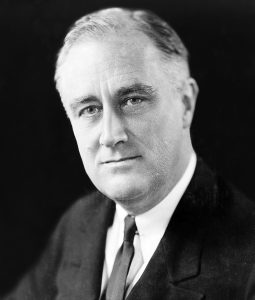
To understand the modern American state—the expansive reach of the federal bureaucracy, the modern welfare safety net, the sweeping scope of presidential war powers, and the perpetual constitutional friction between the executive branch and the judiciary—one must examine the twelve-year presidency of Franklin Delano Roosevelt. Elected to an unprecedented four terms, FDR governed through the two greatest existential emergencies of the twentieth century: the Great Depression and World War II. In doing so, he fundamentally altered the social contract between the American government and its citizens, transforming the presidency into the primary engine of national life and global power.
The Hudson River Aristocrat and the “First Hundred Days” When Franklin D. Roosevelt took the oath of office on March 4, 1933, the American economic system was in near-total collapse. One in four workers was unemployed, national agriculture lay destitute, and the entire banking system was teetering on the brink of paralysis. In a legendary inaugural address, Roosevelt galvanized a terrified public by declaring that “the only thing we have to fear is fear itself” and signaled his intention to request broad executive authority to wage war against the economic emergency as if invaded by a foreign foe.
Though a patrician Hudson River aristocrat by birth, Roosevelt became the premier champion of what he termed “the forgotten man at the bottom of the economic pyramid”. In his dramatic “First Hundred Days,” Roosevelt launched an unprecedented flurry of executive and legislative experimentation. He ordered a national bank holiday to halt financial panic, unpegged the dollar from gold, and established an array of new federal entities.
This bold legislative push gave birth to the modern administrative state, establishing lasting federal safeguards including the Federal Deposit Insurance Corporation (FDIC), the Securities and Exchange Commission (SEC), the Home Owners’ Loan Corporation (HOLC), Social Security, and massive public works programs like the Works Progress Administration (WPA) and Civilian Conservation Corps (CCC). Later in his presidency, FDR affectionately summarized this vast economic rescue under the persona of “Old Doctor New Deal,” whose sweeping remedies had saved the capitalist system from systemic ruin.
The Bully Pulpit, “Fireside Chats,” and the Court-Packing Crisis Roosevelt fundamentally revolutionized presidential communication by mastering the new mass medium of radio. Through intimate, direct broadcasts known as “fireside chats,” FDR explained complex banking and economic policies in plain language, building an unshakeable personal bond with millions of citizens over the heads of hostile newspaper publishers and corporate critics.
However, Roosevelt’s expansion of federal authority provoked a momentous constitutional collision with the Supreme Court. During his first term, a conservative judicial majority struck down core New Deal programs—such as the National Industrial Recovery Act (NRA) and Agricultural Adjustment Act (AAA)—as unconstitutional overreaches of federal power. In response, a frustrated Roosevelt held a famous press conference deriding the Court’s narrow interpretation of interstate commerce as belonging to a “horse and buggy age”.
Following his massive 1936 landslide re-election, Roosevelt attempted to dismantle this judicial roadblock by introducing the Judicial Reorganization Bill of 1937. The proposal—popularly known as the “Court-packing plan”—would have allowed the president to appoint an additional justice for every sitting member over the age of seventy. The maneuver triggered intense public outrage and fierce opposition across party lines, as critics accused FDR of seeking dictatorial control over the coordinate branches of government. Although Congress ultimately rejected the bill, the Supreme Court soon shifted its jurisprudence to uphold New Deal legislation, famously dubbed “the switch in time that saved nine”. Nevertheless, the political fallout permanently fractured the Democratic coalition and created a bipartisan conservative bloc in Congress that halted further domestic expansion.
The Arsenal of Democracy and Global Superpower Status As war erupted across Europe and Asia in the late 1930s, Roosevelt was forced to pivot from domestic economic recovery to international crisis management. Facing a deeply isolationist electorate and stringent Neutrality Acts passed by Congress, FDR deployed creative executive maneuvers to aid Western democracies without an explicit declaration of war.
Roosevelt bypassed Congress to trade fifty overaged American destroyers to Great Britain in exchange for military base leases, and he drafted the landmark Lend-Lease Act. To explain Lend-Lease to the public, FDR used a famous homey analogy: if a neighbor’s house is on fire, one lends them a garden hose without demanding immediate payment, simply wanting the hose returned when the fire is extinguished. In his famous December 1940 radio address, he declared that the United States must become the “great arsenal of democracy,” supplying the tools needed to defeat fascist aggression.
Japan’s surprise attack on Pearl Harbor on December 7, 1941—a “date which will live in infamy”—instantly ended American isolationism. As Commander-in-Chief, Roosevelt directed a massive industrial rearmament, marshaling the American economy to wage a global war across two oceans. Alongside British Prime Minister Winston Churchill and Soviet leader Joseph Stalin, FDR forged the Allied coalition that defeated the Axis powers, while simultaneously laying the groundwork for the postwar international order, including the creation of the United Nations.
The Complex Precedents and Flaws of Executive Power While Franklin D. Roosevelt is consistently ranked by historians alongside George Washington and Abraham Lincoln for preserving the republic during a period of supreme crisis, his expansive presidency established precedents that remain deeply controversial.
Roosevelt’s leadership suffered from glaring moral and constitutional compromises. To maintain the support of Southern Democrats necessary to pass his economic legislation, FDR deliberately refused to endorse federal anti-lynching bills or challenge Jim Crow segregation in the South. Furthermore, his administration demonstrated a cavalier attitude toward civil liberties during wartime, authorizing the forcible internment of over 110,000 Japanese Americans and refusing to significantly lift immigration quotas to shelter European Jewish refugees fleeing the Holocaust.
Conclusion Franklin D. Roosevelt died in Warm Springs, Georgia, on April 12, 1945, just weeks before the final surrender of Nazi Germany. His twelve years in office redefined the scope and nature of the American presidency. By demonstrating that the federal government could be mobilized to guarantee basic economic security at home and defend democratic values abroad, FDR built the framework of modern American governance. Today, as political leaders continue to debate the limits of executive power, the administrative state, and federal social programs, they are operating entirely within the constitutional landscape constructed by Franklin D. Roosevelt.