

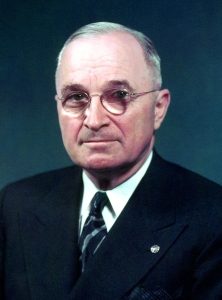
To comprehend the structural architecture of the modern American national security state—the sweeping powers of the imperial presidency in foreign affairs, the creation of permanent international military alliances, the delicate constitutional principle of civilian supremacy over the military, and the ongoing struggle between national security and civil liberties—one must examine the transformative presidency of Harry S. Truman.
When Vice President Harry Truman took the oath of office on April 12, 1945, following the sudden death of Franklin D. Roosevelt, he inherited a global war and a world on the brink of profound geopolitical realignment. A modest Midwesterner who had worked as a farmer, served as a World War I field artillery captain, failed as a haberdasher, and risen through the Kansas City Pendergast political machine to the U.S. Senate, Truman seemed painfully undersized for the moment. As he famously told reporters on his first full day in office, “I felt like the moon, the stars, and all the planets had fallen on me”. Yet, over the course of nearly eight years, the “little man from Missouri” constructed the foundational institutions and doctrines that governed American foreign and domestic policy for the remainder of the twentieth century and beyond.
The Accidental Succession and the Dawn of the Atomic Era
Truman came to the White House facing an overwhelming knowledge gap. During his eighty-two days as vice president, FDR had met with him only twice and had kept him completely uninformed regarding major foreign affairs, secret postwar commitments made at Yalta, and the development of the atomic bomb. Truman’s national reputation had been built in the Senate, where he chaired the Special Committee to Investigate the National Defense Program—the “Truman Committee”—exposing wartime waste, fraud, and corporate profiteering.
Within months of taking office, Truman was thrust into monumental decisions that reshaped human history. In July 1945, while attending the Potsdam Conference with Winston Churchill and Joseph Stalin, Truman learned of the successful Trinity test of the atomic bomb. Facing estimates of staggering casualties for a planned amphibious invasion of the Japanese mainland, Truman authorized the deployment of atomic weapons against Hiroshima on August 6 and Nagasaki on August 9, 1945, forcing Japan’s unconditional surrender and ending World War II.
In the aftermath, however, Truman recognized the terrifying nature of nuclear weapons. Unlike some military commanders who viewed the atomic bomb as merely another piece of artillery, Truman insisted that atomic weapons must remain strictly under civilian control through the newly established Atomic Energy Commission (AEC), establishing a permanent precedent that the decision to unleash nuclear destruction rests solely with the President.
Postwar Reconversion, Labor Unrest, and Civil Rights
Domestically, Truman faced the daunting challenge of reconverting an industrial war economy back to a peacetime footing. The rapid demobilization of over eight million service members, coupled with severe housing shortages and surging inflation, sparked widespread social unrest. In 1946, massive strikes swept the nation’s coal mines, steel mills, and railroads. Demonstrating an aggressive executive posture, Truman briefly seized control of the coal mines and went before a joint session of Congress to demand unprecedented authority to draft striking railroad workers into the U.S. Armed Forces to keep the nation’s transportation network running—a drastic proposal that shocked even his allies before the strike was settled.
Despite his clashes with labor leaders, Truman positioned himself as the defender of the working class against conservative congressional overreach. When the Republican-controlled 80th Congress passed the Taft-Hartley Act of 1947 to curb union power and restrict closed shops, Truman vetoed the bill, branding it a “slave labor bill”. Although Congress overrode his veto, the move solidified Truman’s standing with organized labor and paved the way for his progressive domestic agenda, which he dubbed the “Fair Deal”.
Concurrently, Truman took historic, unprecedented steps on civil rights, despite fierce opposition from the Southern wing of his own party. In late 1947, his President’s Committee on Civil Rights issued a damning report titled To Secure These Rights. In February 1948, Truman sent a historic special message to Congress calling for federal anti-lynching laws, the abolition of poll taxes, a permanent Fair Employment Practices Commission, and an end to discrimination in interstate transportation. When Congress refused to act, Truman wielded his executive power directly: in July 1948, he issued Executive Order 9981, officially ordering the desegregation of the U.S. Armed Forces.
The Architecture of Containment: The Truman Doctrine and the Marshall Plan
As the wartime alliance with the Soviet Union rapidly dissolved into distrust and hostility across Europe and Asia, Truman orchestrated a fundamental revolution in American foreign policy. Influenced by George Kennan’s “Long Telegram” and the comprehensive Clifford-Elsey Report detailing Soviet expansionism, the administration formulated the strategy of containment.
On March 12, 1947, Truman delivered a landmark speech before a joint session of Congress, requesting $400 million in military and economic aid for Greece and Turkey, which were facing Communist insurgencies and Soviet pressure. In what became known as the Truman Doctrine, the president established a sweeping global mandate: “I believe that it must be the policy of the United States to support free peoples who are resisting attempted subjugation by armed minorities or by outside pressures”.
To complement military containment with economic stabilization, Secretary of State George C. Marshall proposed the European Recovery Program, famously known as the Marshall Plan. Truman deliberately insisted on naming the initiative after Marshall to ensure bipartisan passage through a skeptical Congress, recognizing that European economic recovery was essential to prevent Western Europe from collapsing into Soviet orbit. When the Soviets imposed a land blockade on West Berlin in 1948, Truman rejected military options that might spark World War III and instead organized the massive Berlin Airlift, sustaining two million citizens for nearly a year until Moscow lifted the blockade.
During this same period of intense international maneuvering, Truman also made the controversial decision on May 14, 1948, to grant immediate de facto official U.S. recognition to the newly declared State of Israel, overriding intense objections from Secretary of State Marshall and the State Department, who feared alienating Arab nations and endangering Middle Eastern oil supplies.
The National Security State, the Loyalty Program, and the 1948 Upset
To execute this permanent global leadership role, Truman signed the National Security Act of 1947, creating the modern institutional architecture of American power: the Department of Defense, the National Security Council (NSC), the Joint Chiefs of Staff, and the Central Intelligence Agency (CIA). (Decades later, a retired Truman expressed deep regret over how the CIA had evolved from a mere intelligence-gathering clearinghouse into an autonomous, operational arm engaged in covert peacetime operations).
However, the climate of Cold War anxiety also triggered domestic overreach. In March 1947, seeking to head off Republican charges that his administration was “soft on communism,” Truman issued Executive Order 9835, creating the Federal Employee Loyalty Program. Over 6.6 million government employees were subjected to loyalty investigations, establishing secret files and informal informers that stoked nationwide Red Hunt hysteria and laid the groundwork for the rise of Senator Joseph McCarthy.
Heading into the 1948 presidential election, Truman’s political prospects appeared hopeless. His party was fractured into three factions: Southern “Dixiecrats” walked out to nominate Strom Thurmond over civil rights, while left-wing progressives backed former Vice President Henry Wallace. Undeterred, Truman embarked on a legendary 22,000-mile “whistle-stop” rail tour across the country, delivering hundreds of extemporaneous speeches attacking the “do-nothing 80th Congress” and Wall Street special interests. On election night, Truman pulled off one of the greatest upsets in political history, defeating Republican nominee Thomas E. Dewey and famously holding up the wildly inaccurate Chicago Daily Tribune headline: “DEWEY DEFEATS TRUMAN”.
The Korean War and Civilian Supremacy over the Military
Truman’s second term was dominated by the outbreak of the Korean War. On June 25, 1950, Communist North Korean forces launched a massive invasion across the 38th parallel into South Korea. Truman responded decisively, ordering U.S. naval, air, and ground forces into combat under the banner of a United Nations “police action” without seeking a formal congressional declaration of war—a precedent that significantly expanded executive war powers for future commanders-in-chief.
After General Douglas MacArthur executed a brilliant amphibious landing at Inchon and pushed military forces deep into North Korea, massive Chinese armies intervened in late 1950, driving UN troops back in a harrowing winter retreat. As the war ground into a deadly stalemate, General MacArthur publicly challenged administration policy, demanding air strikes on mainland China, a naval blockade, and the deployment of Nationalist Chinese troops. MacArthur’s public letters to congressional leaders directly undermined Truman’s strategy of limited war designed to prevent a catastrophic Third World War with the Soviet Union.
On April 11, 1951, President Truman took one of the most courageous and politically costly steps in presidential history: he relieved General MacArthur of his command for insubordination. The public backlash was furious; Congress was deluged with tens of thousands of angry telegrams demanding Truman’s impeachment, and MacArthur returned home to roaring ticker-tape parades. Yet, Truman stood firm, making it clear that no military commander, no matter how heroic or popular, was above the elected constitutional authority of the President. Truman successfully preserved the fundamental democratic principle of civilian control over the military.
Conclusion
Harry S. Truman chose not to seek re-election in 1952, leaving office with dismal approval ratings amid the ongoing stalemate in Korea and allegations of petty corruption among White House aides. On the desk in the Oval Office, he left behind a small wooden sign that encapsulated his philosophy of executive governance: “The Buck Stops Here”.
Over the subsequent decades, historians and the public dramatically reassessed Truman’s legacy. He was a leader devoid of pretense who made agonizing, world-historical decisions with remarkable decisiveness and moral courage. By establishing the policy of containment, authoring the Truman Doctrine, launching the Marshall Plan, integrating the military, and fiercely defending civilian control of the military, Harry Truman constructed the geopolitical and executive framework of the modern world. His presidency remains an enduring testament to the reality that an ordinary citizen, elevated to extraordinary responsibility, can safeguard the republic through sheer integrity, resilience, and an unshakeable faith in constitutional democracy.