

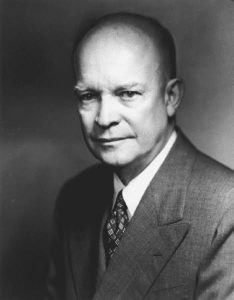
To understand the defining structural realities of modern American governance—the vast reach of the national security state, the tension between executive privilege and congressional oversight, the delicate balance between fiscal health and military spending, and the persistent influence of corporate defense contractors over foreign policy—one must examine the eight-year presidency of Dwight D. Eisenhower. As the supreme commander of Allied forces in Europe during World War II, Eisenhower entered the White House in 1953 as a universally revered war hero and global statesman. Yet behind his broad, reassuring smile and popular image as a golf-playing “father figure” lay one of the most calculating, politically adept, and strategically disciplined chief executives in American history.
The “Middle Way” and Modern Republicanism When Eisenhower won the presidency in 1952 under the iconic campaign banner “I Like Ike,” he ended twenty consecutive years of Democratic rule. His election represented a vital test for the post-New Deal American political order. Conservative “hidebound reactionaries” within the Republican Party, led by figures like Ohio Senator Robert A. Taft, demanded the outright dismantling of Franklin D. Roosevelt’s welfare programs and a return to pre-Depression laissez-faire economics. Eisenhower flatly rejected this reactionary agenda, establishing a governing philosophy he termed the “Middle Way” or “Modern Republicanism”.
Eisenhower recognized that any political party attempting to strip away basic protections for working citizens would not survive in modern America. He preserved and expanded core New Deal and Fair Deal programs, increasing the minimum wage, extending Social Security coverage to millions, expanding federal housing assistance, and creating the Department of Health, Education, and Welfare. His most enduring domestic monument was the Interstate Highway Act of 1956, which authorized a 41,000-mile network of superhighways. This massive public works project transformed the American landscape, accelerated suburbanization, and spurred long-term economic growth, demonstrating his belief that a pro-business climate required robust, bipartisan infrastructure investment.
The Hidden-Hand Presidency and Executive Privilege In managing the government, Eisenhower pioneered a style that political scientists later termed the “hidden-hand presidency”. Rather than engaging in noisy public squabbles, he operated quietly behind the scenes, using organized staff structures while maintaining an above-the-fray public persona. Drawing on his military experience, he reorganized the National Security Council (NSC) into a formal mechanism for systematic planning, ensuring that every crisis response was backed by rigorous contingency papers.
This hidden-hand approach was vividly displayed during his confrontation with Senator Joseph McCarthy, whose anti-Communist witch-hunts were terrorizing federal agencies and damaging the nation’s international standing. Rather than giving McCarthy the national publicity he craved by attacking him directly from the “bully pulpit,” Eisenhower systematically undermined the senator from behind the scenes. When the conflict escalated during the 1954 Army-McCarthy hearings, Eisenhower issued a landmark directive to Defense Secretary Charles Wilson establishing the formal constitutional doctrine of executive privilege. By ordering executive branch personnel to refuse congressional subpoenas regarding internal administration communications, Eisenhower effectively deprived McCarthy of the official files he needed to sustain his allegations. While this move ultimately broke McCarthy’s power, Eisenhower’s refusal to publicly denounce the senator’s demagoguery left many victims unprotected and established an expansive executive privilege doctrine that future presidents would wield to evade congressional scrutiny.
Civil Rights and the Federal Imperative Eisenhower’s record on civil rights reflected the limits of his strict constitutionalism and personal conservatism. He was deeply reluctant to use federal power to enforce social change, privately believing that the Supreme Court’s unanimous 1954 ruling in Brown v. Board of Education declaring school segregation unconstitutional was a mistake. His public silence following the decision alienated Black Americans and emboldened Southern segregationists to launch a campaign of “massive resistance”.
However, when Arkansas Governor Orval Faubus used the National Guard in 1857 to defy a federal court order and block nine Black students from entering Little Rock’s Central High School, Eisenhower recognized a direct challenge to the rule of law. Setting aside his personal misgivings, he placed the Arkansas National Guard under federal control and dispatched 1,000 soldiers from the 101st Airborne Division to Little Rock to enforce the court’s integration order at bayonet point. For Eisenhower, the crisis was not primarily a moral crusade for civil rights, but an absolute constitutional duty to uphold federal judicial authority against state nullification.
The “New Look” and Cold War Realism In foreign affairs, Eisenhower sought to maintain global stability while protecting the domestic economy from the ruinous costs of perpetual militarization. Under his “New Look” strategy, the administration shifted away from expensive conventional forces toward a reliance on nuclear deterrence and “massive retaliation”. By threatening the use of nuclear weapons against Soviet or Chinese aggression, Eisenhower aimed to keep the peace on the cheap, famously quipping that he saw no reason why nuclear weapons could not be used as casually as a bullet if military necessity demanded it.
Despite this aggressive rhetoric, Eisenhower exercised extraordinary personal restraint during international crises. Having witnessed the horrors of total war, he actively avoided committing American ground troops to foreign conflicts. He fulfilled his 1952 campaign promise to end the Korean War by securing an armistice in 1953. In 1954, when French forces were trapped at Dien Bien Phu, he rejected proposals from his Joint Chiefs of Staff for American air strikes or nuclear intervention in Indochina, coining the “falling domino” theory to describe the geopolitical threat while firmly refusing to drag the nation into a new Asian land war. During the 1956 Suez Crisis, when Britain, France, and Israel launched a joint military attack on Egypt, Eisenhower shocked his NATO allies by forcefully condemning the invasion, using economic and diplomatic pressure to compel a full withdrawal and uphold international law.
The Shadow State and the Farewell Warning While Eisenhower successfully kept the nation out of open warfare, his administration relied heavily on the Central Intelligence Agency (CIA) under Director Allen Dulles to conduct secret, covert operations around the globe. Seeking cost-effective ways to combat perceived Communist expansion, Eisenhower authorized covert CIA operations that overthrew the democratically elected government of Prime Minister Mohammad Mossadegh in Iran in 1953 and President Jacobo Árbenz in Guatemala in 1954. These clandestine interventions installed authoritarian regimes, subverted democratic principles abroad, and planted the seeds of long-term global anti-Americanism.
Eisenhower’s foreign policy collapsed into crisis in May 1960 when an American U-2 spy plane was shot down over the Soviet Union. After the White House issued a false cover story claiming the aircraft was a lost weather plane, Soviet Premier Nikita Khrushchev produced the captured American pilot, Francis Gary Powers. The resulting humiliation forced Eisenhower to admit personal responsibility, wrecking a planned Paris summit and shattering his hopes for achieving a nuclear test-ban treaty before leaving office.
On January 17, 1961, three days before handing power to John F. Kennedy, President Eisenhower delivered one of the most famous Farewell Addresses in American history. Drawing on his unique authority as a career soldier and commander-in-chief, the aging general issued a chilling, prophetic warning to the American public. He observed that the Cold War had compelled the nation to create a permanent, vast armaments industry for the first time in its history.
“In the councils of government,” Eisenhower solemnly warned, “we must guard against the acquisition of unwarranted influence, whether sought or unsought, by the military-industrial complex. The potential for the disastrous rise of misplaced power exists and will persist”. He cautioned that the unchecked growth of this war-based corporate and military structure posed an existential threat to democratic processes, scientific inquiry, and civil liberties.
Dwight D. Eisenhower left office as a deeply loved leader who had successfully steered the nation through eight years of peace and unprecedented material prosperity. Yet his presidency stands as a profound historical study in contradiction: he was a man of peace who expanded a clandestine intelligence apparatus, a fiscal conservative who built the foundation for a permanent national security state, and a general who gave the nation its most urgent warning about the dangers of militarized corporate power.