

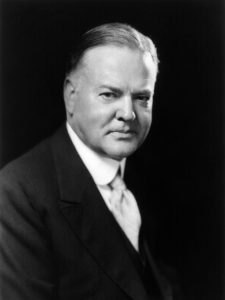
To understand one of the most persistent and dangerous myths in modern American politics—the belief that the nation’s complex government should be run by a billionaire businessman or a technocratic CEO—one must examine the catastrophic presidency of Herbert Hoover. When modern citizens demand an executive who possesses flawless administrative credentials, who promises to run the government like a well-oiled machine, and who views the presidency purely as an exercise in efficient management, they are asking for Herbert Hoover.
Before he entered the White House, Hoover was universally regarded as the most capable man in America, a genius who had never known failure. Yet, his presidency provides a terrifying historical warning: it proves that sheer intelligence, immense wealth, and administrative brilliance are utterly useless if a chief executive lacks emotional empathy, ideological flexibility, and the political capacity to connect with a suffering populace.
The Rise of the Master of Emergencies Herbert Hoover embodied the ultimate American success story. Orphaned as a child and raised in a strict, dour Quaker environment in West Branch, Iowa, he possessed boundless grit. He worked his way through the first class at Stanford University and made a massive fortune as a mining engineer. By the age of forty, he was a self-made millionaire who had scouted mines in the brutal Australian outback and navigated the globe.
His transition into public service made him an international saint. During World War I, Hoover orchestrated the Commission for Relief in Belgium, an unprecedented logistical miracle that fed millions of starving civilians. Woodrow Wilson subsequently appointed him the American “food czar”. Hoover wielded dictatorial power over the American diet, utilizing massive public relations campaigns to urge citizens to “Hooverize” by voluntarily observing “wheatless” and “meatless” days to support the war effort.
Throughout the 1920s, he served as the Secretary of Commerce under Presidents Harding and Coolidge, transforming a sleepy department into the nerve center of the American economy. He relentlessly pursued efficiency and standardization, micromanaging so many aspects of the government that colleagues sarcastically dubbed him the “Secretary of Commerce and Under-Secretary of all other departments”. When the catastrophic Mississippi River flood of 1927 displaced hundreds of thousands of people, Hoover rushed to the scene and brilliantly commanded the rescue and relief efforts, solidifying his reputation as the “Master of Emergencies”.
The Crash and the Myth of the “Do-Nothing” President When Hoover won the presidency in a landslide in 1928, he boldly declared: “We in America today are nearer to the final triumph over poverty than ever before in the history of any land”. Seven months into his term, the stock market crashed, obliterating $30 billion in wealth and plunging the nation into the Great Depression.
History frequently caricatures Hoover as a paralyzed, laissez-faire reactionary who did absolutely nothing while the nation starved. This is a profound distortion. Hoover was actually highly interventionist. Following the crash, he immediately summoned railroad presidents, industrialists, and labor leaders to the White House, securing unprecedented pledges to maintain wages and continue construction. He urged governors to increase public works spending and pushed the Federal Reserve to slash interest rates. He was the progenitor of the activist executive response to economic crises.
The Ideological Prison and the Corporate Bailout However, Hoover was fundamentally trapped by his own unyielding political philosophy of “rugged individualism”. While he was willing to cajole businesses, he was absolutely terrified of expanding the federal government to provide direct relief to starving citizens. He believed that federal welfare—the “dole”—would destroy the moral character of the American people.
As the Depression deepened and unemployment spiraled past 24 percent, 34 million Americans were left with no income at all. Families evicted from their homes lived in miserable shantytowns built on garbage dumps, which they bitterly named “Hoovervilles”. Desperate men stood in massive breadlines, yet Hoover callously insisted that “nobody is actually starving” and claimed that “the hoboes, for example, are better fed than they have ever been”. He famously dismissed the sight of desperate men selling fruit on the street by declaring that “many persons left their jobs for the more profitable one of selling apples”.
While Hoover refused to give federal money to the poor, he had no such qualms about bailing out the rich. In 1932, he created the Reconstruction Finance Corporation (RFC) to funnel hundreds of millions of federal dollars into failing banks, railroads, and corporations. The optics were apocalyptic. The American public watched their president rescue wealthy bankers while refusing to feed starving children. As the comedian Will Rogers acidly noted, “the bankers” had “the honor of being the first group to go on the ‘dole’ in America”.
To compound his failures, Hoover stubbornly signed the disastrous Hawley-Smoot Tariff Act of 1930, ignoring the desperate pleas of over a thousand economists. The tariff sparked a global trade war, prompting retaliatory tariffs from dozens of nations that choked off international commerce and drastically deepened the worldwide slump.
The Bonus Army and the Bitter Exile The defining tragedy of Hoover’s presidency occurred in the summer of 1932. Thousands of destitute World War I veterans, known as the “Bonus Army,” marched on Washington to petition the government for the early payment of a promised cash bonus. Rather than meeting with the veterans, Hoover hid inside the White House. When he ordered the military to clear the squatters from federal property, the Army Chief of Staff, General Douglas MacArthur, vastly exceeded his orders and used tanks, cavalry, and tear gas to violently drive the unarmed veterans and their families out of the city. The sight of the American government unleashing military force against its own starving war heroes destroyed whatever remained of Hoover’s presidency.
Franklin D. Roosevelt crushed Hoover in the 1932 election. Hoover spent the painful, four-month interregnum trying to sabotage FDR, demanding that the president-elect abandon the New Deal before it even started. Roosevelt refused, and Hoover departed the White House as an intensely hated figure.
For the next three decades, Hoover lived in bitter exile in the Waldorf-Astoria in New York, churning out books and articles to defend his record and viciously attack the New Deal as “fascistic” and a “move to gigantic socialism”. He became a staunch anti-interventionist, vehemently opposing American entry into World War II. He viewed Roosevelt’s wartime alliance with the Soviet Union as an unforgivable betrayal. “We should have let those two bastards annihilate themselves,” Hoover said of Hitler and Stalin.
Driven by an obsession for vindication, Hoover secretly spent two decades compiling a massive, multi-volume “Magnum Opus” titled Freedom Betrayed, which he designed as a prosecutor’s brief to prove that Roosevelt deliberately provoked Japan into attacking Pearl Harbor and catastrophically sold out Eastern Europe to the Communists. So venomous and controversial was this secret history that his heirs hid it away; it was not published until 2011, nearly fifty years after his death.
Conclusion Herbert Hoover was partially rehabilitated late in life when President Harry Truman, recognizing Hoover’s unparalleled expertise in logistics, enlisted him to coordinate post-World War II food relief. He died in 1964 at the age of ninety.
Hoover remains one of the most tragic figures in American history. He was a brilliant, hardworking man whose profound rigidity blinded him to human suffering. He proves that a president cannot solve a national crisis simply by relying on corporate voluntarism and balanced budgets, and that an executive who bails out the financial elite while ignoring the destitute will permanently forfeit his political legitimacy. Herbert Hoover’s legacy is a permanent warning against the arrogance of the technocrat: the presidency is not merely an engineering problem, and a nation cannot be managed on a spreadsheet when its people are starving in the streets.