

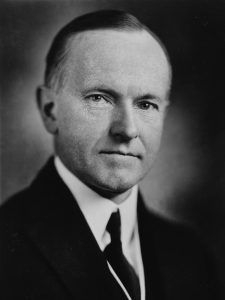
To understand the deepest anxieties of modern American politics—where the public constantly expects the executive branch to solve every domestic crisis, where the national debt continuously explodes under both political parties, and where the presidency is defined by perpetual motion and hyper-activism—one must examine the profound anomaly of the thirtieth president. Calvin Coolidge was a leader who believed that the highest virtue a chief executive could possess was restraint.
Frequently dismissed by modern historians as a lazy placeholder or caricatured by his contemporaries as a man who looked “as though he had been weaned on a pickle,” Coolidge’s obscurity is a profound injustice. He was a rare kind of political hero: a minimalist president who successfully enacted massive tax cuts, slashed the federal budget, and presided over a period of immense national prosperity by deliberately choosing not to act.
The Boston Police Strike and the “Silent Majority” Unlike modern politicians who bend to the demands of powerful public-sector unions, Coolidge forged his national reputation through an uncompromising defense of public safety. In 1919, while Coolidge was serving as the governor of Massachusetts, the Boston police force affiliated with the American Federation of Labor and went on strike, plunging the city into chaos.
While others urged compromise with the striking officers—who complained of low pay and vermin-infested station houses—Coolidge firmly backed the police commissioner’s decision to fire them. When union leader Samuel Gompers protested, Coolidge issued a blistering telegram that became a permanent fixture of American political lore: “There is no right to strike against the public safety by anybody, anywhere, any time”.
Coolidge’s steely resolve instantly made him a national hero. Recognizing his appeal, the advertising executive Bruce Barton wrote a glowing profile of Coolidge, explicitly coining a phrase that would define American politics decades later. Barton declared that there was a “great silent majority” of middle-of-the-road Americans who worked hard, paid their taxes, and wanted the government to meddle in their lives as little as possible. “Coolidge belongs with that crowd,” Barton wrote. “He lives like them, he works like them, and understands”.
The Kerosene Oath and the Accidental President Riding this wave of popularity, Coolidge was elected vice president under Warren G. Harding in 1920. But on August 2, 1923, Harding died suddenly. At the time, Coolidge was vacationing at his family’s rural home in Plymouth Notch, Vermont—a house that lacked both electricity and a telephone.
When messengers finally delivered the news of Harding’s death at midnight, the nation witnessed the humblest transition of power in its history. Because every new president must take the oath of office, and because Coolidge’s father was a local justice of the peace and notary, the elder Coolidge swore his son in as the President of the United States by the light of a kerosene lamp at 2:47 a.m.. By emphasizing the Constitution, the family Bible on the table, and the local notary’s authority, Coolidge signaled that his presidency would honor the basic, grounded contracts between ordinary citizens. He then went back to bed.
The Great Refrainer and “Scientific Taxation” Once in the White House, Coolidge operated under a political version of the Hippocratic Oath: first, do no harm. He believed that “It is much more important to kill bad bills than to pass good ones”. As a result, he vetoed fifty bills during his tenure, stubbornly refusing to expand federal spending even for popular projects like farm subsidies and rural postal roads.
Working closely with his Budget Director, General Herbert Mayhew Lord, Coolidge obsessively hacked away at the federal budget. Simultaneously, he partnered with Treasury Secretary Andrew Mellon to introduce what they called “scientific taxation”. Foreseeing modern supply-side economics, Coolidge argued that lowering surtaxes would not only free up capital but would actually increase federal tax revenues. The administration successfully pushed the top income tax rate down by half, to 25 percent.
The results were staggering. During his sixty-seven months in office, the federal debt fell, the federal budget ran a perpetual surplus, and unemployment plummeted to between 3 and 5 percent. Millions of Americans wired their homes for electricity and bought their first automobiles. Coolidge summarized his philosophy to the American Society of Newspaper Editors in 1925, declaring, “The chief business of the American people is business”. Yet, he instantly balanced this with a vital, often-forgotten corollary: “The chief ideal of the American people is idealism”.
It must be noted, however, that Coolidge’s commitment to protecting the American worker harbored dark, nativist undertones. Writing in Good Housekeeping as vice president, Coolidge explicitly argued that the United States had become a “dumping ground” and advocated limiting immigration to “the right kind” of people—specifically meaning Northern European whites.
Tragedy and the Burden of the Office Coolidge’s political triumphs were shadowed by unimaginable personal heartbreak. In the summer of 1924, his sixteen-year-old son, Calvin Jr., developed a blister on his toe while playing tennis on the White House courts. In the era before penicillin, the blister became infected with staphylococcus, and the boy died of sepsis just days later.
Coolidge was shattered. He applied a grim, unyielding logic to the tragedy: if he had not been president, his son would never have played on that tennis court, and therefore would not have died. In his autobiography, Coolidge wrote with devastating brevity: “When he went, the glory of the presidency went with him”.
Federalism and the Flood Despite his grief, Coolidge maintained his ironclad commitment to limited government, even in the face of catastrophic natural disasters. When the Mississippi River Valley suffered a devastating flood in 1927, demands poured in for a massive federal rescue. Herbert Hoover, Coolidge’s hyper-active Commerce Secretary, advocated for strong federal intervention and infrastructure spending. Coolidge, who dismissively called Hoover “Wonder Boy,” deeply resented Hoover’s persistent, grand plans.
Coolidge refused to call a special session of Congress, insisting that disaster relief was the constitutional duty of state governments and the Red Cross, not the federal executive. Months later, a similarly catastrophic flood devastated Coolidge’s own home state of Vermont. To prove his absolute consistency, Coolidge refused to deploy federal funds to his own people. As one Vermonter noted of the president’s brutal integrity: “He can’t do for his own, you see, more than he did for the others”.
Relinquishing Power In the summer of 1927, while vacationing in the Black Hills of South Dakota, Coolidge stunned the nation. He summoned reporters and handed them small slips of paper containing a single, cryptic sentence: “I do not choose to run for President in nineteen twenty-eight”.
He refused to elaborate, holding to the sacred New England privilege of making up his own mind without having to explain himself. Like George Washington, Coolidge believed that “the chances of having wise and faithful public service are increased by a change in the presidential office after a moderate length of time”. He recognized that extended time in power inevitably breeds the malady of self-delusion.
Leaving his final diplomatic legacy—the Kellogg-Briand Pact, a treaty designed to practically outlaw war—Coolidge retired to Northampton, Massachusetts, where he wrote a syndicated daily newspaper column to caution Americans against expecting too much from Washington during the ensuing Great Depression.
Calvin Coolidge died in 1933. His presidency serves as a profound historical rebuke to the modern assumption that a president must be the center of the American universe. He proved that an executive can achieve monumental economic growth, balance the budget, and restore the dignity of the government simply by having the courage, discipline, and humility to get out of the way.