

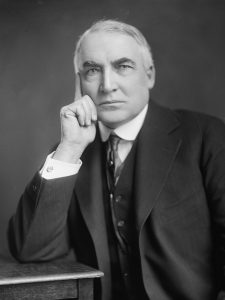
To understand the deepest vulnerabilities of the modern American political landscape—the terrifying power of “fake news” to permanently rewrite historical memory, the outsized influence of Wall Street over the executive branch, and the catastrophic damage that corrupt subordinates can inflict on a trusting leader—one must examine the tragic, deeply misunderstood presidency of Warren G. Harding.
Today, Harding is almost universally dismissed as a “genial nincompoop,” a man of “limited talents,” and is frequently ranked by historians as the absolute worst president in United States history. Yet, this reputation is perhaps the greatest optical illusion in American politics. As historians who have actually studied his primary documents have discovered, Harding’s catastrophic legacy is a product of sensationalist gossip, partisan smear campaigns, and the fact that myths simply command more attention than reality. Harding’s administration provides a profound warning about how easily the truth can be buried when the media and political operatives decide to print the legend.
The Myth of the Smoke-Filled Room The distortions regarding Harding begin with his very nomination. The enduring myth of the 1920 election is that Harding was a clueless, accidental dark-horse candidate, selected by a cabal of corrupt party bosses in a “smoke-filled back room” at the Republican convention after the leading candidates deadlocked.
In reality, Harding ran a shrewd, carefully calculated campaign for the nomination. Recognizing that the American public was utterly exhausted by the grueling idealism, international crusades, and wartime sacrifices demanded by Woodrow Wilson, Harding promised a comforting “return to normalcy”. He refused to engage in negative mudslinging and revived the “front-porch campaign” style, allowing delegations to come to him in Marion, Ohio, where he amiably chatted with reporters by their first names. The strategy was a spectacular success. Harding won the largest popular landslide in Republican history up to that point, capturing 37 states and becoming the first Republican to crack the Democratic “Solid South” since Reconstruction.
The Cabinet and the Money Trust Once in office, Harding surprised his critics by assembling a remarkably distinguished cabinet, deliberately choosing highly capable men of independent public standing. He appointed Charles Evans Hughes as Secretary of State, Herbert Hoover as Secretary of Commerce, and Henry C. Wallace as Secretary of Agriculture.
However, Harding also appointed the billionaire financier Andrew Mellon as Secretary of the Treasury, a move that essentially handed the keys of the American economy directly to Wall Street. Mellon pushed for massive tax cuts for the wealthy and fiercely protected domestic monopolies. The Wall Street elite, particularly the partners at the House of Morgan, viewed the provincial Harding with disdain, calling him a “wishy-washy” chauvinist and a “pathetic figure”. During a debate over canceling European war debts, Thomas Lamont of J.P. Morgan visited the White House and found the president drowning in paperwork. “Lamont, this job is too much for me,” Harding confessed. “Whatever shall I do with all that pile? Well, I suppose I might as well try to learn something about these debts”.
The Hidden Progressive and the Veto Pen Despite his conservative reputation and administrative struggles, Harding demonstrated extraordinary executive courage and a hidden progressive streak. In April 1921, he addressed a joint session of Congress and stunned Southern politicians by demanding federal anti-lynching legislation. “Congress ought to wipe the stain of barbaric lynching from the banners of a free and orderly, representative democracy,” Harding boldly declared. He also championed the creation of a department of public welfare and worked to end the grueling twelve-hour workday in the steel industry.
Furthermore, Harding fiercely defended the Treasury against politically popular but fiscally disastrous legislation. When Congress attempted to pass a massive “bonus bill” for World War I veterans that would have exploded the national debt, Harding shattered precedent by personally traveling to the Senate to lobby against it, warning it would be a “disaster to the Nation’s finances”. When Congress passed the bill anyway, Harding courageously vetoed it just weeks before the midterm elections—a level of fiscal discipline almost unimaginable in modern politics.
Strikes, Civil Liberties, and International Diplomacy Harding’s presidency faced massive domestic crises, including nationwide strikes by coal miners and railroad shop workers in 1922. When the strikes threatened to paralyze the economy, Harding’s fiercely anti-union Attorney General, Harry Daugherty, unilaterally secured one of the most sweeping federal injunctions in U.S. history to crush the railroad strike. While the injunction restored order, it earned Harding the permanent, unfair reputation of being an anti-labor reactionary.
Yet Harding was simultaneously undoing the authoritarian excesses of the Wilson administration. In a remarkable act of executive clemency, Harding pardoned the socialist leader Eugene V. Debs, whom Wilson had spitefully imprisoned under the Sedition Act merely for speaking out against World War I. Harding invited Debs to the White House, shook his hand, and declared he was trying to return the nation to a spirit of harmony. In foreign policy, Harding and Hughes orchestrated the Washington Disarmament Conference, a monumental diplomatic achievement that successfully halted a costly, terrifying global naval arms race.
“My Damn Friends” and the Teapot Dome The tragedy of Warren G. Harding was his fatal inability to recognize the corruption of his subordinates. While his top-tier cabinet appointments were brilliant, he also appointed political cronies to lower-level positions, with disastrous results.
Charles Forbes, the head of the Veterans Bureau, was caught illegally selling government medical supplies and soliciting massive kickbacks from hospital construction contracts. Even worse was Harding’s Secretary of the Interior, Albert Fall. Fall secretly leased the Navy’s petroleum reserves at Teapot Dome, Wyoming, to private oil tycoons in exchange for hundreds of thousands of dollars in bribes. Fall ultimately became the first former cabinet officer in American history to go to prison.
While there is absolutely no evidence that Harding was involved in or aware of these criminal activities, the betrayal broke his spirit. Before embarking on a trip to Alaska, a distraught Harding confided to a journalist: “I have no trouble with my enemies… But my damn friends… they’re the ones that keep me walking the floor nights”.
Death and the Posthumous Assassination Harding never lived to see the full fallout of these scandals. He suffered from severe cardiovascular disease—exacerbated by the fact that he retained an incompetent, small-town homeopathic doctor, Charles Sawyer, as his White House physician. On August 2, 1923, Harding died of an apparent heart attack in a San Francisco hotel room.
What followed was the complete, posthumous assassination of his character. In a misguided attempt to protect his legacy, his widow, Florence Harding, burned many of his presidential papers. This created an information vacuum that was eagerly filled by grifters and sensationalists. A woman named Nan Britton published a massive bestseller, The President’s Daughter, claiming Harding had fathered her illegitimate child in a White House closet—a claim unsupported by historical evidence. Another con man, Gaston Means, published a fraudulent book claiming that Florence Harding had poisoned her husband to save him from impeachment.
Because the official records were hidden away in a basement for decades, these fictionalized, scandalous accounts were accepted by the public and lazily repeated by historians. By the time Harding’s actual presidential papers were opened to scholars in 1964—revealing a hardworking, competent executive—the myth of the incompetent, corrupt buffoon was permanently cemented in the American consciousness.
Conclusion Warren G. Harding’s legacy serves as a terrifying historical warning. He proves that a president’s reputation can be entirely obliterated by the criminal greed of his subordinates and the unchecked proliferation of sensationalist lies. When modern Americans worry about “fake news” rewriting history, or fear the devastating consequences of placing corporate billionaires in charge of the public treasury, they are living in the shadow of the Harding administration—a presidency that was actually quite effective, but was fatally devoured by the scandals of the men he trusted and the myths of the writers who despised him.