

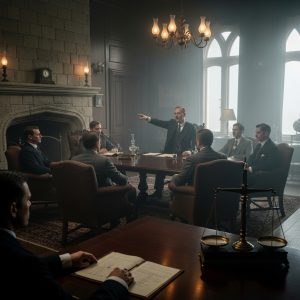
The clandestine gathering of top bankers at the Jekyll Island Club in November 1910 truly marked a pivotal moment in American financial history, framing the very prototype for what would become the Federal Reserve Act. It was a meeting shrouded in an almost theatrical level of secrecy, a “secret expedition” near the close of 1910 where attendees behaved “as secretive—indeed, as furtive—as any conspirator”.
The profound need for such elaborate concealment stemmed from the very nature of their ambition: to forge a banking cartel. Had the public discovered that rival factions of the banking community had converged, it would have immediately raised alarms about “an agreement in restraint of trade—which, of course, is exactly what they were doing”. To maintain this illusion, the participants resorted to extreme measures: they traveled under the cover of darkness on a private railroad car, “stealthily hieing hundreds of miles South,” embarking on a “mysterious launch” to an island “deserted by all but a few servants”. For a full week, they spoke to each other only by first name, ensuring that even the servants wouldn’t learn their true identities. The convenient cover story spun for the press was a simple “duck hunting expedition”, a narrative later confirmed by Paul Warburg’s son, James, who recalled his father borrowing a shotgun to maintain the disguise. Even when a reporter seemed to catch wind of the true purpose, Henry P. Davison, a Morgan partner and a key figure in the meeting, “persuaded” them to remain silent.
The seven men who converged on Jekyll Island represented a colossal concentration of wealth and power, estimated to control one-fourth of the world’s total wealth. Among them were:
- Senator Nelson W. Aldrich: A Republican leader and head of the Senate Finance Committee, deeply connected to the Rockefeller interests through his son-in-law, John D. Rockefeller Jr.. He chaired the National Monetary Commission, a body later acknowledged as a “sham” designed to legitimize reforms.
- Henry P. Davison: A prominent Morgan partner and co-owner of the Jekyll Island Club. He was Aldrich’s chief adviser, acting as a direct conduit for Morgan’s perspectives, and was instrumental in guiding the discussions, possessing an “uncanny gift in sensing the proper moment for changing the topic”.
- Paul M. Warburg: A partner from Kuhn, Loeb & Company, who had immigrated from Germany and was tirelessly advocating for the adoption of European-style central banking in the U.S.. He was considered the meeting’s “key theoretician”, having previously published influential pamphlets like “Defects and Needs of Our Banking System”.
- Frank A. Vanderlip: Vice president of National City Bank of New York, the flagship institution of the Rockefeller interests. He later openly affirmed the meeting’s role in conceiving the Federal Reserve System.
- A.P. Andrew: The head of staff for the National Monetary Commission and Assistant Secretary of the Treasury, a figure amicable to both the Morgan and Rockefeller spheres.
- Benjamin Strong: Who would become the inaugural and highly influential Governor of the Federal Reserve Bank of New York, having spent his career within the Morgan sphere.
- Charles D. Norton: Another Morgan partner.
Their purpose was clear: to design a banking cartel. This wasn’t merely about creating a more stable financial system, though that was a stated goal. It was, as the sources reveal, about achieving five core objectives:
- Curbing Competition: Stopping the “growing competition from the nation’s newer banks,” particularly those in the South and West, and ensuring control of financial resources remained with the established Wall Street institutions.
- Monetary Creation: Securing a “franchise to create money out of nothing for the purpose of lending”. Paul Warburg, for instance, had argued for an “elastic money supply” to address the perceived limitations of a gold-backed system.
- Centralized Control of Reserves: Gaining control over the reserves of all banks, which would prevent individual institutions from being vulnerable to currency drains and bank runs by forcing all banks to follow similar, often “inadequate” reserve policies.
- Socializing Losses: Devising a mechanism to shift the “inevitable losses from the owners of those banks to the taxpayers” by framing banking crises as problems of the “national economy rather than of private banking practice”.
- Political Partnership: Convincing Congress and the public that the system’s purpose was to protect the public interest, and that achieving these goals necessitated a partnership between bankers and politicians, with the creation of a central bank serving as the structural vehicle.
The week-long deliberations at Jekyll Island forged a “blueprint for the Federal Reserve System”. A crucial tactical disagreement arose: Senator Aldrich preferred a direct, European-style central bank, but Warburg and the other bankers insisted on cloaking central control in the “politically palatable camouflage of ‘decentralization'”. Warburg’s more politically astute vision prevailed, resulting in a draft that was fundamentally his plan, albeit with a decentralized veneer. This “cooperative union of all the banks of the country for definite purposes” was, in essence, a “legal private monopoly of the money supply operated for the benefit of the few under the guise of protecting and promoting the public interest”. As Senator Aldrich himself later conceded, “Before the passage of this Act, the New York bankers could only dominate the reserves of New York. Now we are able to dominate the bank reserves of the entire country”.
This secret meeting did not occur in a vacuum. It was the culmination of years of agitation by powerful financial interests. By 1910, control over financial resources was already highly centralized, with the Morgan and Rockefeller groups dominating in the U.S., and the Rothschild and Warburg groups in Europe. The preceding two decades had witnessed 1,748 bank failures, fueling calls for reform. The 1908 Aldrich-Vreeland Currency Act, which established the National Monetary Commission chaired by Aldrich, was part of this reform push. Aldrich’s “so-called fact-finding body” spent years touring Europe, consulting with central bankers, ultimately producing voluminous histories of European banking but no independent recommendations; the true proposals were drafted by Aldrich and a select few, specifically at the “plush private hunting resort in Georgia”.
Leading economists and social scientists of the era, many trained in Germany, lent intellectual support, advocating for a “new industrial order” and a centrally planned state, viewing the decentralized banking system as a problem. Edwin R.A. Seligman, a Columbia University economist from a prominent Wall Street investment banking family, famously declared in 1907 that the “struggle which has been victoriously fought out everywhere else in creating trusts must be undertaken here in earnest and with vigor” for banking. The Wall Street Journal, using its chief propagandist for the National Monetary Commission, Charles A. Conant, published a 14-part series in 1909 advocating for a “central bank of issue”. Front groups like the National Citizens League for a Sound Banking System were established in Chicago, far from New York, to cultivate a “grassroots heartland operation” image, though H. Parker Willis later admitted it was merely a “propaganda organ of the nation’s bankers”.
The Federal Reserve Act, passed triumphantly in December 1913, effectively implemented the Jekyll Island plan. It transformed the government into a “partner with private bankers” and ensured that the New York Federal Reserve Bank, under the leadership of Benjamin Strong, a staunch Morgan ally, would dominate the new system from its inception. Thus, the secret machinations on Jekyll Island laid the groundwork for a fundamental restructuring of American finance, establishing a system where powerful private interests, in alliance with the government, gained unprecedented control over the nation’s money supply.