

The 1988 presidential election presented a striking paradox: a financial crisis of monumental proportions was largely absent from the national political discourse. This essay will explore the reasons behind the Democratic candidate Michael Dukakis’s notable restraint in addressing the Republican administration’s involvement in the Savings and Loan (S&L) crisis, arguing that this silence was a calculated political decision rooted in the Democratic Party’s own vulnerabilities and strategic repositioning in the post-Reagan era. Moreover, this historical episode serves as an illuminating case study in how certain uncomfortable truths can be sidelined or even “eras[ed]” from public consciousness, reflecting the complex interplay between political expediency and the construction of historical narratives.
By the late 1980s, the Savings and Loan crisis had metastasized into what has been termed the “biggest domestic public policy mistake of the century”. The cost of bailing out these insolvent institutions and repaying depositors was spiraling, projected to reach an astounding $200 billion. In 1989, the Resolution Trust Corporation (RTC) was established to manage the assets of 747 failed S&Ls, with the eventual taxpayer cost approaching $200 billion by 1995 (in 2008 dollars). Despite this immense financial burden, the issue was “kept behind a screen,” leaving the American electorate largely uninformed.
The primary reason for Michael Dukakis’s reluctance to highlight the Republican administration’s role in the S&L crisis was the undeniable, albeit politically inconvenient, truth that Democrats in Congress were “heavily involved in bringing about and then covering up the situation”. This widespread entanglement meant that numerous high-ranking Democrats had their own connections to the financial improprieties and the junk bond market crash that contributed to the S&L failures. A prominent example is Speaker of the House Jim Wright, who was forced to resign amidst a scandal that included accepting gifts from corrupt S&L bankers and subsequently lobbying regulators on their behalf. Even well-known liberal figures such as Senators Bob Graham and John Kerry were found to have used the corporate jet of Miami’s CenTrust bank, an institution deeply implicated in a multi-billion dollar S&L disaster. Such widespread complicity across the political spectrum rendered the S&L crisis a dangerous topic for Dukakis; discussing the corruption would inevitably open his own party to intense scrutiny and potential damage.
Given this precarious situation, Dukakis and his campaign, including advisors like Robert Rubin, recognized that there was “little interest in discussing the corruption surrounding the S&Ls”. Consequently, the S&L crisis was “scarcely a word…said by either candidate during the 1988 election campaign” and remained “effectively a non-issue” even into the 1992 election, despite the lingering economic consequences.
This strategic silence on a major national crisis can be understood within the broader context of the Democratic Party’s re-evaluation and repositioning in the 1980s. Following two decisive Republican presidential victories, the Democratic Party was “dazed” and grappling with internal “divisions of race, ideology, and political temperament”. Their primary goal was to reclaim the political center, which involved a deliberate move to the right and a departure from the “full-throated progressive idealism” associated with the New Deal and Great Society eras. The party embraced a new agenda centered on “pragmatic, private-sector-driven economic growth” and modest promises of government services delivered through “frugal management”.
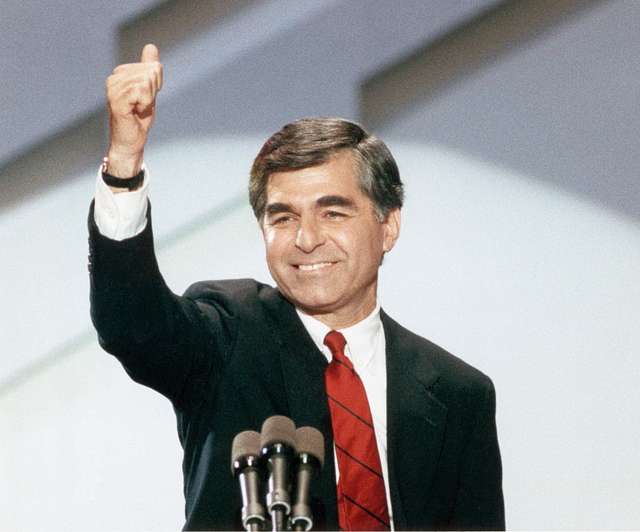
Michael Dukakis personified this “new politics” approach. He projected an image of “cool reason” and presented himself as a “mild-mannered technocrat”. His political identity was rooted in a belief in “rational approaches to public problems, free of political dogma,” echoing John F. Kennedy’s pragmatism. Dukakis’s reputation was built on the “Massachusetts miracle,” a period of high-tech economic growth largely fueled by military contracts. His campaign emphasized “fiscal responsibility and reform of the state bureaucracy,” prioritizing “competence” over “ideology,” and he even “detested all political labels”. In such a carefully constructed campaign, introducing a topic as fraught with allegations of corruption and bipartisan complicity as the S&L crisis would have severely undermined Dukakis’s technocratic, non-ideological appeal.
Furthermore, the tactics employed by the Bush campaign in 1988—which successfully portrayed Dukakis as a “card-carrying liberal” and “soft on crime, soft on patriotism, soft on defense” through controversial means like the Willie Horton ad and questioning his stance on the Pledge of Allegiance—further incentivized Dukakis to avoid any issues that could be easily twisted into attacks on his perceived “liberal” tendencies or integrity. A deep dive into financial corruption, especially one that implicated members of his own party, would have provided ample ammunition for his opponents to paint him as complicit or ineffective in managing such issues.
This historical moment also offers insights into the nature of historical narrative itself. Historians often grapple with the selective presentation of the past, acknowledging that “history is the memory of states”, which may conceal “fierce conflicts of interest” and present a “sanitized” version of events. As Jason Stanley points out, authoritarian regimes frequently find history “profoundly threatening” because it “provides multiple perspectives on the past,” leading them to “eras[e] or conceal[] history in order to consolidate their power”. This impulse to eliminate narratives that challenge a singular, glorified past is evident in various contexts, from the “supremacist nationalism” that glorifies white Europeans while erasing contributions of Black and indigenous Americans, to the “triumphalist history” that overlooks inconvenient aspects of the past to bolster the status quo.
The S&L crisis, with its bipartisan entanglements, was a subject that, had it been fully aired, would have complicated neat narratives of political good versus evil. The “learned sense of moral proportion” can lead to the “easy acceptance of atrocities as a deplorable but necessary price to pay for progress”. When the powerful or politically expedient narratives are “not based in actual historical primary source evidence” and are “highly manipulative”, they serve to “dampen[] the American intellectual suspicion toward concentrated financial power”. This “erasing history” is not merely an accident but can be a deliberate political act.
Historians are tasked with “unearthing and choosing to remember about what happened”, often challenging dominant “myths of national innocence and national purity”. They strive to be “honest not only about ourselves but about the environment in which we have had to live”. While achieving complete objectivity can be “elusive, even impossible”, the pursuit of “dispassionate history” and the willingness to find one’s “prejudices and expectations challenged by the historical record” are central to the craft. By examining suppressed narratives, such as Dukakis’s silence on the S&L crisis, historians bring to light the complexities of political decisions and the societal forces that shape public knowledge and historical memory.
In conclusion, Michael Dukakis’s strategic silence on the S&L crisis during the 1988 election was not an oversight but a deliberate political choice. It was driven by the Democratic Party’s own complicity in the crisis and a broader strategy to shed its “liberal” image in favor of a technocratic, fiscally responsible stance. This episode starkly illustrates how political considerations can lead to the suppression of significant historical events from public discourse, thereby shaping the “memory of states” rather than allowing for a comprehensive understanding of past truths. The role of the historian, then, becomes ever more vital in uncovering these “hidden episodes” and presenting a more complete, if sometimes uncomfortable, account of the past.