

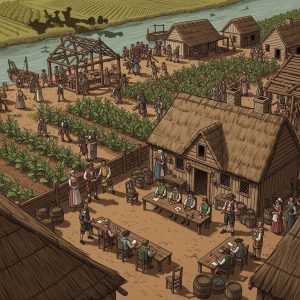
The story of American democracy does not begin in 1776 with the Declaration of Independence, nor in 1787 with the drafting of the Constitution. Instead, its roots stretch back over a century earlier, buried in the harsh realities of early colonial settlement. When the first European colonizers established footholds in North America, they had little intention of fostering democratic societies. In Virginia, the colony was run by a London-based joint-stock company that initially sought to govern the Jamestown settlement through strict, hierarchical control and summary punishments. In Massachusetts, Puritan leaders envisioned a society governed by the “worthy,” explicitly restricting power and preaching against the dangers of excessive democracy. Maryland’s founding charter gave its proprietary governor essentially monarchical powers over the law.
However, these top-down, bureaucratic ambitions quickly collided with the geographic and economic realities of the New World. The North American environment was defined by two critical features: immense land abundance and severe labor scarcity. Furthermore, colonial leaders lacked a strong, coercive state bureaucracy or military force to impose their will on the population. If colonists were unhappy with their treatment, they possessed a powerful “exit option”—they could simply move further inland to the abundant frontier.
Faced with the desperate need to attract and retain labor to make the colonies profitable, and lacking the power to physically coerce white settlers, colonial elites were forced to bargain. They discovered that offering political rights was a necessary enticement to draw migrants across the Atlantic. In Virginia, the discovery of tobacco as a lucrative cash crop required a massive influx of laborers. To attract them, the Virginia Company reformed its governance in 1619, offering land grants and establishing a general assembly of burgesses chosen by the inhabitants. This resulted in the first democratic assembly of European settlers in North America.
Similarly, in Massachusetts, the inability to enforce central control over dispersed towns led to the establishment of town meetings and the General Court, where the colony’s free men asserted the exclusive right to levy taxes. In Maryland, proprietary governors ultimately had to yield legislative and taxing authority to an assembly of freemen simply because the governors had no independent means of raising revenue without their cooperation.
The resulting political culture was far more democratic than anything seen in England at the time. While the English Parliament was called infrequently—only ten times during Queen Elizabeth I’s 45-year reign—American colonial assemblies generally met every year. Furthermore, participation was vastly broader. While the English voting franchise was restricted to a tiny fraction of wealthy property owners (less than 3 percent of adult males), the relative ease of acquiring property in the colonies meant that a majority of adult white men could vote. In some Massachusetts towns, an estimated 72 percent of adult males held the franchise. Colonial voters also exercised tighter control over their representatives through strict mandates and instructions, a practice that had largely disappeared in England.
Yet, this flowering of early democracy contained a tragic and profound contradiction. The very same economic and environmental conditions that birthed democratic rights for white settlers—land abundance and labor scarcity—also drove the creation of American chattel slavery. Because white laborers could easily acquire their own land or demand high wages and political rights, colonial elites seeking to maximize profits from labor-intensive crops like tobacco turned to forced labor. Africans, violently uprooted and stripped of the “exit options” and cultural familiarity that European migrants possessed, were subjected to a brutal system of permanent bondage. Thus, early American history developed along two inextricably linked paths: expansive democratic freedom for white citizens and the oppressive institution of slavery for Africans.
By the time the United States declared its independence, the tradition of early democracy—characterized by broad participation, frequent elections, and the absolute necessity of the consent of the governed—was already deeply entrenched. The founders of the Republic would build upon this robust foundation, even as they grappled with the dark, dual root of slavery that had grown alongside it.