

The year 1995 stands as a critical juncture in the annals of history, a period when significant shifts in domestic policy, international relations, technology, and environmental awareness laid foundations for the future. As the world navigated the immediate aftermath of the Cold War and grappled with emerging challenges, events of this year profoundly shaped the trajectory of global affairs and American society in the decades that followed.
A Shifting Landscape of Global Threats and Counterterrorism
The mid-1990s witnessed a stark evolution in the perception and reality of global terrorism, pushing counterterrorism efforts to the forefront of American policy. Early in 1995, the United States recognized a “newly potent terrorist threat in the Sunni Islamic world,” marked by a surge in Islamist violence, increasingly mysterious perpetrators, and a rise in suicidal attacks emanating from groups in North Africa, Egypt, Sudan, and Pakistan. There was also growing evidence that Islamist terrorists were experimenting with weapons of mass destruction, with Osama bin Laden’s influence increasingly apparent as a source of inspiration or financial support.
By mid-1995, American intelligence analysts began to form a clearer picture of a global terrorist network. A National Intelligence Estimate, circulated by the CIA in July 1995, specifically warned of future terrorist attacks against the United States, both abroad and domestically. This estimate, titled “The Foreign Terrorist Threat in the United States,” highlighted vulnerable targets such as the White House, the Capitol, symbols of capitalism like Wall Street, critical infrastructure, sports arenas, and civil aviation. However, a subsequent 1997 update of this estimate notably failed to discuss new intelligence or prominently mention Osama bin Laden or Al Qaeda, suggesting a potential underestimation of the evolving threat before the September 11 attacks.
Domestically, the year was tragically marked by the Oklahoma City bombing in April 1995. This devastating act, carried out by American anti-government extremists Timothy McVeigh and Terry Nichols, killed 168 people and wounded hundreds. The bombing “galvanized the Clinton administration to focus on terrorism”. However, the extensive investigation into this domestic attack also “drained FBI resources” and inadvertently diverted attention from pursuing other leads, such as an “airplane kamikaze plan” linked to Ramzi Yousef, whose arrest earlier in 1995 had already prompted a search for Khalid Sheikh Mohammed.
In response to these burgeoning threats, President Clinton, in his January 1995 State of the Union message, promised “comprehensive legislation to strengthen our hand in combating terrorists, whether they strike at home or abroad”. By February, he proposed expanding federal criminal jurisdiction, easing terrorist deportations, and targeting terrorist fund-raising. Following the Tokyo subway sarin attack in March and the Oklahoma City bombing in April, Clinton bolstered these proposals, seeking increased wiretap and electronic surveillance authority for the FBI, requiring traceable taggants in explosives, and allocating substantial new funding for the FBI, CIA, and local police. These 1995 procedures governing intelligence sharing between the FBI and the Justice Department’s Criminal Division notably “remained in effect until after 9/11”, illustrating a direct, albeit sometimes insufficient, line of continuity in counterterrorism policy.
A significant challenge within the intelligence community was also evident. 1995 marked a “nadir” for the CIA’s Clandestine Service, with only 25 new officers joining that year. This sharp decline in recruitment eventually led to a long-range rebuilding program endorsed in 1998, which would require several years for new recruits to reach full operational capacity.
Evolving U.S. Foreign Policy and Intervention
1995 also saw a critical re-evaluation of American foreign policy, particularly concerning humanitarian crises and its role as a global power. The Bosnian Genocide reached an undeniable peak in 1995. After a temporary cease-fire ended in May, Serbian forces, under Slobodan Milosevic, intensified their “ethnic cleansing” campaign, culminating in the horrific Srebrenica massacre of over 8,000 men and boys in July—the largest mass killing in Europe since World War II. This atrocity finally “galvanized sentiment within the administration,” prompting a decisive shift in U.S. policy despite public reluctance towards military intervention.
The United States approved a billion-dollar sale of weapons to anti-Serbian forces. Critically, President Clinton authorized U.S. participation in NATO’s “Operation Deliberate Force,” an eighteen-day saturation bombing campaign against Serbian positions, in response to a Serb attack in Sarajevo. This concentrated military pressure ultimately forced Milosevic to accept a settlement, leading to the Dayton Accords in December 1995, with NATO troops deploying to enforce the agreement. This intervention, following earlier non-action in Rwanda and hesitancy in Somalia, demonstrated a complex and evolving American willingness to use military force in humanitarian crises.
In the broader context of global power, by 1995, the United States had “fully recovered its imperialist acumen”. The Pentagon’s Nye Report of 1995, for instance, authorized the permanent basing of 100,000 U.S. troops in Japan and South Korea, solidifying America’s commitment to maintaining its military presence and influence in the Asia-Pacific region amid ongoing debates about engaging or containing China. Furthermore, as the Soviet Union’s collapse opened new opportunities, American energy companies, by late 1995, began to view Afghanistan as a crucial transit route for oil and natural gas, highlighting a new strategic interest in Central Asia driven by economic considerations.
Domestic Political Tensions and Social Movements
The year also brought significant domestic political struggles and social mobilizations. Fierce budget negotiations between the Clinton administration and the Republican-controlled Congress led to a federal government shutdown in late December 1995. This period of political gridlock, marked by Republican intransigence, ultimately worked to Clinton’s advantage, contributing to his strong re-election prospects in 1996 and signaling a perceived loss of momentum for the “Gingrich revolution” that had swept Republicans into power.
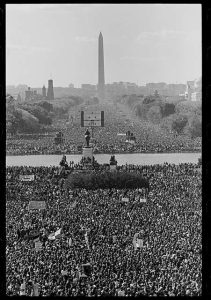
On the social front, 1995 was notable for the Million Man March, where a million black men gathered in Washington, D.C., to express solidarity and address shared frustrations. This event, alongside other movements of the time, was seen as an indicator of increasing national diversity and the potential for a “Rainbow Coalition” to emerge, signaling the continued evolution of social and political activism in the U.S.. For those graduating high school in 1995, they entered an adult world still largely shaped by Francis Fukuyama’s “end of history” narrative, which posited liberal democracy as the ultimate form of government, and ongoing “culture wars”. This pervasive sense of ideological complacency would subsequently be challenged by various countercultural and dissenting voices.
Technological Advancements and Environmental Awareness
Technologically, 1995 was a pivotal year for the burgeoning digital age. The dotcom boom began around this time, prompting businesses to rapidly establish online presences. Concerns about the security of credit card transactions over the internet, particularly the risk of fraud, spurred Microsoft and Netscape to introduce SSL/TLS (Secure Sockets Layer/Transport Layer Security) for encrypting online communications. These foundational developments in internet security were crucial for building trust in online commerce and profoundly shaped the future of e-commerce and digital interaction.
Meanwhile, the increasing importance of data and privacy became apparent in other sectors. In 1995, the UK government’s attempt to centralize all medical records led to a significant public and professional confrontation over medical data privacy, foreshadowing ongoing debates and policy developments concerning data protection in the digital age.
Finally, 1995 marked a scientific milestone in the understanding of climate change. The Second Intergovernmental Panel on Climate Change (IPCC) report, released that year, conclusively detected the “fingerprint” of human-caused greenhouse effect warming and projected “serious warming” in the coming century. Reports of Antarctic ice shelves breaking up further contributed to this growing scientific consensus and began to significantly influence public opinion. This report solidified the scientific basis for climate action and set the stage for future international efforts, such as the Kyoto Protocol in 1997, aimed at addressing greenhouse gas emissions.
In sum, 1995 was a year of profound historical consequence, witnessing the hardening of counterterrorism policies in the face of evolving threats, a shift in U.S. foreign policy toward more assertive intervention in humanitarian crises, and significant domestic political and social transformations. Simultaneously, it was a year that laid crucial groundwork in the digital realm and saw a definitive turning point in global awareness of human-induced climate change, truly setting the stage for the challenges and developments of the twenty-first century.