

As the United States entered the 20th century, democratic majorities increasingly demanded progressive reforms to curb the brutal working conditions and vast inequalities of the Gilded Age. However, these popular reform efforts quickly collided with a formidable roadblock: the United States Supreme Court. During this period, the Court weaponized the Constitution to shield corporate power from government regulation, aggressively utilizing a legal doctrine known as “substantive due process.”
To understand this era, one must look at the tragic transformation of the Fourteenth Amendment. Ratified during Reconstruction in 1868, the amendment was explicitly designed to establish civil rights for formerly enslaved Black Americans, mandating that no state shall “deprive any person of life, liberty, or property, without due process of law”. However, it did not take long for elite corporate and railroad lawyers to argue that this “due process” clause should shield corporations and private individuals from state economic regulations. In 1886, the Supreme Court agreed, recognizing corporations as “persons” entitled to Fourteenth Amendment protections.
Soon, conservative judges began to scrutinize the actual substance of legislation, rather than just the procedures by which laws were enforced. They crafted the doctrine of “substantive due process,” using it to strike down economic and labor regulations that they deemed arbitrary or oppressive to businesses. In doing so, the Court effectively abandoned the Fourteenth Amendment’s original intent of protecting Black freedom, prioritizing white ownership interests and corporate power instead; in a 1912 study of Fourteenth Amendment cases, over half involved protecting corporations, while less than 5 percent concerned the rights of African Americans.
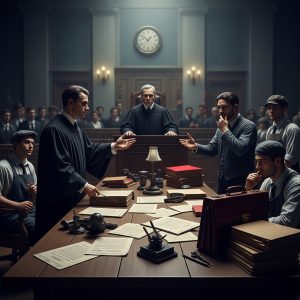
The most infamous application of this doctrine occurred in the 1905 case Lochner v. New York. The state of New York had passed a labor statute preventing bakers from working more than sixty hours a week or ten hours a day. At the time, bakers worked in horrific conditions, often confined to cellar bakeries with terrible ventilation, high temperatures, and poisonous gases. Joseph Lochner, a bakery owner in Utica, was fined for violating the statute and appealed his case to the Supreme Court.
The Supreme Court ruled in Lochner’s favor, striking down the New York law. Ignoring the brutal socioeconomic realities on the ground, the Court declared that the labor protections violated an unwritten constitutional “right of free contract” (or “liberty of contract”) between employers and employees. The conservative majority insisted that the state was interfering with the liberty of a worker and a boss to negotiate their own terms, treating the situation as if a desperately poor bakery worker possessed the same bargaining power as a wealthy factory owner. In the Court’s eyes, the New York legislature possessed illegitimate “other motives” to regulate labor and unfairly favor the working class at the expense of the wealthy.
This decision birthed what is now known as the “Lochner Era,” a period stretching into the 1930s where the Supreme Court systematically struck down state and federal economic regulations. Under the guise of protecting the “liberty of contract,” the Court invalidated minimum wage laws, child labor restrictions, and price regulations. Conservative justices, deeply committed to laissez-faire capitalism, viewed themselves as engaged in a holy war to protect property rights from the “oncoming hosts of communism and anarchy,” acting as a bulwark against “democratic impatience”.
The Court’s rigidity sparked fierce dissents from its more progressive members. In the Lochner case itself, Justice John Marshall Harlan argued that employers and employees “were not upon an equal footing” and that the courts should keep their hands off the legislature’s attempts to protect public welfare. Justice Oliver Wendell Holmes famously scoffed at the majority’s ideology, asserting that the Fourteenth Amendment was not meant to prevent states from making social and economic experiments desired by the community.
The Lochner era exemplifies the deep and explosive tensions between democratic majorities seeking structural reform and an unelected judiciary fiercely protecting capital. By elevating corporate property rights over human welfare and actively thwarting the will of the people, the Supreme Court entrenched a system of stark economic inequality. This ideological standoff between democratic lawmaking and judicial supremacy would eventually reach a breaking point during the unprecedented catastrophe of the Great Depression.