

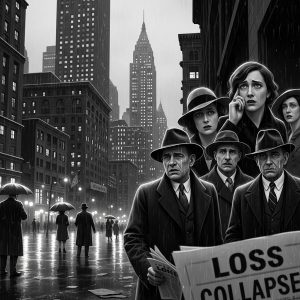
The stock market crash of 1929, which marked the violent end of the “Roaring Twenties,” was the direct result of wild speculation that eventually collapsed and brought the entire global economy down with it. Within a single year following the crash, a staggering $40 billion of wealth vanished into thin air. However, the initial shock of the plummeting stock market was merely a prelude to the devastating economic realities of the Great Depression. Because the American economy was fundamentally unsound—plagued by bad distribution of income and unhealthy corporate and banking structures—the financial panic quickly mutated into a prolonged economic catastrophe.
Between 1929 and 1933, the nation’s Gross Domestic Product dropped by a crushing 45 percent, while industrial production fell by half. The human toll was unprecedented; up to 15 million Americans, representing a quarter to a third of the entire labor force, were thrown out of work. With prices and wages collapsing in a deflationary spiral, desperate people who had been evicted from their homes were forced to live in makeshift shacks in “Hoovervilles” built on garbage dumps. The devastation was not limited to the United States; world exports fell by roughly a third in 1932, paralyzing the global trading system and plunging industrialized nations into widespread misery.
As the public endured breadlines and mass unemployment, a fierce political backlash against Wall Street began to brew. During the 1920s, top bankers had been viewed as men of unimpeachable integrity, possessing almost mythical business genius. But as the crisis deepened, the prestige of the financial elite utterly collapsed, and the public demanded answers for the disaster. To channel this populist outrage, the U.S. Senate Banking Committee launched the most far-reaching public investigation of the financial sector ever undertaken. In January 1933, the committee hired Ferdinand Pecora, a pugnacious and fearless former assistant district attorney, as its general counsel, and he immediately set out to expose the malfeasance of the men who had organized the crash.
Through what became known as the Pecora Hearings, the Senate dragged the aristocrats of American commerce into the public spotlight and stripped away their veil of respectability. Pecora methodically exposed how wealthy investors and Wall Street executives had engaged in massive tax evasion, created secret stock pools to manipulate prices, and conducted phony trades to enrich themselves at the public’s expense. The hearings revealed shocking abuses of power, such as Albert Wiggin, the chairman of Chase National Bank, actively shorting his own company’s stock to profit from the 1929 crash.
Pecora also dismantled the pristine reputation of the era’s “superbank,” National City Bank. The hearings demonstrated that National City had ceased to function as a traditional bank and instead used its trusted name to trick average depositors into buying highly speculative stocks and foreign bonds—investments that the bank itself had a direct financial interest in offloading. Even the mighty House of J.P. Morgan was subjected to Pecora’s relentless questioning, during which it was revealed that Jack Morgan and his twenty partners had paid absolutely no income taxes during the darkest years of 1931 and 1932.
The Pecora Hearings were a watershed moment in American history. By exposing Wall Street’s shadow government and proving that the nation’s financial titans had operated with rampant greed and unaccountable power, the hearings shattered the prestige of bankers and convinced the American public that they had been systemically conned. As President Franklin D. Roosevelt famously declared upon taking office, the “unscrupulous money changers” had finally fled from their high seats in the temple of civilization.
This absolute destruction of Wall Street’s credibility paved the way for massive regulatory reform. Capitalizing on the public outrage generated by Pecora’s revelations, Congress fundamentally restructured American finance. Lawmakers passed the Securities Act of 1933 and created the Securities and Exchange Commission (SEC) in 1934 to police the markets and require public accounting from corporations. Furthermore, Congress passed the landmark Glass-Steagall Act, which established the Federal Deposit Insurance Corporation (FDIC) to protect everyday depositors and strictly separated commercial banking from the high-risk speculation of investment banking. Through these reforms, the government sought to permanently tame the forces that had triggered the Great Depression.