

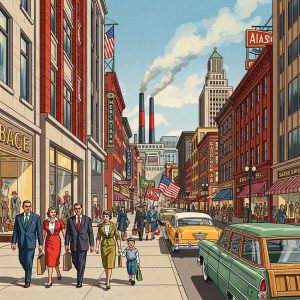
World War II catapulted the United States to unprecedented global dominance. Manufacturing more goods and possessing more oil, gold, and airplanes than all other nations combined, America emerged from the conflict standing alone at the “summit of the world”. Yet, unlike the Gilded Age or the Roaring Twenties, the astronomical wealth generated by this postwar economic boom did not simply pool at the very top. Instead, between 1945 and 1975, the United States forged a remarkable accommodation between capitalism and democracy, creating the largest and most prosperous middle class in human history. This era of plunging inequality and broadly shared prosperity came to be known as the “Great Leveling” or the “Great Compression”.
The foundation of this egalitarian era was a system of “countervailing power”—a political and economic structure where the immense influence of large corporations and Wall Street was balanced by the newly fortified power of labor unions, government regulators, and everyday citizens. The postwar economy was driven by mass production, which inherently relied on mass consumption; to maintain profitability, corporations needed a vast middle class with enough money to buy the automobiles, refrigerators, and appliances rolling off their assembly lines.
Recognizing this interconnectedness, the leaders of America’s giant oligopolistic companies often embraced the role of “corporate statesmen”. They acknowledged a public duty to maintain an equitable balance among the claims of stockholders, employees, and consumers. When Charles E. Wilson, the president of General Motors, was asked during a Senate confirmation hearing if he could make a decision adverse to his former company as Secretary of Defense, he perfectly captured the era’s consensus: “I cannot conceive of one because for years I thought what was good for our country was good for General Motors, and vice versa”.
Three primary pillars sustained this unique blend of democratic capitalism:
1. Strong Labor Unions and Worker Bargaining Power Bolstered by New Deal legislation that guaranteed the right to organize and collectively bargain, organized labor became a formidable economic force. By the mid-1950s, almost a third of all employees in the American private sector belonged to a labor union. In 1950, Big Business and Big Labor cemented a historic compromise known as the “Treaty of Detroit,” in which corporations agreed to share the gains of rising productivity in exchange for uninterrupted labor peace. For the next three decades, the typical American worker’s earnings doubled in perfect lockstep with the overall growth of the economy. Employees effectively possessed property rights in their jobs, securing robust wages, pensions, paid vacations, and employer-provided health benefits that insulated them from economic ruin.
2. High and Progressive Taxation This broad distribution of wealth was further engineered by highly progressive government tax policies. To finance the war and subsequent social investments, the federal government instituted steeply progressive tax rates that remained in place for nearly forty years, contributing to an era of wealth redistribution entirely unprecedented in American history. During the postwar decades of rapid economic expansion, the top marginal income tax rate never fell below 70 percent, peaking at 90 percent between 1952 and 1964, while top estate tax rates sat at an astonishing 77 percent. Rather than stifling economic growth, these revenues funded the social welfare state, public education, and massive infrastructure projects like the Interstate Highway System, which spurred suburbanization and further economic development. The GI Bill transformed the working class, heavily subsidizing college educations and homeownership for millions of returning veterans.
3. Robust Financial Regulation Finally, the Great Leveling relied on a heavily regulated and highly constrained financial sector. Burned by the speculative excesses of the 1920s that triggered the Great Depression, the government maintained tight regulations, most notably the Glass-Steagall Act, which strictly separated commercial deposit banking from high-risk investment banking. With banking rendered a highly supervised and relatively “boring” profession, the financial sector remained stable for half a century, completely avoiding the catastrophic crashes that defined earlier and later eras. Wall Street was forced to serve the real economy of manufacturing and commerce, rather than dominating and extracting from it.
The result was a dramatic convergence of living standards. The percentage income gains of the middle and lower classes vastly eclipsed those of the rich, and the share of national income captured by the top 1 percent plummeted to historic lows. Regular working Americans could now afford the trappings of a lifestyle—homeownership, college educations, and reliable automobiles—that had once been the exclusive domain of the wealthy elite.
By creating a society where the immense rewards of capitalism were actively and legally distributed downward, the United States stabilized its political system against the appeals of radicalism. In the shadow of the Cold War, this new industrial state served as the ultimate ideological weapon against Soviet communism, proving to the world that a democratic republic could successfully merge dynamic economic growth with unprecedented economic fairness.