

The quarter-century following World War II brought unprecedented prosperity, built upon a carefully constructed international economic architecture known as the Bretton Woods system. Negotiated in 1944, Bretton Woods established the U.S. dollar as the bedrock of global trade by fixing its value to gold at $35 per ounce, while all other major currencies were pegged to the dollar. This dollar-gold link provided the stability that allowed Western Europe and Japan to rebuild their war-torn economies. However, the system contained a fatal structural contradiction: to finance growing global trade, the United States had to pump ever more dollars into the international economy, which inevitably undermined the currency’s value and threatened its gold backing.
By the late 1960s and early 1970s, the post-WWII economic consensus began to violently unravel. The United States was struggling under the immense financial burdens of funding both the Vietnam War and Lyndon B. Johnson’s Great Society domestic programs without significantly raising taxes. This generated an overheating economy and birthed a baffling new phenomenon known as “stagflation”—a toxic, simultaneous rise in both inflation and unemployment, coupled with stagnant economic growth. Conventional Keynesian economics had no remedy for this paradox; if policymakers slowed the economy to fight inflation, they exacerbated unemployment, and if they stimulated the economy to create jobs, prices soared.
Furthermore, America’s competitive edge was deteriorating. In 1971, the United States ran its first merchandise trade deficit since 1893. As the nation bled dollars overseas, foreign central banks accumulated massive reserves of greenbacks. By the summer of 1971, foreign governments held roughly $40 billion in dollar claims, while the U.S. Treasury held just over $10 billion in gold reserves. The math was terrifying: if foreign nations lost confidence in the dollar and demanded their gold, the United States would be unable to honor its most sacred international financial commitment, potentially triggering a catastrophic collapse of the global trading system.
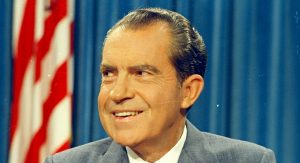
Faced with an impending run on the bank and desperate to secure a booming economy before his 1972 reelection campaign, President Richard Nixon convened a highly secretive meeting of his top economic advisors at Camp David during the weekend of August 13–15, 1971. Guided by his unapologetically nationalist Treasury Secretary John Connally, Nixon decided to deliver a massive shock to the international system. On the evening of Sunday, August 15, Nixon preempted global financial markets with a stunning television address, unilaterally announcing that the United States was suspending the convertibility of the dollar into gold. With a single stroke, he closed the “gold window,” effectively ending the Bretton Woods system.
To combat domestic stagflation and force foreign allies to the negotiating table, Nixon also implemented a 90-day freeze on all wages and prices and levied a sweeping 10 percent surcharge on all imports. Nixon’s aggressive, unilateral moves—dubbed the “Nixon Shock” by the traumatized Japanese—stunned America’s allies. Western Europe and Japan felt blindsided; their financial markets crashed, and foreign leaders angrily accused the United States of retreating into economic nationalism and protectionism. However, the Nixon administration calculated that raw unilateral leverage was the only way to force nations like West Germany and Japan to revalue their currencies, which would make American exports cheaper and foreign imports into the U.S. more expensive, thereby saving American manufacturing jobs.
The death of the gold standard initiated years of frantic diplomacy, but efforts to restore fixed exchange rates, such as the December 1971 Smithsonian Agreement, quickly fell apart. Instead, the world was forced to transition to a system of floating exchange rates, where the value of currencies is determined by the open market—a reality formally legitimized by the Jamaica Accords in 1976.
This chaotic transition was severely compounded by a massive geopolitical crisis. In October 1973, in retaliation for U.S. support of Israel during the Yom Kippur War, Arab members of OPEC launched an oil embargo against the United States. Oil prices quadrupled practically overnight, transferring billions of dollars of wealth to oil-producing nations while unleashing devastating inflation and the worst economic recession since the 1930s across the industrialized world. Americans endured gasoline shortages, plunging stock markets, and a profound psychological realization that their era of effortless postwar dominance was over.
Yet, the ultimate legacy of the Nixon Shock was profoundly paradoxical. While severing the dollar from gold was viewed at the time as a humiliating admission of American decline, it actually freed the United States from the rigid constraints of international monetary rules. Under the old fixed-rate system, the U.S. government was theoretically forced to sacrifice domestic economic growth to maintain the dollar’s value. By moving to floating fiat currencies (money backed by nothing but government decree), Washington gained the freedom to prioritize its domestic political and economic needs.
Furthermore, despite losing its gold backing, the U.S. dollar was not dethroned. Because of the sheer size of the American economy, the depth of its capital markets, and the security of its institutions, the fiat dollar remained the world’s undisputed reserve currency. Today, the greenback still accounts for the vast majority of global foreign exchange reserves and international trade. By forcing the world to adapt to a flexible, dollar-centric fiat system, the Nixon Shock successfully restructured the global economy, cementing the unparalleled financial supremacy that allows the United States to run massive deficits and project global power to this day.