
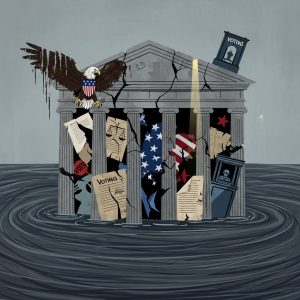
For much of modern history, we have imagined that the death of a democracy occurs in spectacular fashion: at the hands of men with guns, through military coups, or by the sudden declaration of martial law. But since the end of the Cold War, a new and dangerously deceptive pattern has emerged. Today, democracies most often die at the hands of elected leaders—presidents or prime ministers who use the very institutions of democracy to subtly, and often legally, subvert the process that brought them to power. As the United States navigates an era of unprecedented political instability, it has become clear that the American system is highly vulnerable to this slow erosion.
Many Americans take comfort in the U.S. Constitution, believing that its Madisonian system of checks and balances is robust enough to thwart demagogues and contain autocratic ambitions. However, constitutions are inherently incomplete; they cannot anticipate every contingency or constrain every abuse of power through written law alone. Historically, the American system of checks and balances has functioned not just because of its constitutional design, but because it has been reinforced by two vital unwritten norms: mutual toleration and institutional forbearance.
Mutual toleration is the collective understanding that competing parties accept one another as legitimate rivals. It is the recognition that even if political opponents hold ideas deemed foolish or wrong-headed, they are not treasonous, subversive, or an existential threat to the nation. Institutional forbearance is the idea that politicians should exercise patient self-control and restraint in deploying their institutional prerogatives. It means avoiding actions that respect the letter of the law but obviously violate its spirit. Like players in a pickup basketball game who know not to endlessly commit intentional fouls just because there are no referees, politicians with forbearance eschew dirty tricks in the name of preserving the democratic system.
For most of the twentieth century, these soft guardrails protected American democracy from devolving into a no-holds-barred conflict. However, driven by extreme partisan polarization—fueled by deep-seated racial, cultural, and religious divisions—these unwritten norms have rapidly unraveled. When societies become so deeply divided that political parties represent mutually exclusive worldviews, stable partisan rivalries give way to perceptions of mutual threat.
When politicians view their rivals as mortal enemies, the stakes of elections become apocalyptic, and the temptation to abandon forbearance becomes irresistible. This results in “constitutional hardball”—a form of institutional combat where politicians play by the rules but push them to their absolute limits to permanently defeat rivals, without caring if the democratic game survives. A prime example of this was the Senate’s unprecedented refusal in 2016 to even consider President Barack Obama’s nomination of Merrick Garland to the Supreme Court, effectively stealing a Court seat and trampling a norm that had stood since Reconstruction.
Stripped of these protective guardrails, the political system becomes highly susceptible to executive overreach. Frustrated by legislative gridlock and partisan obstruction, presidents increasingly turn to unilateral action, transforming the executive branch into a “constitutional battering ram”. For a demagogue or a would-be authoritarian, the immense administrative and war-making capacities of the presidency present an opportunity to govern by fiat.
To consolidate their power, elected autocrats typically follow a specific playbook: they attempt to capture the referees, sideline key opponents, and rewrite the rules of the game. By capturing neutral “referees”—law enforcement, the Department of Justice, intelligence agencies, and the courts—a leader secures a shield against investigations while simultaneously gaining a weapon to selectively punish political enemies. This politicization of the justice system creates a climate of fear, forcing critics and civil servants into self-censorship. Presidents may also lash out at the press, branding them the “enemy of the people” to delegitimize independent oversight and create a state of unreality where only the leader’s words are trusted.
Tragically, the American judiciary, intended to be the ultimate check on executive overreach, has increasingly enabled it. The Supreme Court has systematically dismantled frameworks that protect democratic representation. In cases like Shelby County, the Court gutted the heart of the Voting Rights Act, enabling a new wave of targeted voter suppression. In Rucho v. Common Cause, the Court ruled that partisan gerrymandering was a “political question” beyond the reach of federal courts, giving lawmakers a free pass to draw election maps that lock in minority rule. Most alarmingly, the Court recently granted the president sweeping absolute immunity from criminal prosecution for “official acts” (Trump v. United States), effectively placing the executive above the law and removing a critical deterrent against the corrupt use of presidential power.
This erosion of norms and the unchecked expansion of executive power paved the way for direct assaults on the democratic process itself, most notably the refusal to accept the results of the 2020 election and the subsequent violent attack on the U.S. Capitol on January 6th. Former intelligence officials and political scientists now warn with “moderate to high confidence” that the United States is on a trajectory toward “competitive authoritarianism”—a system where elections are held and courts function, but the ruling party systematically abuses state power to stifle dissent and permanently tilt the playing field.
American democracy’s survival is not guaranteed by the parchment of the Constitution alone. Unless political leaders and citizens can restore the essential norms of mutual toleration and institutional forbearance, the United States risks completing a slow, legalistic descent into autocracy.