
The modern conflict between the United States and Iran is rooted in decades of profound animosity and proxy warfare. In 1953, the CIA orchestrated a coup to overthrow Iran’s democratically elected Prime Minister Mohammad Mosaddegh after he nationalized the country’s oil industry, installing the autocratic Shah who was highly favorable to Western interests. Resentment over this intervention culminated in the 1979 Islamic Revolution, which ousted the Shah, established a hardline theocracy, and sparked a traumatic hostage crisis at the American embassy. For the next forty years, the two nations engaged in a bitter shadow war.
A brief window of diplomatic resolution appeared in 2015 when the Obama administration brokered the Joint Comprehensive Plan of Action (JCPOA), a landmark agreement that lifted economic sanctions in exchange for strict international monitoring to prevent Iran from developing nuclear weapons. However, during his first term in 2018, President Donald Trump unilaterally withdrew the United States from the deal, reimposing a “maximum pressure” strategy of crippling economic sanctions. Freed from international oversight, Iran resumed its nuclear enrichment program at full speed.
During Trump’s second term, this escalating standoff finally erupted into direct military confrontation. In June 2025, the U.S. and Israel executed “Operation Midnight Hammer,” a joint strike using B-2 stealth bombers to attack fortified Iranian nuclear facilities. While Trump boasted in his February 2026 State of the Union address that the U.S. had successfully “obliterated” Iran’s nuclear program, intelligence assessments indicated the strikes had only set the program back temporarily. Meanwhile, the Iranian regime was ruthlessly suppressing a massive wave of domestic anti-government protests, massacring thousands of its own citizens.
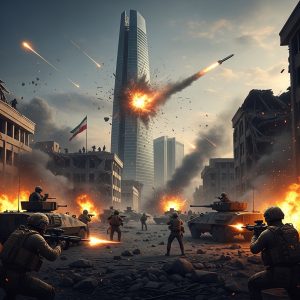
In the early hours of February 28, 2026, President Trump initiated “Operation Epic Fury,” a massive, unprovoked bombardment of Iran coordinated alongside Israeli forces. Utilizing drones, missiles, and hundreds of Israeli fighter jets, the surprise attack targeted Iranian military installations, government sites, and leadership compounds. The strikes successfully assassinated several top Iranian officials, most notably Supreme Leader Ali Khamenei and security chief Ali Larijani. In a video statement, President Trump explicitly indicated that the goal of the invasion was regime change, urging the Iranian people to overthrow their government and claiming the U.S. was eliminating an “imminent threat”.
Crucially, President Trump launched this massive war without seeking authorization from Congress, informing lawmakers only after the bombing had already begun. The administration attempted to legally justify the offensive under the President’s Article II powers as Commander-in-Chief, stretching the definition of “self-defense” to claim that Iran’s nuclear ambitions constituted an imminent danger. Critics and international law experts fiercely condemned the attack as an illegal war of aggression, noting that an anticipatory first strike aimed at regime change constitutes a flagrant violation of the U.S. Constitution’s Declare War Clause and international law.
The strategic fallout from the invasion was catastrophic. Instead of capitulating, the Iranian regime proved remarkably resilient and launched a fierce retaliatory campaign of missile and drone strikes against Israel, U.S. military bases in Iraq and Jordan, and American-allied Gulf states.
Most devastatingly, Iran immediately moved to close the Strait of Hormuz, the narrow maritime chokepoint through which approximately 25 percent of the world’s seaborne oil and 20 percent of its liquefied natural gas must pass. In response, the U.S. Navy blockaded Iranian ports, creating a chaotic “dual blockade” that severely disrupted global trade. The resulting energy crisis triggered a worldwide economic shock; oil and gas prices surged, global financial markets plummeted, and the head of the International Energy Agency described the situation as the “greatest global energy security challenge in history”.
As the war bogged down into a bloody stalemate and the U.S. faced mounting domestic and international backlash, President Trump’s rhetoric grew increasingly apocalyptic. Frustrated by Iran’s refusal to unconditionally surrender and reopen the Strait of Hormuz, Trump took to his Truth Social platform on April 7, 2026, threatening that if Iran did not yield, “a whole civilization will die tonight, never to be brought back again”. This threat to utilize disproportionate force against civilian populations drew widespread horror, with human rights organizations warning that the President was casually threatening genocide.
The following day, on April 8, 2026, a fragile and temporary ceasefire was brokered through diplomatic backchannels in Islamabad, Pakistan. The agreement was meant to pause hostilities and reopen the Strait of Hormuz, but it almost immediately broke down into disputes over Iran attempting to charge exorbitant tolls for commercial shipping.
The 2026 Iran War stands as a terrifying testament to the realization of the unchecked “imperial presidency.” By bypassing the legislative branch to unilaterally launch a major war of choice, executing foreign heads of state, and threatening the annihilation of an entire civilization, the executive branch demonstrated that the traditional constitutional guardrails designed to prevent monarchical war-making had completely failed. The conflict not only destabilized the global economy but further entrenched the United States in a state of permanent, unaccountable warfare.