

On September 8, 2025, the Department of Homeland Security (DHS) initiated a massive and highly controversial surge of federal forces into the greater Chicagoland area under the operational designation Operation Midway Blitz. Ostensibly launched to “target the criminal illegal aliens” whom the Trump administration claimed were exploiting local sanctuary policies, the operation surged Immigration and Customs Enforcement (ICE) and Customs and Border Protection (CBP) agents into local communities. In practice, the sweep resulted in the violent arrests of immigrants who had resided peacefully in the United States for decades, the vast majority of whom possessed no criminal records. This aggressive, militarized campaign immediately ignited intense, sustained public backlash, transforming local neighborhood streets and federal detention facilities into volatile battlegrounds over human rights, civil liberties, and the constitutional limits of executive power.
The Militarization of Chicago and Judicial Intervention
As the operations unfolded across Chicago’s working-class neighborhoods, the tactics utilized by federal agents sparked widespread terror and condemnation. On September 29, 2025, DHS deployed Blackhawk helicopters to conduct a high-profile raid on an entire apartment complex. Throughout the city, armed and masked federal agents threw tear gas canisters into crowds, shattered car windows, dragged occupants from their vehicles, and physically assaulted peaceful demonstrators. In response to this aggressive federal footprint, U.S. District Judge Sarah Ellis intervened, finding that the reality on the ground did not match the administration’s “overheated rhetoric”. Judge Ellis issued a temporary restraining order (TRO) that prohibited federal agents from targeting journalists, ordered them to stop deploying riot-control weapons—such as rubber bullets, pepper balls, tear gas, and flashbangs—against individuals who posed no immediate threat, banned agents from tackling non-threatening civilians, and commanded all field officers to wear visible badges and body cameras.
The Broadview Detention Crisis and the October 4 Assault
The primary flashpoint of Operation Midway Blitz was an ICE processing facility located in Broadview, Illinois, a suburb of Chicago. The Broadview building had been constructed strictly for short-term processing and lacked any beds, cafeteria facilities, or adequate medical infrastructure. Nevertheless, under the administration’s policy of indefinite, comprehensive confinement, ICE utilized Broadview’s three small holding cells to incarcerate hundreds of immigrants for days and even weeks on end. Detainees were forced to sleep on concrete floors next to overflowing toilets, denied access to legal counsel, cut off from their families, and deprived of basic medical attention and hygiene products. Furthermore, pervasive dehydration spread through the cells as ICE restricted prisoners to only three bottles of water per day.
This inhumane treatment drew a devastating federal lawsuit, and on November 5, 2025, a federal judge formally ordered the government to immediately provide detainees at Broadview with bedding, showers, food, medical care, and unhindered access to telephones and attorneys. Outside the facility, a massive, peaceful coalition of clergy and local residents maintained a constant vigil to protest the conditions. Federal forces responded with extreme hostility; on October 4, 2025, agents fired indiscriminate volleys of pepper balls, rubber bullets, and tear gas at the peaceful demonstrators, shockingly shooting a praying priest directly in the head with a pepper ball.
The Rise and Collapse of the “Broadview Six” Conspiracy Prosecution
The escalating tension at Broadview culminated in a major political and legal scandal following a demonstration on September 26, 2025. On that morning, protesters engaged in a peaceful “Jericho walk,” walking back and forth across a public crosswalk to block access to the Broadview building while local police managed the flow of traffic. An ICE agent, driving a black Ford Expedition, chose not to wait for police to clear the crosswalk and drove his vehicle directly into the crowd. Protesters surrounded the vehicle, banging on the hood and windows, resulting in minor damage, including a torn windshield wiper and the word “pig” scratched into the paint, before police safely cleared the path. The agent, who was only a few minutes late to work, later joked in group chats with colleagues that “riot control is fun” and referred to the local residents as “trash in the street”.
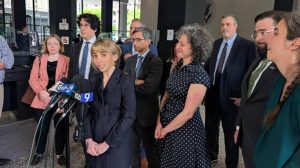
Rather than pursuing standard misdemeanor charges, the Justice Department indicted six politically prominent figures in the crowd—who came to be known as the “Broadview Six”—for felony conspiracy to impede a federal officer under 18 U.S.C. § 372 and misdemeanor assault under 18 U.S.C. § 111. The defendants included progressive congressional candidate Cat Abu Ghazale, her field director Andre Martin, Oak Park Village Trustee Brian Straw, Cook County Board candidate Katherine Sharp, Cook County Democratic Committee member Michael Rabbit, and musician Jocelyn Walsh. DHS immediately weaponized the indictment, posting images of Abu Ghazale being roughed up by police to discourage further civil disobedience.
However, the high-profile prosecution collapsed in spectacular, humiliating fashion. On May 21, 2026, U.S. Attorney Andrew Bros walked into a federal courtroom and dismissed every charge against the Broadview Six with prejudice. The unsealing of the grand jury transcripts exposed shocking, systemic prosecutorial misconduct, prompting federal Judge April Perry to declare she had never witnessed such severe abuse of the grand jury process in her career. The scandal resulted in the firing of the lead prosecutor and a formal apology from the U.S. Attorney’s Office, which subsequently faced massive judicial sanctions and civil lawsuits.
The National Guard Conflict and the Constitutional Stalemate
Parallel to the judicial battles, Operation Midway Blitz triggered a profound constitutional crisis regarding federalism and the domestic deployment of military forces. White House adviser Steven Miller publicly labeled the anti-ICE protests an “insurrection”, while President Trump threatened to deploy troops “everywhere” on American streets and called for the arrests of Illinois Governor J.B. Pritzker and Chicago Mayor Brandon Johnson for defending the state’s sanctuary laws. On October 4, 2025, Secretary of Defense Pete Hegseth issued a memo demanding the federalization of 300 members of the Illinois National Guard to protect federal ICE personnel.
The state of Illinois immediately sued to block the order, and on October 10, 2025, Judge April Perry issued a temporary restraining order barring the federalization. Judge Perry ruled that the statutory preconditions of 10 U.S.C. § 12406—which require a factual showing of a foreign invasion, a domestic rebellion, or an executive inability to enforce federal laws with conventional forces—were entirely unmet. She pointed out the extreme contradiction in the administration’s legal theory: the executive branch could not credibly claim it was “unable” to execute federal laws while simultaneously issuing constant press releases boasting of the immense success of its Midway Blitz campaign. Although the Seventh Circuit later issued a partial stay allowing the Guard to be federalized, it explicitly prohibited them from being deployed into Chicago’s streets.
The Legislative Resistance: The Ban Warehouse Detention Act
The fallout from Operation Midway Blitz extended to the halls of Congress, where lawmakers moved to dismantle the physical infrastructure of the administration’s mass detention policies. In April 2026, investigations revealed that ICE was actively scouting, purchasing, and planning to convert approximately 23 commercial warehouses nationwide into makeshift immigration prisons. This plan aimed to rapidly expand the daily detention capacity of the United States to a historic high of 92,600.
In direct response to these revelations and the inhumane conditions exposed at the Broadview facility, Congressman Jesús “Chuy” García of Illinois, alongside Congresswomen Rashida Tlaib and Delia Ramirez, introduced the Ban Warehouse Detention Act on April 23, 2026. Backed by fifteen members of Congress, the legislation sought to prohibit DHS and ICE from establishing, operating, expanding, or renovating any warehouse-like structure for the purposes of detaining human beings, while legally barring the executive branch from inventing new, unconstitutional detention models. The legacy of Operation Midway Blitz and the battle over Broadview stands as a stark and sobering reminder of the fragile vulnerability of the constitutional rule of law, demonstrating the profound crises of civil rights, federal overreach, and institutional trust that occur when the machinery of the state is mobilized to prosecute civil dissent.