

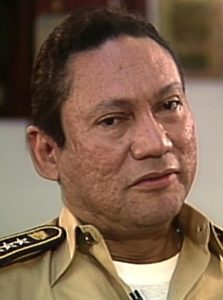
The complex relationship between General Manuel Noriega and the United States was historically defined by deep-seated cold war priorities that eventually gave way to a violent, direct confrontation. For nearly two decades, Noriega was a highly valued anti-communist asset in Central America, operating on the Central Intelligence Agency’s payroll since at least 1972 and earning over $100,000 annually. During George H.W. Bush’s tenure as Director of Central Intelligence in 1976 and 1977, the future president personally protected the Panamanian strongman. Although Noriega’s regime was notoriously corrupt, brutal, and authoritarian, successive American administrations systematically overlooked his misdeeds because of his geopolitical usefulness. Noriega cooperated with the CIA in numerous ways, offering Panama as a secure training and staging area for the counterrevolutionary Contras fighting the Marxist Sandinista government of Nicaragua, meeting with Colonel Oliver North to plan sabotage operations, and utilizing Panamanian banks to launder drug money that directly subsidized these covert operations. In June 1985, Noriega even met with North and offered to coordinate direct sabotage and assassinate the entire Sandinista leadership in exchange for the United States helping to clean up his increasingly tarnished public image.
By 1987, however, Noriega’s strategic usefulness to Washington had expired. His direct complicity in the international drug trade became public knowledge, culminating in his 1988 indictment by federal grand juries in Florida on charges of smuggling drugs. Furthermore, as sovereignty over the strategically vital Panama Canal was scheduled to transition fully to Panamanian control in the year 2000 under the terms of the 1977 Carter-Torrijos treaties, defense planners grew deeply alarmed that Noriega’s erratic behavior, money laundering, and drug cartel ties would directly threaten the canal’s operational security. In response, the Reagan and Bush administrations implemented tight economic sanctions and diplomatic isolation to force Noriega to step down. These measures failed, prompting Noriega to clamp down harder on political opponents—even forcing civilian President Nicolas Barletta to resign after the brutal murder of critic Dr. Hugo Spadafora—and rig the 1989 elections. On December 15, 1989, the Panamanian National Assembly, under Noriega’s control, passed a resolution declaring that a state of war existed between Panama and the United States.
The immediate trigger for direct military intervention occurred on December 16, 1989, when Panamanian soldiers shot and killed U.S. Marine Lieutenant Robert Paz at a checkpoint near Noriega’s headquarters. Shortly after, a Navy lieutenant and his wife were detained and harassed at the same roadblock, where the lieutenant was kicked in the groin and brutally assaulted. Upon receiving briefings on these events from Defense Secretary Dick Cheney and Joint Chiefs Chairman Colin Powell, President George H.W. Bush declared “We’ve had enough,” ordering a major combat operation on the afternoon of Sunday, December 17. Bypassing congressional authorization and opting not to invoke the War Powers Act, President Bush legally justified the operation as an act of self-defense to protect the lives of American citizens, capture an indicted drug fugitive, restore democratic institutions, and safeguard the Panama Canal under the terms of the canal treaties.
On December 20, 1989, the United States launched Operation Just Cause, unleashing a massive force of roughly 26,000 to 28,000 troops and over 300 advanced aircraft. The Panamanian Defense Forces quickly folded under the overwhelming weight of the assault, prompting Noriega to flee and seek sanctuary inside the Apostolic Nunciature—the Vatican embassy in Panama City. To force his surrender, American forces surrounded the nunciature and launched a relentless campaign of psychological warfare. They blasted deafening rock music—including “I Fought the Law” by The Clash, “Welcome to the Jungle” by Guns N’ Roses, “You Shook Me All Night Long” by AC/DC, and “Never Gonna Give You Up” by Rick Astley—while revving armored vehicle engines and bulldozing adjacent fields. After nearly two weeks of this auditory and psychological siege, Noriega finally surrendered to the U.S. military on January 3, 1990, and was immediately extradited to Florida to face trial.
While the Pentagon celebrated the swift victory, the human toll of the invasion was severe, particularly for Panamanian noncombatants. Densely populated neighborhoods in Panama City were heavily bombarded, leaving 14,000 people homeless. While the U.S. military suffered 23 deaths and 322 wounded, the Commission for Human Rights in Panama estimated that at least 3,000 Panamanian civilians were killed. Although a new, pro-American president was quickly installed—holding weekly breakfasts with U.S. Ambassador Deane Hinton to make key national decisions—poverty and unemployment remained rampant, and the removal of Noriega failed to halt the flow of illicit narcotics through Panama.
Ultimately, the legacy of Operation Just Cause reached far beyond the borders of Panama. Secretary of State James Baker III noted that the quick, high-tech victory broke the restrictive “mindset of the American people about the use of force in the post-Vietnam era,” creating the emotional predicate necessary to build public support for the subsequent Gulf War. Operation Just Cause stood as the first military intervention of the post-Cold War era. Unlike previous conflicts in Central America, it was not fought under the guise of stopping communism or protecting falling dominoes. Instead, it signaled a new doctrine of “democratic intervention” and high-tech, rapid-deployment warfare, demonstrating that former U.S. intelligence assets could swiftly be cast aside once they became a liability to regional stability.