

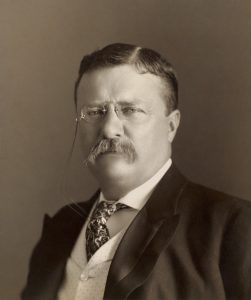
To fully comprehend the seismic shifts in modern American politics—the rise of the “unitary executive,” the desperate struggle between democratic institutions and billionaire plutocrats, the transformation of the presidency into a ceaseless media spectacle, and the terrifying realities of an American empire that polices the globe—one must look to the twenty-sixth president.
When William McKinley was assassinated in 1901, the conservative establishment was terrified. Mark Hanna, the quintessential political boss, had reportedly warned against putting Theodore Roosevelt on the ticket, crying, “Don’t you realize that there’s only one life between that madman and the White House?”. Hanna’s fears were justified. Roosevelt’s ascension marked the definitive end of the nineteenth-century republic and birthed the modern, muscular, and inherently dangerous American presidency. As the historian Henry Adams famously observed, Roosevelt possessed a primitive, elemental energy: “he was pure act”. He was the architect of the modern executive branch, providing a profound historical mirror for our current constitutional crises.
The “Stewardship Theory” and the Unitary Executive As we discussed regarding the recent Supreme Court rulings that dismantled independent agencies to give the president absolute control, modern executives rely on the “unitary executive theory.” Theodore Roosevelt was the intellectual grandfather of this concept, operating under what he called the “stewardship theory” of the presidency.
Before Roosevelt, most presidents (with the exceptions of Jackson and Lincoln) believed they could only execute powers explicitly granted to them by the Constitution or Congress. Roosevelt inverted this entirely. He argued that the executive was the steward of the public welfare, and therefore the president was legally permitted to do anything the needs of the nation demanded, unless the Constitution explicitly forbade it.
This breathtaking assumption of power allowed him to bypass a sluggish, conservative Congress. When negotiations over building a canal across Central America stalled, Roosevelt did not wait for legislative permission; he tacitly supported a revolution in Panama, deploying American warships to prevent Colombia from putting down the rebellion. He later boasted of his unilateral action: “I took the Isthmus, started the canal and then left Congress not to debate the canal, but to debate me”. He expanded the power of the Oval Office to monarchical dimensions, creating a permanent precedent: a determined president can reshape the globe through raw executive action, daring the coordinate branches of government to stop him.
The “Square Deal” vs. The Plutocrats Modern America is currently paralyzed by a second Gilded Age, where mega-corporations, private equity firms, and billionaire oligarchs exert terrifying control over the economy and the political system. Roosevelt faced the exact same crisis. In 1901, men like J.P. Morgan and John D. Rockefeller had consolidated the nation’s wealth into massive, unaccountable monopolies.
Roosevelt was not a socialist; in fact, he loathed radicalism and feared “mob rule”. He was an aristocratic conservative who realized that if the government did not curb the greed of the plutocrats, the working class would eventually launch a violent, socialist revolution. He sought to establish a “Square Deal”, arguing that the government must be the supreme power in the country, superior to any corporation.
To the shock of Wall Street, Roosevelt used the Sherman Antitrust Act to break up J.P. Morgan’s massive railroad monopoly, the Northern Securities Company. Morgan, accustomed to the subservience of politicians, traveled to the White House and complained as one sovereign to another, asking Roosevelt to have his attorney general meet with Morgan’s lawyers to “fix it up.” Roosevelt refused, proving that the American Republic could not be bought. He recognized what modern politicians frequently forget: the only force strong enough to protect the citizen from the “tyranny of mere wealth” is a powerful, uncompromising federal government.
The Master of Media and the Bully Pulpit Roosevelt also invented the modern, media-driven presidency. He understood that “the executive spirit comes first” and that a president’s greatest weapon is public opinion. He referred to the White House as a “bully pulpit”.
Long before Twitter or television, Roosevelt dominated the news cycle by manufacturing spectacle. He timed his announcements for maximum press exposure, coined unforgettable slogans, and allowed his personality to permeate every aspect of American culture. When he refused to shoot a captive, stunned bear on a hunting trip, a cartoonist immortalized the moment, inadvertently launching the global industry of “Teddy Bears”. He was the first president to become a true celebrity, recognizing that in a mass democracy, the leader who controls the cultural narrative controls the political reality.
The Brownsville Outrage and the Danger of Executive Arrogance Yet, Roosevelt’s belief in his own supreme righteousness also produced the darkest, most tyrannical moment of his presidency—a stark warning about the dangers of unchecked executive discretion.
In 1906, in Brownsville, Texas, a mysterious midnight shooting resulted in the death of a white bartender. Townspeople blamed the Black soldiers of the Twenty-Fifth Infantry stationed nearby. Despite a complete lack of evidence, no trial, and no due process, President Roosevelt acted on his own racial prejudices and absolute executive authority. He summarily discharged 167 Black soldiers “without honor,” barring them forever from military or civil service.
Among those ruined were men holding the Medal of Honor and veterans like First Sergeant Mingo Sanders, who had literally shared his rations with Colonel Roosevelt in Cuba during the Spanish-American War. When the Black community and civil rights leaders expressed outrage, Roosevelt’s response was chillingly autocratic: “The order in question will in no way be rescinded or modified… I can only say that I feel the most profound indifference to any possible attack which can be made on me in this matter”. Brownsville stands as a permanent, tragic reminder: when a president is convinced of his own infallibility and operates under the theory that his power is absolute, the civil rights of vulnerable minorities are the first to be crushed.
The Global Empire and the Big Stick Finally, Roosevelt fundamentally altered America’s relationship with the world. He famously claimed to “Speak softly and carry a big stick”. Under his command, the United States abandoned its historical reluctance for foreign entanglements and embraced its role as a global empire.
He issued the “Roosevelt Corollary” to the Monroe Doctrine, essentially declaring that the United States had the right to act as an “international police power” in the Western Hemisphere, intervening in the domestic affairs of Latin American countries to maintain order. He vastly expanded the U.S. Navy and sailed the “Great White Fleet” around the world to project American dominance. Yet, paradoxically, he was a brilliant, highly pragmatic diplomat who won the Nobel Peace Prize for mediating the end of the Russo-Japanese War. He proved that global peace often requires the active, heavily armed mediation of a superpower.
Conclusion Theodore Roosevelt left office in 1909, but he could not stay away, eventually splitting the Republican Party in 1912 by running as a third-party “Bull Moose” candidate. His life forces us to confront the ultimate paradox of the modern executive branch. Roosevelt saved American capitalism from the robber barons, championed the conservation of millions of acres of wild lands, and elevated the United States to a world power.
But in doing so, he shattered the cautious, restrained system designed by the Founders. He proved that an executive armed with immense popular appeal, boundless energy, and the “stewardship theory” of constitutional law can bend the entire government to his will. We live today in the shadow of Theodore Roosevelt’s White House. He taught the American public to look to the president—not Congress—as the savior of the republic, creating a towering, imperial office that is capable of magnificent reform, but equally capable of tyrannical overreach.