

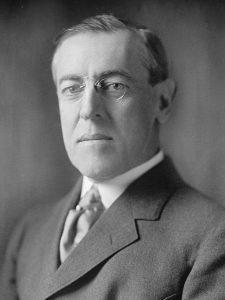
To understand the profound contradictions of the modern American presidency—the tension between democratic ideals and autocratic realities, the terrifying vulnerability of the executive branch to the physical incapacitation of the commander in chief, and the dark paradox of a government that fights for freedom abroad while crushing civil liberties and racial equality at home—one must confront the legacy of the twenty-eighth president, Woodrow Wilson.
Wilson’s ascent to power was breathtakingly rapid; just two years before entering the White House in 1913, he had never held or run for public office. He remains the only professional academic and the sole holder of a Ph.D. to ever become president, having previously served as the president of Princeton University. Overcoming childhood dyslexia that prevented him from reading until the age of twelve, Wilson fashioned himself into an unparalleled intellectual force and arguably the most articulate politician since Thomas Jefferson. Yet, his administration serves as a profound historical warning about the dangers of a messianic executive, a shadow government, and the catastrophic costs of ideological hubris.
The Prime Minister President and the “New Freedom” Unlike his predecessor William Howard Taft, who believed the executive was strictly limited by the Constitution, or Theodore Roosevelt, who believed the president was a steward who could do whatever the nation demanded, Wilson believed in “party government”. He admired the British parliamentary system and essentially functioned as an American prime minister. Shattering a precedent that had stood since John Adams in 1800, Wilson boldly traveled to Capitol Hill to address Congress in person to demand legislative action.
Operating under his “New Freedom” platform, Wilson proved to be one of the most effective legislative presidents in American history. In his first term alone, he successfully pushed through the creation of the Federal Reserve, the Federal Trade Commission, the Clayton Antitrust Act, the first permanent graduated income tax, and the first federal laws mandating an eight-hour workday and restricting child labor. He also successfully appointed Louis Brandeis, the first Jewish justice, to the Supreme Court. Through sheer force of intellect and political discipline, Wilson proved that a highly organized executive could entirely dominate the legislative branch to remake the American economy.
The Segregated State and the War on Dissent However, Wilson’s progressive idealism harbored a dark, exclusionary rot. Born in Virginia to a Presbyterian minister who had authored a pamphlet defending slavery, Wilson never entirely shook off the racial prejudices of the Confederacy. In his five-volume History of the American People, Wilson explicitly defended the motives of the Ku Klux Klan, arguing that the white supremacist terror group acted out of a “mere instinct of self-preservation” to protect the South.
Once in the White House, Wilson actively betrayed African Americans. Despite his visionary pretensions, Wilson permitted his cabinet secretaries to officially segregate the federal workplace and actively reduce the number of Black Americans employed in the civil service. He paternalistically viewed nonwhites as “children” who required “training” before they could govern themselves, effectively bringing Jim Crow to the nation’s capital.
This authoritarian streak extended terrifyingly to civil liberties during World War I. Under Wilson’s watch, the administration committed egregious constitutional violations, pushing for the Espionage Act to punish dissident opinions and allowing the postmaster general to indiscriminately ban left-wing and dissenting publications from the mail. The president who championed democracy abroad willingly acquiesced to his attorney general’s crackdown on radical labor unions and the mass arrests of the ensuing “Red Scare”.
The Secret Path to War and “America First” When World War I erupted in Europe, Wilson initially championed strict neutrality. In 1915, he urged the public to exercise “self-mastery,” ironically coining the motto “America First” to argue that the United States must remain neutral to act as the world’s moral arbiter. Even after a German U-boat sank the British ocean liner Lusitania, killing 128 Americans, Wilson refused to declare war, controversially declaring, “There is such a thing as a man being too proud to fight”. He successfully won reelection in 1916 on the popular slogan, “He kept us out of war”.
Yet, behind the scenes, a shadow diplomacy was at work. Wilson was heavily dependent on his closest advisor, Colonel Edward Mandell House. Ten months before the 1916 election, Colonel House negotiated a secret agreement with England and France on Wilson’s behalf, pledging that the United States would intervene on the side of the Allies. Wilson and House recognized that a long and bloody war might be the only way to condition the American public to accept a new world government, and they knew that by loaning massive amounts of money to the Allies, the U.S. could dictate the terms of peace.
When unrestricted German submarine warfare forced his hand in April 1917, Wilson went before Congress to demand a declaration of war. In the most famous phrase of his life, he declared, “The world must be made safe for democracy”.
The Stroke and the Audacious Cover-Up Wilson’s ultimate tragedy occurred after the war, during his desperate crusade to force the Senate to ratify the Treaty of Versailles and join the League of Nations. Exhausted by the Paris Peace Conference and a grueling nationwide speaking tour, the president suffered a massive stroke on October 2, 1919, which paralyzed the left side of his body and left him completely incapacitated.
What followed was a constitutional crisis and a brazen political cover-up that rivals any scandal in American history. Rather than resigning or transferring power to Vice President Thomas Marshall, Wilson’s inner circle hid the president away. The White House physician, Dr. Cary T. Grayson, lied to the public, claiming the president merely suffered from “nervous exhaustion”.
For the remaining seventeen months of his presidency, the executive branch was effectively hijacked by his second wife, Edith Wilson. She acted as a shadow president, screening every document and deciding what few matters her husband would see. Papers were returned to the government with notes written in Edith’s handwriting, not the president’s. The Vice President was not allowed to see Wilson until the day they left office. Deprived of Wilson’s active leadership and political maneuvering, the Senate rejected the Treaty of Versailles, dooming American participation in the League of Nations.
Conclusion Woodrow Wilson left office in 1921 as a broken man, his presidency having descended into an inglorious, secretive twilight. He fundamentally modernized the American state, proving that a brilliant executive could master Congress to enact sweeping economic reforms. Yet, his legacy is a terrifying testament to the dangers of executive arrogance. He proved that a president convinced of his own moral righteousness can effortlessly sacrifice the civil rights of minorities, crush domestic dissent, and plunge the nation into global conflicts, all while a secretive inner circle shields his ultimate frailties from the American people.