

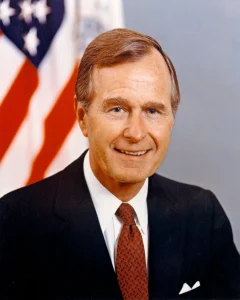
To understand the defining geopolitical and domestic transitions of late twentieth-century American democracy—the peaceful conclusion of the Cold War, the management of German reunification, the projection of international coalition power in the Persian Gulf, the delicate balance between fiscal realism and party orthodoxy, and the twilight of the World War II “Great Generation” in executive leadership—one must examine the forty-first presidency of George Herbert Walker Bush. Serving as chief executive from 1989 to 1993, Bush occupied a unique historical threshold. He was neither an ideological revolutionary nor a populist performer, but a seasoned, results-oriented guardian who viewed public service as a solemn, moral obligation. His four years in the White House witnessed some of the most profound international transformations in modern history, yet his principled willingness to place fiscal health above political self-preservation ultimately triggered a conservative backlash that cut his presidency short.
Born in 1924 into a prominent, civic-minded New England family—the son of Connecticut Senator Prescott Bush—George H. W. Bush was raised under a strict family code that emphasized duty, competition, personal modesty, and a fierce aversion to self-aggrandizement. On his eighteenth birthday in 1942, he enlisted in the United States Navy, becoming the youngest aviator in naval history. While flying a TBM Avenger torpedo bomber off the aircraft carrier USS San Jacinto in September 1944, his plane was struck by Japanese anti-aircraft fire over the Pacific island of Chichi Jima. Despite his aircraft being engulfed in flames, Bush completed his bombing run on an enemy radio station before parachuting into the ocean, where he was rescued by a U.S. submarine. Following his decorated military service and graduation from Yale University, Bush eschewed comfortable Wall Street opportunities and moved his young family to West Texas, co-founding the Zapata Off-Shore Company and building a successful career in the oil industry.
Driven by a hunger to serve and excel in the public arena, Bush constructed one of the most impressive administrative résumés in American political history. After serving two terms in the House of Representatives representing Houston, he was appointed U.S. Ambassador to the United Nations by President Richard Nixon. In 1973, during the height of the Watergate crisis, Bush assumed the chairmanship of the Republican National Committee, maintaining his personal integrity while steadying a demoralized party. He subsequently served as chief of the U.S. Liaison Office in Beijing during the early opening to China and as Director of Central Intelligence under President Gerald Ford, restoring morale and public trust to a deeply troubled intelligence agency. After mounting a formidable primary campaign against Ronald Reagan in 1980, Bush served for eight years as a intensely loyal vice president, quietly mastering the inner mechanics of White House governance and international diplomacy.
In the 1988 presidential campaign, seeking to succeed Reagan, Bush faced intense skepticism from conservative hardliners who doubted his ideological purity, while critics derided his loyal style as that of a political “cheerleader”. Guided by campaign manager Lee Atwater and media strategist Roger Ailes, Bush ran a tough, disciplined campaign against Democratic nominee Michael Dukakis, framing the election around national security, law enforcement, and traditional patriotism. At the Republican National Convention in New Orleans, Bush delivered a historic acceptance speech written by Peggy Noonan, calling for a “kinder, gentler nation” and extolling the power of voluntary community organizations as a “thousand points of light”. To solidify his support among economic conservatives, Bush issued an absolute, unambiguous pledge: “Read my lips: no new taxes”. He won the election in an electoral landslide, becoming the first sitting vice president to be elected to the presidency since Martin Van Buren in 1836.
Upon taking office in January 1989, President Bush brought a calm, consultative, and deeply pragmatic approach to the Oval Office. In his inaugural prayer, he asked to “use power to help people,” viewing governance not as a vehicle for grand sweeping theories, but as a daily practice of sound administration and crisis management. This prudent stewardship proved essential as the post-World War II international order collapsed with breathtaking speed. When the Berlin Wall fell on November 9, 1989, signalling the end of East German communist rule, domestic critics demanded that Bush deliver a triumphant, celebratory speech. Bush stubbornly refused to “dance on the wall,” recognizing that public gloating would humiliate Soviet General Secretary Mikhail Gorbachev, strengthen hardline revanchist military forces in Moscow, and jeopardize delicate negotiations. Through quiet, masterly personal diplomacy, Bush reassured European allies, managed the peaceful reunification of Germany within the NATO alliance, and navigated the ultimate dissolution of the Soviet Union in 1991 without firing a single shot.
Concurrently, Bush demonstrated a firm willingness to deploy American military force when international stability or vital interests were threatened. In December 1989, following the killing of a U.S. Marine and escalating harassment of American personnel, Bush launched Operation Just Cause, dispatching over twenty thousand U.S. troops to Panama to overthrow and capture dictator Manuel Noriega, who was under federal indictment in the United States for drug trafficking. Two years later, when Iraqi dictator Saddam Hussein launched a surprise invasion of Kuwait in August 1990, threatening global energy reserves and Gulf stability, Bush forcefully declared to reporters on the South Lawn, “This will not stand, this aggression against Kuwait”.
In responding to the Gulf crisis, Bush executed a textbook model of international coalition building. He personally contacted dozens of world leaders, assembling a 34-nation military coalition that included key Arab states and was formally authorized by the United Nations Security Council. Applying the post-Vietnam Powell Doctrine, Bush insisted on defining clear military objectives and deploying overwhelming force before taking action. Following a decisive vote of authorization from the U.S. Congress, the allied coalition launched Operation Desert Storm in January 1991. Following weeks of devastating precision air strikes, allied ground forces liberated Kuwait in a sweeping 100-hour campaign. Displaying political restraint, Bush firmly resisted calls to march on Baghdad or overthrow Saddam Hussein’s regime, recognizing that occupying Iraq would shatter the international coalition, destabilize the Middle East, and trap American forces in an unmanageable urban quagmire. In the wake of victory, Bush articulated his vision of a “New World Order” grounded in international law, collective security, and superpower cooperation, sending his public approval ratings to an unprecedented 89 percent.
On the domestic front, Bush worked with a heavily Democratic Congress to enact significant, long-lasting reform legislation. He signed the landmark Clean Air Act Amendments of 1990, introducing innovative, market-based cap-and-trade mechanisms to combat acid rain and industrial pollution. He also championed and signed the Americans with Disabilities Act (ADA) of 1990, a historic civil rights measure that prohibited discrimination against disabled citizens in employment, public accommodations, and transportation. Furthermore, his administration initiated negotiations for the North American Free Trade Agreement (NAFTA), creating the framework for economic integration across Canada, Mexico, and the United States.
However, Bush’s domestic presidency was severely damaged by compounding fiscal and economic crises. Inheriting staggering federal budget deficits generated by 1980s tax cuts and defense spending, Bush recognized that unconstrained national debt threatened the long-term economic stability of the country. In the summer of 1990, during grueling budget negotiations at Andrews Air Force Base, Bush made the courageous but politically fatal decision to break his “no new taxes” pledge, agreeing to a bipartisan compromise that combined spending caps with tax increases on high earners. Although the 1990 Budget Agreement established the structural fiscal discipline that enabled the federal budget surpluses of the late 1990s, the tax increase provoked an enraged revolt among conservative hardliners led by Congressman Newt Gingrich, who accused the president of betraying the Reagan Revolution.
The political damage from the budget deal was exacerbated by the 1990–1991 economic recession. As unemployment rose and white-collar layoffs mounted, the public experienced a painful, sluggish recovery. Bush’s natural reticence and discomfort with grand rhetorical performances left him vulnerable to charges that he was disengaged from domestic concerns. Media coverage exaggerated minor incidents—such as his illness at a Tokyo state dinner and his polite interest in a grocery checkout scanner—to portray the president as out-of-touch with ordinary working citizens. In the 1992 presidential election, Bush faced a devastating three-way political battle. He was severely bruised on the right by populist commentator Pat Buchanan during the Republican primaries, while populist billionaire Ross Perot launched a formidable third-party candidacy that peeled away millions of fiscally conservative voters. Capitalizing on economic anxiety under the famous campaign mantra “It’s the economy, stupid,” Democratic nominee Bill Clinton won the presidency with 43 percent of the popular vote, bringing Bush’s presidency to a premature end.
George H. W. Bush accepted his election defeat with profound grace and quiet stoicism, privately reflecting in his audio diary on his heartbreak while offering his full support to the incoming administration. In his post-presidential years, history was exceptionally kind to the forty-first president. Scholars and the public increasingly came to admire his steady, unsensational foreign policy, his commitment to bipartisan compromise, and his fundamental personal decency. He developed a warm, celebrated friendship with his former political rival, Bill Clinton, joining forces to raise hundreds of millions of dollars for humanitarian relief following the 2004 Asian tsunami and Hurricane Katrina. He also experienced the unique pride of seeing his eldest son, George W. Bush, elected as the forty-third president in 2000, establishing a historical legacy of public service matched only by John and John Quincy Adams.
Awarded the Presidential Medal of Freedom by President Barack Obama in 2011, George H. W. Bush passed away in November 2018 at the age of ninety-four. His life and four years in the White House represent the grand finale of an era in American statecraft. As a combat hero, diplomat, intelligence chief, and president, George H. W. Bush proved that true executive leadership lies not in fiery rhetoric or ideological dogmatism, but in the quiet, steady, and selfless willingness to put the long-term good of the nation above all else.