

Following the rapid collapse of France in May 1940, Great Britain was left to stand alone as the final democratic barrier against Nazi dominance in Western Europe. In July 1940, Adolf Hitler formally directed the German military to prepare plans for a frontal, water-borne invasion of the British Isles under the codename Operation “Seeloewe” (Sea Lion). The execution of this massive amphibious operation fell to the German General Staff, whose planning immediately exposed deep strategic divisions and logistical anxieties.
The tactical demands of launching a successful cross-Channel landing against a determined defender were unprecedentedly severe. To establish and hold secure beachheads on British soil, military planners estimated that the German army would require an initial assault force of at least 300,000 men and one million tons of equipment and supplies, quickly followed by a second wave of at least one million more men. Transporting and sustaining this gargantuan force required a massive, coordinated armada of merchant ships.
However, the actual state of German naval power in the summer of 1940 stood in stark and laughable contrast to these grand invasion requirements. The Kriegsmarine was critically weak, possessing only three cruisers and four destroyers in its entire operational arsenal. Germany completely lacked the heavy warships necessary to contest the Royal Navy, control the Channel waters, and securely effect the transport of an invasion army. Although the German General Staff worked feverishly to organize a huge flotilla of requisitioned river barges, tugs, and small commercial craft, these flat-bottomed vessels were highly vulnerable to both naval attack and Channel weather.
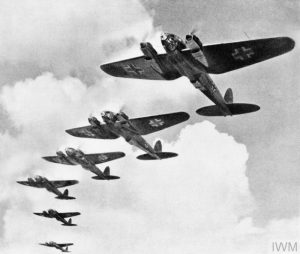
Confronted with these limitations, the German staff fell into intense vacillation and division over the feasibility of a frontal assault. The army and naval commands ultimately concluded that a sea-borne landing was a military impossibility unless the British defenses could first be completely paralyzed. Both Hitler and his generals agreed that the German Luftwaffe would have to launch a massive, preemptive air blitz—the Battle of Britain—to achieve absolute air supremacy over the Channel and southern England before any landing forces could be committed to the water.
Ultimately, the failure of the Luftwaffe to destroy the Royal Air Force shattered the foundational prerequisite for the invasion. Without control of the air, even Hitler recognized that a cross-Channel amphibious assault was a suicidal fantasy, leading to the indefinite postponement of the operation. On July 31, 1940—even as the air battle over Britain was just beginning—Hitler’s strategic focus had already turned away from the English Channel. Believing he could solve his British problem by securing a land empire in the east, Hitler bypassed his unresolved naval crisis and ordered his staff to draft operational plans to betray and invade his nominal ally, the Soviet Union.