
Following the end of World War II, foreign intelligence responsibilities were assigned to the newly established Central Intelligence Agency (CIA) under the National Security Act of 1947. However, due to intense political lobbying by the Federal Bureau of Investigation (FBI) and widespread domestic fears of establishing an oppressive “U.S. Gestapo,” the FBI was given sole responsibility for domestic internal security and counterespionage. Under its founding charter, the CIA was explicitly barred from holding any “police, subpoena, or law enforcement powers or internal security functions”. This institutional divide created immediate, enduring tensions between the CIA and the FBI. J. Edgar Hoover jealously guarded the FBI’s domestic intelligence portfolio against all rivals, even as the FBI’s domestic activities grew throughout the 1950s and 1960s. Despite these strict statutory boundaries, the CIA increasingly assisted the FBI with domestic intelligence gathering, operating on highly dubious legal bases.
Among the most secretive of these domestic initiatives was HT/LINGUAL, an illegal, classified mail-opening program run during the Cold War. Officially, the mails were legally protected, but the CIA established a clandestine arrangement with the U.S. Post Office to intercept, examine, and reinsert mail. The program was operated jointly by the CIA’s Office of Security, the FBI, and the CIA’s highly compartmented counterintelligence unit, the Counterintelligence Special Investigation Group (CI/SIG). Birch D. O’Neal, an ex-FBI agent who directed CI/SIG, had direct jurisdiction over the HT/LINGUAL project files. Within this counterintelligence apparatus, a specialized “Projects Branch” processed the intercepted information and systematically indexed the names of targets.
HT/LINGUAL was principally designed to monitor domestic dissent, track political activists, and detect potential Soviet and Chinese influence during the height of the Red Scare. The program routinely intercepted and opened first-class letters coming from or destined for the Soviet Union (USSR) and China. For example, the program targeted prominent anti-war activists, dissidents, and journalists. Before the program was eventually terminated, the CIA opened mail associated with a wide range of public figures, including future political activists such as Jane Fonda. Furthermore, the program swept up individuals suspected of foreign ties; the CI/SIG maintained an HT/LINGUAL file on former defector Lee Harvey Oswald, which was opened in 1960 under the false name “Lee Henry Oswald”.
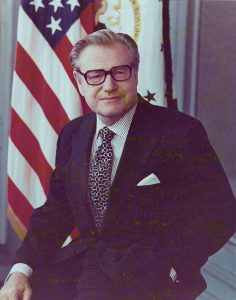
The tight shroud of official secrecy surrounding the program began to unravel in the mid-1970s in the wake of the Watergate scandal, as intense public and congressional scrutiny forced a series of sweeping investigations into domestic and foreign intelligence abuses. In late 1974, investigative journalist Seymour Hersh published a landmark front-page exposé in the New York Times revealing the CIA’s “family jewels”—a compendium of illegal and highly sensitive operations that included the surreptitious surveillance of domestic anti-war protests and the covert, unlawful opening of mail. In response to the growing public outcry, President Gerald Ford sought to pre-empt a broader congressional inquiry by establishing the Rockefeller Commission, chaired by Vice President Nelson Rockefeller, to investigate the abuses. On June 11, 1975, the Rockefeller Commission published its report, officially concluding that the CIA had carried out “plainly unlawful” domestic operations, including spying on protest groups, wiretapping, committing burglaries, and opening first-class mail.
Though the Rockefeller Commission and parallel probes by the Church and Pike committees exposed the broad outlines of the program, the exact details remained classified for decades as intelligence agencies fiercely resisted the full disclosure of their records under federal “sunshine laws”. It was not until June 2007 that the CIA finally declassified and officially released the full “family jewels” dossier. These historic documents formally confirmed the CIA’s direct, systemic involvement in various illegal domestic operations, explicitly detailing the covert opening of mail and the unlawful surveillance of journalists. HT/LINGUAL stands as a powerful historical testament to how Cold War anxieties routinely eroded constitutional protections and civil liberties on the home front.