

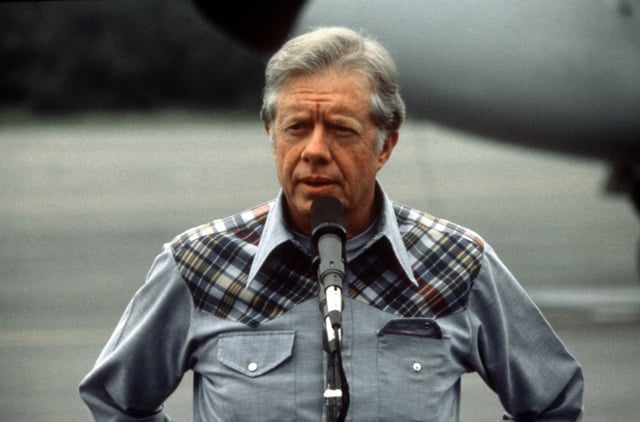
The year 1980, far from being a simple calendar transition, marked a profound inflection point in American political and economic history, culminating in a seismic shift in national leadership and a clear redefinition of governmental priorities. It was a year when accumulated discontents found their voice at the ballot box, driven by a convergence of foreign policy frustrations and relentless economic challenges that had been building throughout the preceding decade.
The Economic Tide Turns the Political Landscape
At the heart of the 1980 election lay an economy in profound distress, a continuation and exacerbation of the “stagflation” that had plagued the nation since the late 1960s. By 1979, inflation was running at almost 14 percent a year, with consumer prices rising 11 percent for the year, and unemployment around 6 percent. The oil price shocks, intensified by the Iranian Revolution in 1979, had directly led to long lines at gas pumps and fueled rampant inflation, creating a tangible sense of insecurity for many Americans. President Jimmy Carter, who had promised full employment by 1979 during his 1976 campaign and expressed less concern about inflation then, found himself increasingly “befuddled by the economic mess”. His attempts to address the issues, such as a major energy program announced in July 1979 after a retreat at Camp David, were widely criticized for blaming the public’s “crisis in spirit” rather than presidential leadership. His approval ratings plummeted.
Despite efforts by the Federal Reserve to curb rising prices by raising interest rates, the economy continued to struggle. Carter’s first budget director, Bert Lance, a fiscal conservative, resigned in 1977 due to an alleged scandal. When the Federal Reserve, under Chairman Paul Volcker whom Carter appointed in 1979, raised interest rates in response to inflation, it pushed the nation’s prime rate to 14.5 percent, sparking fears of a recession. Volcker’s deliberate policy of tightening the money supply, though ultimately successful in curbing inflation by 1982, caused an “intentional recession of surpassing severity”. The unemployment rate hovered around 6 percent through most of Carter’s term, rising to 7.5 percent by 1980. This perplexing combination of high unemployment and soaring inflation became a hallmark of his presidency.
Against this backdrop of economic malaise, former California Governor Ronald Reagan challenged Carter for the presidency in 1980. Reagan capitalized on the widespread discontent, framing the economic problems as a result of “bad leadership” rather than the public’s character. He introduced “supply-side economics,” a fiscal theory advocating for large cuts in taxes for corporations and the wealthy, claiming it would stimulate the economy and generate revenue. Reagan’s message offered “straightforward, commonsense solutions”. In contrast, Carter, perceived as “weak, rudderless, unwilling to govern”, was seen as unable to solve the nation’s problems.
The 1980 election was a decisive rebuke of Carter. Polls in the summer of 1979 had shown Senator Ted Kennedy as the “odds-on favorite” for president, presenting a challenge from within the Democratic Party. Kennedy’s campaign, however, struggled, particularly after the U.S. embassy in Tehran was taken over on November 4, 1979, just three days before his formal announcement of candidacy. Kennedy’s public criticism of the Shah and Carter for admitting him to the U.S. at a time when Americans were held hostage “sounded nearly unpatriotic”. The hostage crisis initially rallied the public around President Carter, allowing him to “fend off Kennedy’s challenge within the party” by “acting presidential”. However, as the crisis dragged on for fourteen months, remaining a prominent feature of foreign news, it, along with the persistent economic distress, was “largely responsible for Carter’s defeat”.
Reagan’s campaign effectively hammered Carter on his mishandling of both the economy and the hostage crisis. In their single televised debate on October 28, just days before the election, Reagan famously parried Carter’s criticisms with “There you go again” and concluded with the impactful question, “Are you better off than you were four years ago?”. For many Americans, the answer was a “resounding no”. Reagan’s performance projected confidence and firmness, countering Democratic portrayals of him as an “old, out-of-touch madman”. Reagan won by a landslide, taking 44 states and 51.6% of the popular vote to Carter’s 41.7%. This victory, with only 54% of eligible voters participating, meant that “27 percent voted for Reagan” out of the total eligible. It was a clear signal that “the nation wanted something new”.
The Evolving Regulatory Landscape: Deregulation Takes Hold
The concept of deregulation had a “bipartisan gestation,” with initial steps taken by the Ford administration and then “radically expanded” by Jimmy Carter’s administration. Carter’s administration launched “the first systematic efforts to reassess and ultimately eliminate to whatever extent possible federal oversight in the finance, telecommunications, and transportation sectors”. This included significant actions like the Airline Deregulation Act of 1978, which dismantled structures designed to protect small- and medium-sized towns from predatory financiers, leading to regional inequality. Carter also pursued policies such as the Paperwork Reduction Act of 1980 and the Regulatory Flexibility Act, making public rules “harder to write and enforce”. The Motor Carrier Act of 1980, signed by Carter after being pushed by Ted Kennedy, eliminated rules for trucking, transforming it from a middle-class profession into one often characterized as “Sweatshops on Wheels”.
These initiatives reflected a new type of thinking, focused on “efficiency, consumerism, and technocracy”, and were influenced by conservative ideas from the Chicago School of economics. Milton Friedman, a prominent Chicago School economist, won the Nobel Prize in 1976, and his conservative ideas were ascendant even as Republicans were losing elections. Carter’s own economic advisors, like Charles Schultze, despite being fiscally conservative, were caught between the traditional Keynesian approach and the emerging anti-inflationist sentiments. Carter’s choice of Paul Volcker, a perceived “conservative” and “candidate of Wall Street,” to head the Federal Reserve further underscored this shift, as Volcker believed that the “standard of living of the average American must decline” to combat inflation. The underlying philosophical shift in Washington was moving away from the New Deal era’s focus on public rules and market shaping towards a vision where “private concentrations of power would govern”.
Thus, the Depository Institutions Deregulation and Control Act of 1980 was not an isolated event but part of a larger, bipartisan trend that redefined the relationship between government and industry. These deregulatory moves, though often framed as promoting efficiency, would later have “profound and exceedingly costly consequences” in sectors like savings-and-loans.
Reconsidering Conservatism: A Call for Dialogue
In this era of profound political and economic reorientation, the historian William Appleman Williams suggested that the left “must in truth honor if not indeed rehabilitate the best of our conservative tradition in order to have a serious dialogue”. This statement speaks to a deeper intellectual and ideological crisis within American politics, particularly on the left, which had largely assumed the “hegemony of the New Deal order”.
Williams’s perspective underscored the idea that after the Vietnam War and the economic slump of the 1970s, many Americans, including some leaders, needed to reconsider the consequences of “empire as a way of life”. He acknowledged that conservatives, such as Nixon and Kissinger, showed “greater realism” in understanding that undermining the Soviet Union was “no longer conceivable”, contrasting this with Carter’s “extremely weak understanding of strategy and tactics”. Williams, in effect, highlighted a fundamental incongruity: while electoral politics and Washington’s power struggles dominated public discourse, a significant portion of the populace felt alienated from the political system. There was a “troubling incongruity” between the televised political drama and the reality of unresolved “fundamental problems” like economic insecurity and environmental deterioration, which no major party candidates seemed willing to address with “bold changes in the social and economic structure”.
The Democratic Party, traditionally seen as the party of the working class, had “lost the ability even to think about the problem of concentrated economic power” by the 1980s. This intellectual vacuum meant they “did not understand what was happening, hence could not oppose the process even if they wanted to”. The “new type of thinking” centered on efficiency and technocracy had taken hold across the political spectrum. Even leading Democratic thinkers began to sound “exactly like leading Republican thinkers”. The 1980 primary contest between Carter and Kennedy, though full of “intra-party recriminations,” had “little actual ideological disagreement” on these fundamental economic shifts.
Williams’s call, therefore, was not merely an academic observation but a reflection of a practical necessity for the left to find new intellectual footing and a coherent critique that could resonate with a disillusioned public. It was an acknowledgment that the “New Deal vision of benign governmental promotion of the public well-being” was fading, and a new conservative ascendancy, characterized by different ideas about economic management and the role of government, was firmly taking root. This ideological shift, combined with Reagan’s ability to articulate a clear, optimistic vision for America and project strength, particularly in foreign policy, cemented 1980 as the dawn of a new political era. The subsequent “Reagan Revolution” would implement many of the conservative ideas that had gained traction during the 1970s, facing only “minor resistance from the opposition”.
In sum, 1980 was more than an election year; it was a testament to the profound impact of economic woes and foreign policy challenges on domestic politics. It signaled a broader shift in American political thought, particularly a move towards conservative economic principles and a bipartisan acceptance of deregulation. William Appleman Williams’s observation encapsulated the intellectual and political dilemma of the time, suggesting that for any meaningful dialogue or alternative path to emerge, a deeper engagement with the evolving nature of American conservatism and its impact on the nation’s direction was imperative. The events of 1980 underscored that the “American political tradition” remained bounded by certain horizons, pushing the nation toward a future that would look “unlike any it had ever known”.