

The year 1991 stands as a complex crucible, forging the post-Cold War landscape through military interventions, economic turmoil, and significant shifts in American popular culture. It was a period that vividly demonstrated how quickly national sentiments could pivot from triumph to discontent, and how cultural expressions could both reflect and influence this dramatic evolution.
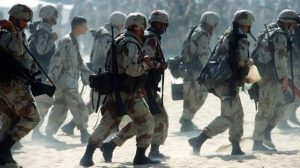
The Persian Gulf War in 1991 reflected a fundamentally different model of warfare compared to the proxy interventions that characterized much of the Cold War. While the Cold War often involved indirect support for factions in various regions, particularly in Central America and the Caribbean Basin, the Gulf War was a massive, decisive, and technologically advanced conventional conflict. The preceding invasion of Panama in December 1989, which ousted General Manuel Noriega, had been the nation’s first post-Cold War military intervention, explicitly aiming to spread democracy rather than fight communism. This intervention, though small-scale and quickly victorious, with Panamanian military offering little resistance, aimed to raise U.S. esteem after the Vietnam era. However, it was deemed too minor to fully overcome public abhorrence of foreign military engagements.
The Gulf War, triggered by Iraq’s August 1990 invasion of Kuwait, provided President George H.W. Bush with a much larger opportunity. Bush’s popularity had suffered a “plunge in public confidence”, and his administration saw a “short successful war” as “pure political gold” that could ensure his reelection. Beyond political gain, a long-standing U.S. desire to have a decisive voice in Middle East oil control was a crucial element in the decision to go to war. Despite international sanctions appearing to be effective, Bush doubled U.S. forces in the Gulf to 500,000, creating a clear offensive posture. The public narrative, however, focused on liberating Kuwait, largely ignoring other invasions where the U.S. showed less concern. The justification of Iraq building a nuclear bomb was weakly supported by evidence.
Bush, determined to go to war, rejected opportunities for negotiation. In January 1991, he sought Congressional authority for military action, which was granted, albeit with a narrow Senate vote. The air war, “Operation Desert Storm,” launched in mid-January, saw the U.S. Air Force achieve total control of the air, bombing at will. U.S. officials also maintained near-total control of the airwaves, with major networks presenting claims of “smart bombs” without question, contributing to a significant shift in public opinion from divided to about 85% support. Critiquing the war, once military action was underway, was often seen as betraying the troops. The ground assault that followed encountered virtually no resistance.
The human cost, however, was immense, with bombings causing starvation, disease, and the deaths of tens of thousands of children. A Baghdad pediatric hospital director recounted losing over 40 premature babies due to electricity outages on the first night of bombing. Yet, Saddam Hussein was left in power, not eliminated, a decision seemingly aimed at maintaining him as a balance against Iran. This also meant the U.S. did not support Iraqi dissidents or the Kurdish minority who were rebelling against Hussein. Zbigniew Brzezinski, a former National Security Advisor, noted the war’s benefits for U.S. military power and influence in the Middle East, but also warned that the intensity of the air assault might make Americans appear to view Arab lives as “worthless,” leading to an “ugly wave of anti-Arab racism” in the U.S.. President Bush famously declared that the “specter of Vietnam has been buried forever in the desert sands”, a sentiment widely echoed by the establishment press. However, alternative information networks, including newspapers and community radio stations, worked to provide critical analyses of the war, as exemplified by the dissemination of Noam Chomsky’s critique. The Gulf War set the stage for subsequent U.S. military power projections, with the Pentagon’s 1995 Nye Report authorizing the permanent basing of 100,000 U.S. troops in Japan and South Korea, signifying a continued global military presence rather than demobilization after the Cold War’s end.
Despite the overwhelming military success and initial euphoria, the period of 1991-1992 was also marked by a recession and a significant drop in President Bush’s approval rating. The economic downturn, dating to August 1990, saw major automakers suffer losses, leading to plant closures and 60,000 worker layoffs. By mid-1991, the national unemployment rate rose to 7.8%. This recession was further exacerbated by the end of the junk-bond-fueled real estate boom of the 1980s, resulting in a “jobless recovery” where jobs did not return even as the economy started growing again.
The federal deficit, reeling from the tax cuts and increased military spending of the 1980s, was rapidly approaching $300 billion by 1990, with national debt nearing $4 trillion. Despite his earlier “no new taxes” pledge, Bush agreed to a deficit-reduction package that included a tax hike, primarily for upper-income brackets. This move alienated conservative Republicans, leading to a challenge from Pat Buchanan in the 1992 primaries. While the Bush White House initially downplayed the recession, refusing to admit its existence until late 1991 and forecasting it as mild and brief, Americans felt he was out of touch with their economic anxieties. His veto of an Unemployment Insurance Reform Bill, despite being fiscally responsible, reinforced perceptions of him as a remote elitist. Consequently, Bush’s approval rating, which had soared to an unprecedented 89% in March 1991 after the Gulf War victory, plummeted to 29% by July 1992. His domestic struggles overshadowed his foreign policy successes, leading to his defeat in the 1992 election, which Bill Clinton won with the campaign tagline, “It’s the economy, stupid”.
Concurrently with these political and economic shifts, 1991 witnessed significant cultural transformations in American youth music. Post-punk, often referred to as “alternative” music by the recording industry, exploded into the cultural mainstream after having remained commercially marginal throughout the 1980s. This breakthrough was highlighted by Nirvana’s Nevermind album, which sold 3.5 million copies in the last four months of 1991 alone, with its hit single “Smells Like Teen Spirit” being hailed as a generational anthem. Grunge rock, a subgenre associated with Nirvana, even spawned its own fashion trends. Major record labels, recognizing the newfound commercial potential, rushed to sign bands previously ignored.
The sudden commercial success sparked debates about the music’s authenticity and whether it could maintain its “oppositional posture” or if it was “selling out”. The timing of this musical surge was no coincidence, as uncanny parallels were drawn between the U.S. in 1991 and British punk’s emergence in 1977, both periods marked by economic recessions. This music filled a void for youth ripe for a resurgence of rebellious expression. Nirvana’s “rage” on Nevermind was seen as implicitly rebelling against the national dialogue and reflecting an awareness of the 1991 Persian Gulf War. Indeed, one fan, upon hearing Nevermind hit number one in early 1992, presciently predicted, “Bush will not be reelected”. This proved true, as the highest number of young people since 1972 turned out to vote Bush out of office.
Furthermore, 1991 also marked the transition of hip-hop from a niche genre to the “default soundtrack for American youth regardless of racial background”. This collective shift in musical tastes and sensibilities signaled the arrival of a new cultural landscape, one that resonated with the undercurrents of economic discontent and a desire for alternative expressions in a rapidly changing world. These cultural breakthroughs, despite commercial co-optation, demonstrated consumer capitalism’s capacity to absorb “dissonant noise” while also proving the enduring appeal of an “authentic spirit of resistance”.
In summation, 1991 was a pivotal year that encapsulated the profound transformations occurring in America. The Persian Gulf War showcased a new paradigm of military intervention, moving away from Cold War proxy conflicts to high-tech, decisive conventional warfare. Yet, the military victory and its fleeting euphoria were swiftly overshadowed by a domestic recession that crippled President Bush’s popularity. Amidst this economic and political volatility, American youth culture underwent its own revolution, with alternative rock and hip-hop breaking into the mainstream, providing a soundtrack that both reflected and responded to the era’s discontents and the evolving societal landscape.