

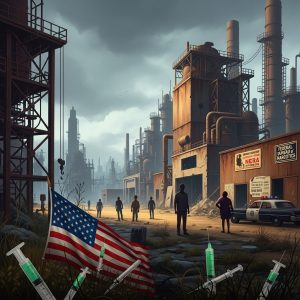
The history and enduring legacy of the “War on Drugs” in the United States present a truly revealing look at the intricate interplay between economic interests, political power, social control, and profound societal inequalities. It’s a narrative that lays bare how policies, seemingly designed for public good, can be meticulously shaped and perpetuated to serve powerful, often hidden, agendas. Robert B. Reich’s broader analysis of “Supercapitalism” finds a stark illustration in this “war,” demonstrating how widening inequality and corporate influence are not accidental but rather engineered outcomes.
This “war” is not a simple battle against illicit substances; it is, and has always been, a multifaceted conflict with shifting targets and disproportionate impacts, particularly on marginalized communities. It has, in essence, transformed into a civil war within American society itself.
The Genesis of Control: From Regulation to Racialized Prohibition
Before the federal government became deeply involved in regulating drug distribution, the 19th century saw drugs like cocaine and opium freely prescribed by doctors. However, public concern over drug abuse began to mount, leading to early restrictions, such as San Francisco’s 1875 Anti-Opium Smoking Act and the federal ban on opium importation in 1909. A pivotal moment was the 1914 Harrison Narcotics Act, which, while ostensibly regulating opiates and cocaine, often led to the arrest and jailing of physicians for practices that were deemed “beyond medical scope”.
Crucially, the roots of drug policy were deeply intertwined with racial and ethnic prejudices. Early laws targeting cocaine were fueled by racist propaganda portraying “menacing African American men,” while anti-marijuana legislation emerged amidst anti-Mexican and Mexican American sentiments. Opium laws, too, were initially directed at Chinese immigrants. This established a pattern: drug addiction and the need for punishment were often defined by “who is addicted,” with “reprobate addicts” deserving punishment over sympathy or medical support.
The Federal Bureau of Narcotics (FBN), established in 1930 and led by Harry Anslinger, marked a significant shift. Anslinger saw his mission as stamping out drug trafficking, particularly by targeting international suppliers. He aggressively expanded the federal anti-drug campaign to include marijuana in the 1930s, using inflammatory rhetoric, such as his “Assassin of Youth” articles, which linked marijuana use to violence, rape, and insanity, despite these claims not being widely believed even then. The mid-20th century saw further criminalization with acts like the Boggs Act (1951) and the Narcotic Control Act (1956), which established mandatory prison sentences and even the death penalty for certain offenses. While there was a fleeting push for a more medical approach in the 1960s, a strong emphasis on law enforcement persisted.
Nixon’s Offensive and the Escalation of Force
The modern “War on Drugs” officially began on June 17, 1971, when President Richard Nixon declared drug abuse “public enemy number one” and called for an “all-out offensive” with a significantly increased federal budget. This declaration was a direct response to a “two-front heroin ‘epidemic'” in inner cities and among American soldiers in Vietnam, and also reflected Nixon’s strong negative feelings towards the rising casual drug use among countercultural white youth.
The Controlled Substances Act (CSA) of 1970 served as the statutory framework for this war, classifying controlled substances into five schedules based on their perceived danger, abuse potential, and medical use. Initially, the CSA included provisions for treatment, but by 1974, Nixon had already begun to shift funding drastically away from treatment and towards enforcement.
The Reagan administration of the 1980s ushered in a new, even tougher era. His presidency marked the beginning of skyrocketing incarceration rates, largely due to an “unprecedented expansion of the drug war” that saw nonviolent drug law offenses increase from 50,000 in 1980 to over 400,000 by 1997. The emergence of crack cocaine, particularly in low-income Black communities, intensified public and political support for punitive measures. First Lady Nancy Reagan’s “Just Say No” campaign, while widely ridiculed today for its oversimplification, enjoyed widespread media and public support at the time. The Anti-Drug Abuse Act of 1986, influenced by figures like Congressman Charles Rangel, massively increased federal prison sentences, disproportionately targeting young Black men selling crack cocaine. The George H.W. Bush administration continued this aggressive stance, even floating the idea of capital punishment for certain drug-dealing offenses, leading to thousands of letters from the public demanding escalation, including military involvement.
The Enduring Legacy: Incarceration, Inequality, and Corporate Profit
The consequences of this prolonged “war” have been devastating and far-reaching:
- Mass Incarceration and Racial Disparity: Despite over $1.5 trillion spent and consistent drug addiction rates, the “War on Drugs” has primarily been effective at generating policies that lead to incarceration. Black Americans are nearly six times more likely than white Americans to be incarcerated for drug charges, even though both groups use drugs at similar rates. The “law-and-order” ideology, often fueled by fear and prejudice, justified the targeting and punishment of poor, Black, and other marginalized communities, making drug enforcement “a way to police” these populations. In Chicago, for instance, local institutions developed “punitive capacity” specifically to incarcerate Black residents for drug-related crimes.
- Job Insecurity and Economic Dislocation: The “War on Drugs” policies, alongside broader economic shifts towards post-industrialism, contributed to “the disappearance of neighbors, friends, and family into an aggressive criminal justice system,” and has been described as a “proxy war against people of color”. This aligns with Reich’s argument that economic insecurity is an engineered outcome, as the system effectively removes a segment of the population from the formal economy through incarceration.
- Corporate Influence and “The System”: The punitive logic of the War on Drugs has been a boon for certain economic interests. Pharmaceutical industries and political careers have been “built on the logic of a punitive War on Drugs”. Agencies and organizations at all levels of government actively “fight to keep the drug offender–to–prison pipeline flowing,” ensuring continued funding and institutional power. The “revolving door,” where government officials move to lucrative positions in the industries they once regulated, is a “recurring theme of the opioid crisis” and a “neglected feature of neoliberalism in general”. The implication here, consistent with Reich’s view, is that the system benefits a powerful few, leveraging political influence to maintain profitable structures.
- The Lucrative Underground Economy: Paradoxically, by making certain drugs illegal and attaching high risks to their sale, the “War on Drugs” created “extremely lucrative” profit margins, incentivizing a massive underground supply chain from kingpins to street dealers. Drug trafficking organizations (DTOs) like the Herrera family in Mexico constantly adapted and innovated, making them incredibly resilient to law enforcement efforts. This highlights that the “war” has not eliminated the drug market but rather reshaped it, often making it more violent.
- Global Imperialism and Foreign Policy: The US-led “War on Drugs” has also been an “exercise in hegemonic power,” extending American influence globally. US anti-drug aid and policies were often used by foreign governments for their own internal security measures and political control, as seen in Mexico’s “dirty war” against internal dissent or Afghanistan’s efforts to expand state power. This often resulted in a “balloon effect,” where successful eradication in one region merely shifted drug production and trafficking to another, demonstrating the limits of supply-side interdiction.
- Public Health vs. Criminal Justice: Despite growing recognition that drug abuse is a public health issue rather than solely a criminal one, policy largely remained punitive. The opioid crisis particularly underscores this failure: the oversupply and overprescribing of legal “white market” opioids by major pharmaceutical companies, driven by “neoliberal” policies and lax government regulation, led to a national tragedy with thousands of deaths. This demonstrates how “politicians and government regulators deliberately supported the efforts of Big Pharma to unleash highly addictive prescription opioids on other Americans, whose communities were unraveling economically”.
- “Utter Failure” in Objectives: President Barack Obama accurately summarized the “War on Drugs” as an “utter failure” in stemming addiction rates, which have remained “relatively consistent” despite massive spending. The “war” has failed to defeat its targeted enemy—tens of millions of Americans who use and supply illegal drugs.
The Shifting Sands of Cannabis and the Future of Drug Policy
Cannabis, despite being the “workhorse” powering the global drug war and accounting for the majority of drug arrests, has seen a significant shift in public perception and legal status. Debates over cannabis, once centered on the “Reefer Madness” era fears of it turning users violent, have now transformed. Legalization is increasingly framed as a public health and safety measure, often presented as a better way to protect children through regulation than prohibition.
However, the “cannabis exceptionalism” that allows for its legalization often overlooks the broader global impacts of the drug war and the harms inflicted upon cultivators worldwide. This exceptionalism risks becoming another form of “US market capture,” where the benefits of legalization flow primarily to the Global North, potentially leading to “new round of dispossession and marginalization of those in the Global South”. It highlights how racial and class disparities continue to shape drug policy, with white, middle-class users benefiting from decriminalization and legalization, while poor and non-white individuals continue to face disproportionate arrests and incarceration.
The underlying “Prison Industrial Complex” (PIC), deeply linked to the “War on Drugs” and mass incarceration, continues to thrive, with private prisons profiting from the locking away of “vulnerable bodies”. Even if the “War on Drugs” were to end tomorrow, the PIC, with its focus on punishment over rehabilitation and the pervasive “nothing works” ideology, would continue to exist, impacting a significant portion of the incarcerated population.
Ultimately, the “War on Drugs” serves as a powerful case study for Robert Reich’s analysis of “Supercapitalism.” It demonstrates how an American oligarchy, operating within a system that inherently siphons economic gains to the top, has largely triumphed by influencing the “rules of the game”. The shift away from solely blaming individuals to examining systemic failures, corporate complicity, and political influence, as seen in the opioid crisis, is a crucial step towards imagining and building “more thoughtful, less violent policies in the future”. The core debate, as Reich emphasizes, remains “about whom government is for”.