

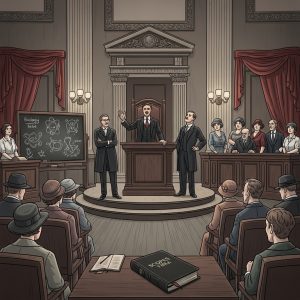
Ah, the Scopes Trial! It’s an absolutely fascinating episode in American history, truly a “signal episode” that dramatically highlighted the cultural and intellectual fault lines of the 1920s.
This wasn’t just a simple legal dispute; it was a profound “cosmological conflict” that defined the clash between religious conservatives and progressives for decades to come. It vividly dramatized the “gap between the gullible multitudes and the thinking elite,” representing a cultural struggle between rural and urban values, science and faith, reason and revelation, and religion and modernity.
The whole affair was, in essence, a strategic move. The State of Tennessee had outlawed the teaching of evolution as a scientific fact. Hoping to prevent a wave of similar legislation, the American Civil Liberties Union (ACLU) advertised in Tennessee newspapers, offering to finance a test case. A transplanted New Yorker named George Rappleyea, living in Dayton, Tennessee, saw the ad. He, along with local school officials, recognized the potential for a “big sensation” that could benefit the local economy, despite their differing views on Darwinism. John Scopes, a biology teacher and a “committed Darwinist,” volunteered to be the defendant, setting the wheels of this dramatic trial in motion.
The legal teams assembled were equally compelling. The established churches were keen to join the fray, bringing in William Jennings Bryan. Bryan was a prominent figure, a former secretary of state, and a three-time progressive presidential candidate, but crucially, his biographer noted he was “always more interested in religion than in government”. Darwinism had been a major focus for him since 1921, and he frequently lectured against what he called a “gigantic conspiracy of atheists and agnostics”. On the other side, Clarence Darrow, by then “the nation’s most famous criminal lawyer,” offered his services to Scopes free of charge. Darrow and Bryan, surprisingly, had once been political allies in the Democratic party, but Darrow’s militant atheism diverged sharply from Bryan’s deeply held religious convictions.
When the trial began on July 10th, the atmosphere was charged. The weather was “blistering hot,” and the courtroom was packed with vocal and unruly spectators. From the very beginning, the exchanges between Darrow and Bryan were acrimonious, with Darrow famously fulminating against a “narrow, ignorant, bigoted shrew of religion”. While the judge was a fundamentalist, his rulings were generally fair.
The defense aimed to argue that evolution was established science and not anti-religious, suggesting that religion and science occupied “different, but compatible, intellectual universes”. The prosecution called school officials and two boys to confirm Scopes had taught evolution, which he did not deny. A key moment came when Darrow called a Johns Hopkins professor, an eminent zoologist and devout Protestant, to explain scientific evolution. The courtroom audibly gasped when the professor estimated evolution began “600,000,000 years ago”.
The attorneys then debated the very relevance of scientific evidence – was the trial about the science, or simply whether Scopes broke a specific law? Bryan, in his element, delivered a conversational, caustic, learned, and very funny speech, punctuated by continuous laughter from the transcript. He dramatically read from Charles Darwin’s The Descent of Man, humorously lamenting that humans proceeded “Not even from American monkeys, but from old world monkeys”. Scopes himself was taken by Bryan’s speech, calling it “almost like a symphony”. Ultimately, the judge ruled that scientific evidence was irrelevant to the core question of whether Scopes violated the law. With conviction seeming inevitable, many of the press corps and celebrity visitors left.
Despite the portrayal in popular culture like Inherit the Wind (which, based largely on press reports, reduces Bryan to a “gibbering, tearful fool”), a fair reading of the trial transcript reveals Bryan “rather holding his own”. Darrow, conversely, came across as “hectoring and intemperate”. Darrow’s strategy was to highlight points of scientific consensus, such as the age of early Egyptian civilization, contrast them with the Bible’s implied age of the earth, and then mock Bryan’s acceptance of biblical dates. However, for most of the audience in Dayton, including the judge and local spectators, Bryan’s answers — such as “anything was in the power of God” — would have resonated deeply.
The back-and-forth grew so “cantankerous” that the judge finally halted the examination, ruling it irrelevant and not for the record. The defense, having conceded Scopes taught the forbidden material and unable to present scientific evidence, offered no closing statement, which, by procedural rule, prevented Bryan from giving one. The jury then retired and, after just nine minutes, returned a guilty verdict. Scopes was fined $100, a sum paid by the Baltimore Evening Sun.
The historiography of the trial was largely shaped by the secular publishing industry. Frederick Lewis Allen’s popular 1930s book, Only Yesterday, depicted the trial as a “crushing blow against fundamentalism,” with Bryan “covered with humiliation”. It argued that while fundamentalism “theoretically had won,” it “really had lost” as “civilized opinion” regarded the trial with “amazement and amusement,” leading to a “slow drift away from Fundamentalism”. Later, in the 1950s, figures like Richard Hofstadter and the playwrights of Inherit the Wind further solidified this narrative, linking fundamentalism with “sinister forces” such as the Ku Klux Klan and McCarthyism, suggesting these were put to rout by “education and intellectual progress”.
However, the sources indicate that earlier histories, like Allen’s, often contained “many details” that were incorrect, relying primarily on newspaper accounts rather than the trial transcripts. The trial’s enduring symbolic significance became evident decades later, for instance, in the mid-1980s. A local dispute in Mobile, Alabama, where parents sued the school board for promoting “secular humanism” through textbooks, again drew national attention and involved major players in the “culture war” like the ACLU. This demonstrates that the Scopes trial wasn’t just a historical footnote; it was a profound cultural moment whose themes of science, faith, and societal values continued to reverberate through American life, serving as a touchstone for ongoing debates about national identity and what is taught in schools.