
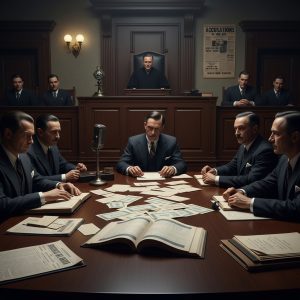
The 1933 Senate subcommittee hearings on stock market manipulations, often remembered as the Pecora hearings, represented a watershed moment in American financial history, profoundly altering the landscape of Wall Street and the federal government’s role in its oversight. These exhaustive inquiries, conducted by the Senate Banking and Currency Committee, cast a harsh spotlight on the speculative excesses and alleged misconduct that characterized the lead-up to the 1929 stock market crash and the ensuing Great Depression.
The Genesis of the Inquiry: While the hearings reached their most impactful phase in 1933, their origins traced back to Herbert Hoover’s administration. Hoover, deeply concerned by what he perceived as “vicious speculation” and “sinister” bear raids aimed at driving down stock prices, had, as early as 1919, called for government regulation of the stock market. Convinced of a Democratic conspiracy to manipulate stocks downward for political gain, he compiled lists of alleged “bear cabal” members and even claimed they met weekly to plot “destruction”. Despite privately mocking Hoover’s “absurd and fantastic” obsession, J.P. Morgan partners could not dissuade him from his vendetta. Under threat of federal regulation, Hoover pressured the New York Stock Exchange (NYSE) president, Richard Whitney, to “voluntarily” restrict short selling in late 1931 and early 1932. Dissatisfied with continuing stock price declines, Hoover finally compelled the U.S. Senate to investigate the NYSE in February 1932, despite admitting the federal government lacked constitutional jurisdiction over the New York-based institution.
Initially, the hearings under the Republicans proved ineffective. Two general counsels were fired, and another quit. Wall Street bankers, including Thomas Lamont of J.P. Morgan, attempted to quash the inquiry, fearing it would unearth “discouraging filth” and jeopardize economic recovery efforts. Lamont, in a heated exchange with Hoover, candidly stated that 99 percent of the market’s decline was due to poor business conditions, famously asking, “But what can be called ‘real value’ if a security has no earnings and pays no dividends?”. The early “bear hunt” by the Senate, which never found a Democratic conspiracy, was openly ridiculed by the press.
However, mounting public outrage and a growing demand for accountability for the economic collapse led to a renewed push for a “real inquiry”. Samuel Untermyer, who had chaired the earlier “Money Trust” Pujo hearings of 1912-1913, demanded a new investigation.
Ferdinand Pecora’s Ascendancy: The hearings took a decisive and fateful turn when they reopened in January 1933 with the appointment of Ferdinand Pecora as chief counsel. A Sicilian-born, anti-Tammany Democrat, Pecora was a former chief assistant district attorney in New York known for his aggressive, fearless, and incorruptible prosecutorial style, having tackled tough assignments from crooked banks to the police department. Pecora’s “feisty integrity” and talent for “taunts and withering asides” quickly captured public attention. He had previously been active in politics, serving as a district leader for the Progressive Party in 1912 and later joining the Wilson Democratic Party.
Pecora, initially expecting to conclude the investigation before Roosevelt’s inauguration, instead led an inquiry that extended until May 1934, generating ten thousand pages of testimony. President Franklin D. Roosevelt, having railed against “unscrupulous money changers” in his inaugural address, secretly met with Pecora and Senate Banking Committee Chairman Duncan Fletcher, encouraging them to target J.P. Morgan & Company. Pecora was more than willing to oblige.
Shocking Revelations and the Naming of the “Old Order”: The Pecora hearings peeled back the layers of Wall Street’s practices, exposing a pervasive culture of manipulation, self-dealing, and unchecked power that had thrived in the 1920s. Key revelations included:
- Investment Trusts and Pools: The hearings revealed how “investment trusts”—leveraged mutual funds—were central to the speculative fervor. J.P. Morgan itself participated in over fifty stock pools between 1927 and 1931, which blatantly manipulated stock prices. Publicity agents were hired, and reporters allegedly bribed, to “talk up” stocks.
- “Preferred Lists”: Morgan partners were “pilloried” for maintaining a “preferred list” of financiers and politicians who were allowed to purchase new stock issues before public sale, an undeniable attempt to curry favor.
- Call Loans: It was uncovered that large corporations like Standard Oil of New Jersey had lent tens of billions of dollars in “call loans” to encourage speculation at the peak of the 1929 boom.
- Self-Dealing and Greed: The investigations showed that Wall Street’s interlocking depositary and investment banking businesses were “ripe fields for self-dealing, gross fiduciary violations, and rampant greed”. Clarence Dillon of Dillon, Read’s unapologetic statement, “We could have taken 100 percent. We could have taken all that profit,” exemplified this attitude.
- Fraudulent Ventures: The hearings exposed the spectacular story of Ivar Kreuger, the “match monopolist,” who raised $760 million through American banking syndicates, stealing much of it before committing suicide. Samuel Insull’s vast utility empire, built on complex holding companies and borrowed money, was also laid bare.
- National City Bank: Pecora’s “evisceration” of National City Bank’s (the “superbank”) business practices and leadership was particularly impactful, with the hearings revealing loans made to officers to save their stock.
When Pecora demanded J.P. Morgan & Company’s balance sheets, Jack Morgan initially resisted, prompting Pecora to wage war in the press and on Capitol Hill, leading the Senate to pass a resolution to investigate private banking—a clear reminder of its unregulated status. Morgan’s investigators then spent six weeks sifting through records at 23 Wall Street, documents “no outsider had ever before seen”.
Outcomes and Legacy: The Pecora hearings generated a “tidal wave of anger” against Wall Street, convincing the public that they had been “conned” in the 1920s, transforming bankers into “banksters” in the public imagination. This public outrage and Pecora’s sensational findings pressured the Roosevelt administration to take immediate action.
The direct legislative consequences were swift and profound:
- Glass-Steagall Act (Banking Act of 1933): This landmark legislation, influenced by Senators Carter Glass and Representative Henry Steagall, mandated the compulsory separation of commercial and investment banking. It also prohibited commercial banks from paying interest on demand deposits and, importantly, established federal insurance for bank deposits. This act directly aimed to dismantle the “power” of institutions like J.P. Morgan by severing their deposit-and-loan businesses from their securities work.
- Securities Act of 1933: Passed unanimously by the House, this act made it illegal to lie about stocks and bonds offered for sale. It imposed rigorous and expensive procedures for new securities issues, effectively “cartelizing” the sources of new capital and the investment banking industry, channeling savings toward larger, established firms.
- Securities Exchange Act of 1934: This “more powerful successor” act created the Securities and Exchange Commission (SEC) to police the practices Pecora had uncovered. Ferdinand Pecora himself was named a commissioner of the SEC.
For the House of Morgan, the impact was immediate and long-lasting. The bank was described as “paralyzed” and seemingly “unable to exercise influence” in Washington, its partners lamenting their “exclusion” and becoming “a caste of untouchables” at the start of the New Deal. While J.P. Morgan initially hoped Glass-Steagall would be repealed and postponed its decision until 1935, it was legally barred from securities work for a year. The bank ultimately chose deposit banking, leading to the creation of Morgan Stanley in 1935 as its investment banking spin-off. This period also marked a shift towards greater transparency, as the firm, which had never before published a balance sheet, was now required to do so and submit to government examination.
The Pecora hearings, by publicly exposing the inner workings of the financial elite, “smashed their credibility,” creating the necessary political space for the Roosevelt administration to implement sweeping reforms. As Pecora himself stated, “Never before in the history of the United States had so much wealth and power been required to render a public accounting”. While some contemporary analyses argued that Pecora’s “findings were usually only ad hoc speculation by individual senators” and that the charges were “trumped up”, the hearings indelibly shaped public perception and laid the foundation for modern financial regulation in the United States.