

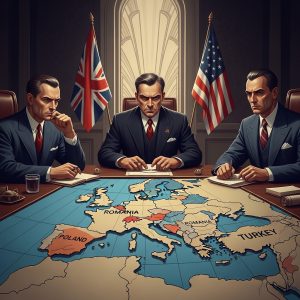
Ah, indeed, the year 1945, a true watershed moment, where the titanic struggle of World War II gave way not to a serene peace, but to a new, albeit frigid, global order. The “spheres-of-influence settlement” reached in this period was less a formal, universally agreed-upon document and more a recognition of the brutal realities forged by the war, particularly by the advancing armies of the victors. It marked the definitive end of one era and the uneasy birth of another, setting the stage for decades of ideological confrontation.
To truly grasp its significance, we must look to the momentous decisions and underlying aspirations of the major powers as the war drew to a close.
The Crucible of Yalta: Reshaping Europe’s Destiny
The most prominent stage for this “settlement” was the Yalta Conference in February 1945, where U.S. President Franklin D. Roosevelt, Soviet Premier Joseph Stalin, and British Prime Minister Winston Churchill, the “Big Three,” met to determine the shape of postwar Europe. It was here that the burgeoning fault lines between the Western Allies and the Soviet Union became unmistakably clear, particularly concerning the disposition of Poland and Germany.
At Yalta, there was a shared understanding that Germany must be dismembered. The Americans, British, and eventually the French would occupy the western zones, while the Soviets would take the east, with Berlin itself also divided. This was initially conceived as a temporary measure to address the immediate political and security vacuum left by Nazism’s defeat. However, fundamental differences in vision emerged. Roosevelt and Churchill, acutely aware of the economic collapse that followed World War I, saw the necessity of an economically viable Germany for Europe’s overall stability. Stalin, conversely, viewed Germany as a nation that must pay a heavy price for the immense damage inflicted upon the Russian people, insisting on stiff reparations and the confiscation of German industrial machinery to rebuild his war-torn economy. These unresolved differences at Yalta would become a major flashpoint in the nascent Cold War.
Furthermore, within weeks of Yalta, the fragility of promised cooperation became apparent. The Soviets established a “puppet government” in Romania, and President Roosevelt expressed his “astonishment,” “anxiety,” and “bitter resentment” over Moscow’s failure to allow promised elections in Poland. This signaled a growing distrust of Stalin’s intentions.
The Specter of Soviet Hegemony and American Response
Beyond Germany and Poland, Stalin’s strategic priorities extended to the “central front,” aiming to assert Soviet rights in Central and Eastern Europe, creating a buffer zone. He also pointed to Iran and Turkey, expressing dissatisfaction with the southern Soviet border in the Caucasus and seeking more territory and oil concessions. In March 1946, the Soviets even blocked Iranian forces from subduing an armed rebellion in northern Iran and initially refused to withdraw their own troops, despite a 1942 treaty. This move brought a “brief war scare” to Washington, fearing Soviet influence over the entire Middle East. The Soviet Union, in essence, was consolidating control in what would soon be characterized as its “exclusive Soviet control” of Eastern Europe, triggering a “forty-year-long security confrontation”.
From the Soviet standpoint, the war had been a class coalition against fascism, and their immense sacrifices (including driving the Germans out of Russia and engaging 80 percent of German troops by the time of the cross-Channel invasion) earned them a legitimate right to influence in Eastern Europe. Stalin, as one source notes, was at all times “guided…by the rule that one must come to terms with a superior power,” acknowledging America’s newfound global status.
On the American side, the end of the war brought a strong public desire for demobilization; by mid-1946, U.S. forces had been slashed from 12.3 million to 1.5 million people under arms. In October 1945, a mere 7 percent of Americans considered foreign problems “vitally important”. President Truman, stepping into Roosevelt’s shoes, initially focused on the domestic front, notably canceling Lend-Lease aid to Britain, the Soviet Union, and France in August 1945. There was a significant fear of the Great Depression resuming post-war, though this did not materialize due to wartime finance and new policy tools.
However, the “surprise attack on Pearl Harbor” had left an “indelible image of national vulnerability”, and a new geopolitical understanding was emerging: the need to prevent any single power from controlling the vast Eurasian landmass. While Roosevelt’s vision for peace had been somewhat vague, relying on “Four Policemen” (U.S., Soviet Union, Great Britain, Republic of China) and the United Nations, the brutal Soviet actions in Poland and Romania, coupled with Stalin’s “pugilistic speech” in early 1946 about Soviet system superiority, quickly “confirmed” American fears. Europe, as described by Assistant Secretary of War John McCloy, was experiencing a “complete economic, social, and political collapse”, leading to fears of “agitation,” “arbitrary and absolutist controls,” and “overthrow of governments”. This context fueled the perception of a growing “Soviet threat”.
Beyond territorial divisions, 1945 also saw the cementing of a new international economic system, largely shaped by American power. Quietly, “behind the headlines in battles and bombings,” American diplomats and businessmen worked to ensure U.S. economic preeminence post-war. The aim was to extend the “Open Door Policy” of equal access from Asia to Europe, essentially pushing Britain aside in areas like the Middle East’s oil resources. This was driven by the need for “enormously increased production” after the war, which the domestic market could not absorb indefinitely, necessitating “greatly increased foreign markets”.
The Bretton Woods Agreement, culminating in July 1944, established a new multilateral world order with fixed exchange rates based on the U.S. dollar, effectively moving “the financial center of the world from London to the United States Treasury”. The International Monetary Fund (IMF) and the International Bank for Reconstruction and Development (IBRD, or World Bank) were set up during the war, with American dominance ensured by voting proportional to capital contributed. This structure was seen as a “prerequisite to peace and economic development”. Key figures like Cordell Hull had long championed this vision of a world free of trade barriers, a “reversal of a hundred years of American policy” that aimed to make America “the supreme world factor economically and morally”.
The U.S. also pressed hard against British imperial preferences and exchange controls, with the Lend-Lease agreements serving as a lever to secure commitments to multilateralism. This shift was so profound that in January 1945, Lamar Fleming Jr., president of the world’s largest cotton export brokers, could write that the “British Empire and British international influence is a myth already”.
The destruction of the Fascist powers was undeniable, but the underlying elements of fascism—militarism, racism, imperialism—were questioned as to whether they were truly gone or absorbed by the victors. Both the Soviet Union and the United States, now “without swastikas, goose-stepping, or officially declared racism,” began to “carve out their own empires of influence” under the guise of “socialism” and “democracy,” respectively. They built military machines “far greater than the Fascist countries had built” and sought to control more countries than Hitler, Mussolini, and Japan ever did.
The United Nations, created in 1945, was presented as a beacon of “international cooperation to prevent future wars”. However, it was dominated by the “Western imperial countries—the United States, England, and France—and a new imperial power…the Soviet Union”. Its effectiveness was quickly diminished by the emerging Cold War, which “sharply limited its ability to effect major changes in the nature of international relations”.
The “Good Wars” ideological mobilization had created a “template” that not only demonized German and Japanese enemies but also “inculcated the polarizing mind-set” that facilitated the justification of force against future antagonists. The war also “created the military and industrial infrastructure that shaped the embryonic national security state at home and then spread its dubious blessings abroad”. This construction of empire was underway “before the end of World War II”.
In retrospect, the “spheres-of-influence settlement” of 1945 was not a definitive peace but a tense redistribution of power that directly paved the way for the Cold War. It solidified the bipolar world order, where two ideologically opposed superpowers, the United States and the Soviet Union, became global hegemons. While it seemingly prevented immediate large-scale conflict among the major powers—what some historians later termed “the long peace”—it did so by containing former enemies and establishing a fragile balance of power, often at the cost of “proxy wars and considerable bloodshed on the periphery”. This period, then, signifies the moment when the world fundamentally reorganized itself, leaving an enduring legacy of geopolitical competition and a new global economic architecture that would define the latter half of the 20th century.