

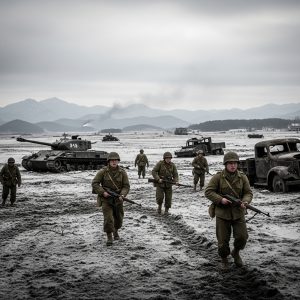
The period spanning 1950 to 1953 witnessed a stark escalation of Cold War tensions into open conflict, with United States forces playing a central and leading role in the Korean War. This engagement, often referred to as “the forgotten war,” was far from insignificant; it profoundly reshaped American foreign policy, military strategy, and domestic perceptions of global responsibility in the nascent Cold War era.
Just a year after the Universal Declaration of Human Rights (UDHR) was signed in Paris in December 1948, a document born from the ashes of World War II and a profound shift in international relations, the world plunged into a new kind of war. The UDHR itself, while lacking immediate enforcement, had set new standards for human rights amidst the rapidly escalating Cold War. By 1949, the Cold War’s “new temporal sense” was fixing U.S.-Soviet conflict into a permanent reality, and the U.S. administration was already debating the implications of expanding United Nations (UN) jurisdiction, ultimately deciding against establishing precedents that might unduly restrain American foreign policy. This backdrop of deepening ideological division and a growing American resolve to assert its influence set the stage for Korea.
The Outbreak and Initial U.S. Response On June 25, 1950, North Korean troops, spearheaded by approximately 150 Soviet-made T-34 tanks, launched a sudden invasion of South Korea. The South Korean army was quickly overwhelmed, with its capital, Seoul, falling within two days. President Harry S. Truman responded with remarkable speed, deciding to intervene within twelve hours of being notified. He famously declared, “By God… I’m going to let them have it,” and instructed his Secretary of Defense, Louis Johnson, to “hit ’em hard”.
Truman’s decision, while swift, was not impulsive. It stemmed from the charged political climate of 1950. The previous year had seen two major geopolitical shifts: in August 1949, the Soviet Union successfully developed an atomic bomb, ending America’s nuclear monopoly, and in October, Mao Zedong inaugurated the People’s Republic of China, effectively concluding China’s civil war with a Communist victory. This “loss” of China deeply impacted American domestic politics, with Republicans accusing Democrats of being “soft” on communism and figures like Senator Joseph McCarthy beginning their crusades against alleged communists in government. Truman felt he could not afford to “lose” Korea as well.
Furthermore, the UN had condemned the North Korean invasion under U.S. leadership, and Truman believed that upholding the UN resolution was crucial to preventing the organization from meeting the same fate as the League of Nations. He also drew heavily on the “lessons of World War II,” particularly the appeasement at Munich in 1938, which he believed taught that giving in to aggressors only led to further demands and expanded conflict. The fear that “if South Korea was allowed to fall, Communist leaders would be emboldened to override [other] nations” was a strong motivator. Beyond these, Truman recognized that a failure to respond forcefully would lead to a significant loss of American influence abroad to the Soviets. Just five years after World War II, the United States was again at war, although Truman initially insisted on calling it a “police action” rather than a full-scale war. This “police action” was conducted by a coalition of forces representing the “free world” under the auspices of the UN, with soldiers from sixteen nations and non-combat aid from thirty others, though it was undeniably “clearly an American war” led by U.S. generals.
The War’s Progression and Chinese Intervention The American army that entered Korea in 1950 was not the seasoned, well-equipped force that had triumphed in World War II; it was described as “under-funded, badly supplied, and reportedly overweight and poorly trained”. Initially, U.S. and South Korean troops were pushed back to a defensive line around the South Korean port of Pusan. However, with a buildup of forces and effective U.S. air power, General Douglas MacArthur executed a brilliant amphibious landing at Inchon, deep behind North Korean lines, which, combined with an offensive from the Pusan Perimeter, successfully pushed North Korean forces back north of the 38th Parallel.
At this point, the initial objective of containing the North Korean aggression was achieved. However, Truman, eyeing upcoming midterm elections and believing a military victory against communism would garner significant support, decided to pursue the unification of Korea by “rolling back” the Red tide. With approval from the Joint Chiefs of Staff, U.S. troops were authorized to cross the 38th Parallel and advance north to the Yalu River, on the Chinese border. This decision, made without adequately considering how China might react, proved to be a critical turning point.
In late November 1950, between 40,000 to 80,000 Chinese “volunteers” crossed the Yalu River and launched a massive counter-offensive that caught the UN forces by surprise. This intervention dramatically changed the nature of the conflict, transforming it into “an entirely new war”. This turn of events led to a fierce public and strategic disagreement between Truman and MacArthur. MacArthur, still advocating for total victory reminiscent of World War II, demanded an expanded war against China, including a naval blockade, air attacks on Chinese installations in Manchuria, significant reinforcements, and the potential use of nuclear weapons. Truman, however, firmly refused to expand the conflict, recognizing that in the nuclear age, such an escalation could quickly draw in the Soviets and ignite World War III. The tension culminated in Truman’s decision in April 1951 to relieve MacArthur of his command, a unanimous decision among his military policy makers.
Stalemate and Costs Peace talks began in July 1951, but the fighting dragged on for another two years, as neither side was willing to negotiate from a position of weakness. The war became a costly stalemate, both in terms of lives and resources. By 1952, the U.S. defense budget had skyrocketed to $50 billion from just $13 billion before the war, demonstrating how military production could bring “stability and high profits” to the U.S. economy. The American public grew increasingly tired of the war, and it was largely “relegated to the back pages” of newspapers. However, for the soldiers on the ground, “Korea was still cold and the enemy remained dangerous”. Approximately 2 million Koreans, both North and South, were killed during the war. U.S. forces suffered over 108,000 casualties.
The “New Look” and End of the War The Korean War played a significant role in the 1952 U.S. presidential election. Dwight D. Eisenhower, campaigning on the promise to go to Korea, narrowly defeated Richard Nixon. Although Eisenhower’s trip after the election was largely a symbolic “campaign tactic,” it helped raise troop and public morale. Public approval for the war had dropped to around 30%, and a strong dissenting opinion was growing, indicating that “a limited war of attrition was a difficult commodity to sell”.
Eisenhower was determined to end the war, possibly viewing it as “increasingly unwinnable” and a “volatile powder keg”. In July 1953, a ceasefire was finally agreed upon, leaving Korea divided at roughly the 38th Parallel, where the war had begun. For Americans, it became “the forgotten war,” often perceived as a victory when it was, in fact, “little more than a successful containment of Communist aggressions”.
The Korean War also profoundly influenced Eisenhower’s “New Look” foreign policy. This strategy aimed to cut the federal budget while advancing American interests abroad, essentially a “foreign policy on the cheap”. Instead of relying on expensive ground forces, Eisenhower and his Secretary of State, John Foster Dulles, emphasized an aggressive nuclear strategy known as “massive retaliation”. This was a warning to Moscow that the United States would respond with nuclear force to deter Soviet-sponsored aggression. The policy involved reducing ground forces while expanding the Air Force and its weapons-delivery capabilities, demonstrating a desire for “more bang for the buck”. The hydrogen bomb test in March 1954 further underscored this strategy. This approach also prioritized using “friendly indigenous forces” or providing weapons to allies to fight wars in America’s interests, which was inexpensive and kept U.S. soldiers out of harm’s way, thus relieving anti-war sentiment at home. Vannevar Bush’s 1949 book, Modern Arms and Free Men, had already highlighted the need for the U.S. to balance its democratic values with the necessity of maintaining quality conventional forces alongside nuclear weapons, a point underscored by the “shock of the Korean War”.
Legacy and Broader Implications The Korean War had far-reaching consequences for American foreign policy and its role in the world. It solidified the “containment” doctrine, making it a central pillar of U.S. strategy. The war, alongside the Communist victory in China, pushed the Truman administration to implement NSC-68 in September 1950, a document that posited the conflict with the Soviet Union as a threat to the “very survival of the United States” and called for a “massive rearmament plan”. This dramatically increased military spending and fueled the growth of the military-industrial complex.
The conflict also highlighted America’s emerging global military presence. Even though Truman initially lamented the waning of U.S. influence after World War II demobilization, the Korean War demonstrated that the U.S. still possessed immense military capacity, even if its peacetime army was only the sixth largest globally. The war led to significant military procurement orders for Japan, funneling hundreds of millions of dollars into Japanese firms and contributing to their economic recovery, effectively linking Asian growth to U.S. military spending.
The Korean War served as a crucial “reference point” for later U.S. interventions. It was viewed as an unpopular, stalemated war that many policymakers wished to avoid replicating. General Maxwell Taylor, for instance, concluded from his Korean experience “that the United States should never again fight a land war in Asia, at least without nuclear weapons”. Yet, the military establishment, particularly during the Vietnam War, sometimes still operated under the assumption that U.S. forces would prevail if sufficient effort was made, “such as the one in Korea”. The concept of the “domino theory,” that the fall of one nation to communism would lead to others, was reinforced by Korea, influencing U.S. involvement in Indochina, where the U.S. began providing substantial military aid to the French by 1950.
The war also solidified the notion of a “permanent American ‘national security state,’ organized around military solutions,” where millions would die in proxy wars in Korea, Vietnam, and elsewhere, with countries’ self-determination subordinated to the U.S.-Soviet rivalry. This led to a pervasive belief in military superiority and a “credible” nuclear striking force as the definition of “national security,” often presented to the public as an “inevitable” outcome forced by Soviet aggression. The “cold war” (lowercase, as defined by Williams) as a conflict between Western capitalism led by the U.S. and its opponents in different cultures, shows no sign of ending, even after the formal conclusion of the Cold War. The legacy of the Korean War, therefore, extends far beyond its specific dates, continuing to shape the dynamics of international relations and America’s persistent global military footprint. Indeed, as the “best example in modern history of how easy it is to get into a war, and how hard it is to get out,” Korea’s impact on U.S. foreign policy remains undeniable.