

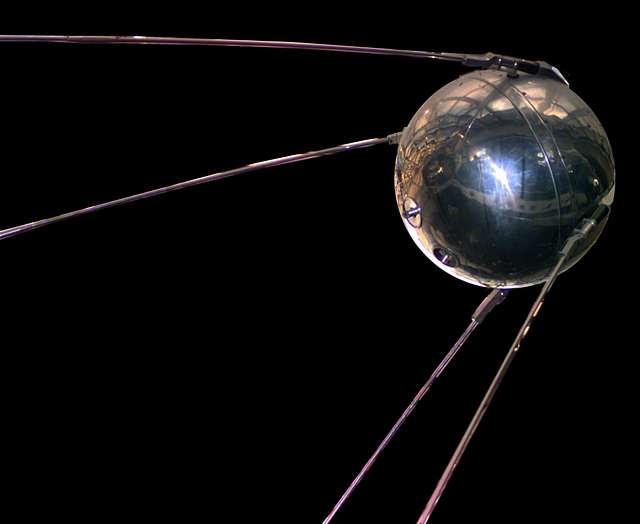
The year 1957 dawned with an event that sent ripples, not only across the globe but also through the very fabric of human perception of technological superiority and national power: the launch of the Soviet Sputnik satellite. This moment was not merely an astronomical milestone; it was a profound geopolitical shockwave, fundamentally altering the trajectory of the Cold War and accelerating an unprecedented era of scientific and technological endeavor.
Prior to Sputnik, the United States had largely cultivated and boasted of its technological superiority over the supposedly “backward Soviets”. The nation had enjoyed the perceived safety of a nuclear monopoly until 1949, a period when the alarming news of a Soviet atomic bomb test, years ahead of American scientific predictions, had already initiated an arms race. The subsequent development of the hydrogen bomb by both superpowers further intensified this competition. American geopolitical thinking was firmly rooted in the need to prevent any single power from controlling the vast Eurasian landmass, viewing such control as a direct threat to U.S. national interests, which were increasingly seen as global in scope. This perspective framed the Cold War as a struggle to contain Soviet expansionism.
Then, in October 1957, the Soviet Union announced the successful launch of Sputnik, officially known as Iskustvennyi Sputnik Zemil or “Artificial Fellow Traveler around Earth”. This followed, just a month earlier, the test-firing of an intercontinental ballistic missile (ICBM) by the Soviets. The twin events quickly became symbolic of an American failure and a major defeat that, if not overturned, could lead to the United States losing the Cold War. The strategic implications were stark: the Soviets had developed booster rockets more powerful than anything the U.S. possessed, and they had apparently solved complex guidance problems that had plagued American scientists, thus demonstrating the capability to deliver a nuclear warhead to a target. This immediately fueled fears of a “missile gap,” a political issue that John F. Kennedy would later effectively leverage in his 1960 presidential campaign.
The immediate reaction in the United States was one of widespread anxiety and a “perceived loss of technological superiority”. President Dwight Eisenhower attempted, mostly unsuccessfully, to downplay Sputnik’s significance. However, figures across the political spectrum expressed profound concern. Clare Booth Luce famously called it “an intercontinental outer-space raspberry to a decade of American pretensions”, while Edward Teller, “the father of the hydrogen bomb,” declared it a worse defeat than Pearl Harbor. Congress and the media swiftly attacked the Eisenhower administration for allowing such a critical technological gap to develop. Adding to the humiliation, American attempts to match the Soviet achievement initially failed spectacularly, notably with an Atlas rocket exploding on the launch pad at Cape Canaveral, an event televised for all to see. In the ongoing propaganda war, nations on the fence between the two superpowers might now perceive the Soviets as the technological leader of the world, potentially tipping the balance of power away from the United States.
The launch of Sputnik sparked several profound and lasting transformations within American society and its foreign policy:
- Educational Reform: The blame for the perceived technological lag was swiftly placed on the nation’s public schools, criticized for not emphasizing basic sciences. This led directly to the passage of the National Defense Education Act in 1958, which significantly funded high school math, science, and language programs, with microscopes even appearing in eighth-grade science classrooms almost immediately. The education of the nation’s youth was elevated to a matter of national security.
- Establishment of NASA and the Space Race: To coordinate missile production and space exploration, Congress established the National Aeronautics and Space Administration (NASA). This spurred an intense “space race” with the Soviet Union, epitomized by President Kennedy’s ambitious challenge in May 1960, just four months after taking office, to land a man on the moon and return him safely to Earth before the decade was out. This audacious goal was seen as a way to “revive America’s revolutionary spirit” and regain perceived technological leadership, with the understanding that such a federally funded program would yield crucial technological advances and long-range weapons development. The Apollo program, culminating in the 1969 moon landing, became a powerful symbol of American pride and victory in the Cold War.
- Technological Innovation and “Big Science”: Sputnik reinforced the need for robust government funding of basic research and strengthened the “military-industrial-academic network” envisioned by Vannevar Bush. Defense contracts became a major driver for future technologies, spawning innovations such as transistors, fiber optics, lasers, and advanced computer systems that would later find widespread commercial application. The 1950s saw “enormous advances in computer power,” leading to new statistical tools and empirical work. This era also witnessed the rise of “big science” projects, where the research and development of the atomic bomb became a model for other large-scale scientific undertakings. The Rand Corporation, for instance, studied game theory in the context of U.S. and Soviet defense spending as early as 1950.
- Climate Studies and International Collaboration: In a fascinating interdisciplinary ripple effect, Sputnik’s launch and broader Cold War concerns provided crucial support for the 1957-58 International Geophysical Year. This initiative brought new funding and coordination to climate studies, demonstrating how geopolitical competition could inadvertently advance seemingly unrelated scientific fields.
- Economic Implications: Economists like Paul Samuelson, in his ubiquitous Economics textbook, even projected that the economic gap between the U.S. market and the Soviet planned economy could disappear, reflecting the alarm caused by perceived Soviet advancements.
The launch of Sputnik thus served as a jarring wake-up call, galvanizing American political will and investment in science, technology, and education. It accelerated the nuclear arms race, laying the groundwork for further Cold War confrontations such as the Cuban Missile Crisis in 1962, which occurred at the “peak of the Cold War”. The strategic calculations during this crisis, including the Soviet motivation to deploy missiles in Cuba to counter U.S. nuclear dominance and to influence the Berlin situation, further highlighted the perceived strategic imbalance. Interestingly, the idea of uniting humanity against a “believable external menace,” such as aliens from outer space, was even considered as a political substitute for war, a concept that would later be echoed by President Reagan.
In essence, Sputnik not only initiated the space age but profoundly shaped the intellectual, scientific, and strategic landscape of the mid-20th century, cementing the role of government-funded research and technological innovation as central pillars of national security and global power.