
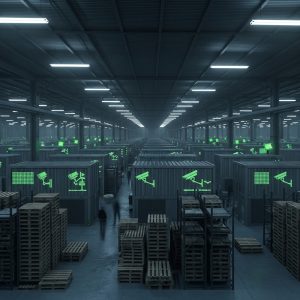
President Donald Trump’s second term brought an unprecedented escalation in domestic immigration enforcement, centered on a mass deportation effort that required an equally massive expansion of the American carceral state. To achieve this, the Department of Homeland Security (DHS)—originally under the leadership of Secretary Kristi Noem—initiated a plan to spend nearly $40 billion to purchase dozens of industrial warehouses across the United States. These cavernous structures were to be converted into makeshift detention camps holding anywhere from 1,000 to 10,000 immigrants each, with the ultimate goal of building a mass detention system capable of warehousing over 100,000 detainees across more than 20 facilities at a time.
However, investigations quickly revealed that this massive expansion was not merely a draconian immigration policy, but a staggering display of corruption and oligarchic wealth transfer. Journalists and investigators discovered that ICE systematically purchased these warehouses—many of which had been sitting vacant on the market for years—at massive markups from financial institutions with deep ties to the Trump administration.
The scale of the grift was astronomical. In Socorro, Texas, ICE bought a warehouse previously valued at $11 million for $123 million, netting the seller a profit of over 1,000 percent. In Surprise, Arizona, a property valued at just under $12 million was purchased by the government for over $70 million in cash. In Social Circle, Georgia, a $30 million property was acquired for nearly $130 million.
Crucially, the primary beneficiaries of this taxpayer-funded windfall were members of the president’s inner circle and massive Wall Street firms. In Roxbury, New Jersey, ICE paid over $129 million—more than double its $54.6 million assessed value—for a warehouse majority-owned by Goldman Sachs, the former employer of several first-term Trump appointees, including Treasury Secretary Steve Mnuchin. In Tremont, Pennsylvania, the government paid $120 million for a $60 million warehouse owned by Blue Owl, a private capital firm in which at least 33 members of the Trump administration, including the president himself, hold investments. Another facility in Salt Lake City, destined to become a 10,000-bed “mega center,” was purchased for $145 million from a subsidiary of Deutsche Bank, an institution that had loaned Trump approximately $2.5 billion over the previous two decades.
To understand this “new level of corruption,” one must situate it within the broader historical evolution of the American Prison-Industrial Complex (PIC). As detailed in previous essays, the modern carceral state exploded in the late 20th century during the “War on Drugs,” driven by a neoliberal ideology that championed the privatization of public services and the warehousing of marginalized populations. As the United States abandoned the mid-century goal of prisoner rehabilitation in favor of sheer retribution, a multi-billion-dollar enterprise arose to commodify human caging.
The private prison industry, dominated by conglomerates like the Corrections Corporation of America (now CoreCivic) and The GEO Group, was actually pioneered in the 1980s specifically for the purpose of immigrant incarceration. By the 21st century, these corporations recognized that their profit margins relied entirely on strict law enforcement and mass incarceration, prompting them to invest heavily in political lobbying. The warehouse buyout scheme was simply the latest, most brazen iteration of this system. GEO Group and CoreCivic collectively received more than $2.8 billion in ICE contracts after donating millions to pro-Trump super PACs and inaugural committees. As one investigative journalist noted, the plan to buy these warehouses originated directly from “folks very close to the White House who were sitting on properties that were causing them losses every year,” resulting in a deliberate decision to bail out these corporate allies at taxpayer expense.
The creation of these warehouse prisons triggered fierce local and federal resistance. The DHS Office of Inspector General launched an investigation into the exorbitant purchases, scrutinizing whether taxpayers were defrauded. At the local level, even conservative municipalities fought back against the imposition of these mega-prisons. In Roxbury, New Jersey, the Republican-led Township Council passed a resolution opposing the facility, citing a projected loss of $85 million in tax revenue and the severe environmental strain a 1,500-person facility would place on the region’s protected water and sewage systems. New Jersey’s Attorney General sued to stop the conversion, while similar bipartisan resistance and water-supply concerns emerged in places like Social Circle, Georgia, and Romulus, Michigan.
At the federal level, progressive lawmakers introduced the “Ban Warehouse Detention Act” to halt the creation of what they termed “torture factories”. Advocates pointed out that warehousing human beings in spaces designed for storing commercial products normalizes large-scale confinement and exponentially increases the likelihood of human rights abuses, medical neglect, and death. Indeed, those held in existing ICE detention centers consistently report horrendous conditions, including a lack of basic sanitation and medical care, frequent denial of due process, and horrific abuses by guards.
Despite the administration’s rhetoric that its deportation machine targets “the worst of the worst” criminals, the vast majority of individuals swept up in these dragnets have had no criminal records. By utilizing public funds to purchase industrial warehouses at hyper-inflated prices from political allies, the executive branch weaponized its xenophobic immigration agenda to execute a massive transfer of wealth. This scheme represents the darkest culmination of the Prison-Industrial Complex: a system where the mass deprivation of human liberty serves primarily as a highly lucrative, taxpayer-subsidized real estate grift for the nation’s oligarchs.