

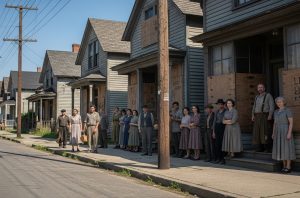
The Great Depression, a severe global economic downturn that gripped the world from 1929 to 1939, fundamentally reshaped the American economic and political landscape, challenging democratic institutions and prompting a profound re-evaluation of the government’s role in society. To truly understand its impact, we must first lay bare the complex array of factors that converged to cause this unprecedented catastrophe.
Causes of the Great Depression
The Great Depression was an international phenomenon with deep roots in the disordered aftermath of World War I. The war left Europe “awash with fear and mistrust,” with broken markets, impoverished treasuries, and restive populations. While the United States initially enjoyed economic success in the 1920s, signs of “overheating” were rife, and by the time of the 1929 stock market crash, a major correction was due.
Several key factors contributed to the onset and virulence of the Depression:
- Underlying Economic Unsoundness and Speculation: The U.S. economy, despite outward appearances of a “sleek and smoothly humming machine” in early 1929, was fundamentally unsound. John Galbraith points to unhealthy corporate and banking structures, unsound foreign trade, economic misinformation, and a “bad distribution of income,” where the top 5 percent of the population received about one-third of all personal income. There was also a remarkable surge in consumer debt and a very large run-up in home mortgages, with total outstandings reaching $27.5 billion in 1930. This environment fueled “wild speculation,” famously highlighted by the Florida real estate craze and subsequent collapse, which proved a prelude to speculative fever shifting to Wall Street.
- Monetary and Banking Policies: The Federal Reserve, despite its creation partly to provide a “lender of last resort” and an elastic currency, contributed to the conditions that made the crash inevitable. From 1921 through June 1929, the quantity of dollars increased by 61.8% due to expanding credit and artificially low interest rates, primarily intended to assist European governments, particularly Great Britain, which sought to return to the gold standard and manage its post-WWI inflation. This loose monetary policy stimulated borrowing and led to speculation in securities markets. The Federal Reserve also engaged in a series of “engineered” recessions to moderate booms, such as the one in 1920-21, which resulted in sharp price falls, increased unemployment, and bank failures. However, the economic lessons from this earlier crash went “unheeded by those in power”.
- Banking Crises: The American banking system was highly fragmented and “failure-prone”. A series of banking crises from late 1930 through 1933, identified as a causal factor in prolonging the Depression, involved widespread bank failures that spread to substantial institutions like the Bank of the United States in New York City. These failures, exacerbated by deflation, meant that banks stopped lending and deposits were frozen, contracting credit and money supply. The crisis culminated in early 1933 with a nationwide banking crisis, leading states to declare “bank holidays”. While some banking failures were fundamental due to poor management or external forces, the 1933 crisis “clearly qualifies as a panic,” sweeping up solvent and insolvent banks alike.
- Deflationary Spiral: A key feature was “deflation” or falling prices, which increased the “real burden of debt”. Even as nominal interest rates were low (e.g., Fed rates near 1%), real interest rates rose significantly due to appreciating real value of future payoffs, causing real investment to collapse. This deflationary process fed on itself: companies defaulted, banks reined in credit, production slowed, and people were laid off.
- Global Agricultural Glut and Trade Collapse: The world agricultural crisis was a significant contributor to the Depression. Industries like agriculture, which had boomed during WWI, struggled with overproduction once European farm sectors recovered. The 1930s combination of deflation, bumper crops, and heavy debt loads “prostrated farm belts throughout the world”. This was compounded by trade protectionism, notably the U.S. Smoot-Hawley Tariff Act of 1930. Although its direct impact on GDP is debated, it “compounded the problems and triggered a wave of higher tariffs and reprisals” globally, leading to a plummet in U.S. exports and imports. This “extreme trade protectionism” created a “downward spiral of global economic growth”.
- Government Inaction and Misguided Policies: Initial responses by the Herbert Hoover administration were based on “conventional wisdom” emphasizing balanced budgets, which, in retrospect, “would be hard to imagine a better design for reducing both the private and the public demand for goods, aggravating deflation, increasing unemployment and adding to the general suffering”. Hoover’s efforts involved asking businesses to maintain wages and cut prices, and some public works, but he largely “refused to renounce economic orthodoxy and mount a vigorous attack on the Depression”. He was an advocate for a “different form of easy money and cheap credit” and tried to discourage stock market speculation through “moral persuasion”. His administration saw the stock market crash as something speculators “deserved” and believed the economy would recover on its own. However, the administration’s initial “inflationist program” ultimately failed, with the Fed’s efforts “partially thwarted by increasing caution and by withdrawal of money from the banking system by the general public”.
Effect on American Democracy and the Rule of Law
The Great Depression exerted immense pressure on American democracy and fundamentally altered its trajectory and the perception of the rule of law.
- Erosion of Public Confidence and Rise of Radicalism: The widespread economic despair, with millions unemployed and suffering, led to a profound sense of disillusionment. Liberal democracy, with its free markets and parliaments, seemed “unable to respond to the world economic collapse”. In this vacuum, radical ideologies, including various forms of right-wing extremism and fascism, gained traction, offering “powerful stor[ies] about who was to blame” and “authentically radical approaches to political economy”. While the U.S. did not succumb to dictatorship, contemporary observers and even political figures questioned whether democracy could “endure much longer” in the face of mass hunger and desperation. There was a visible “desire for radicalism”. The government’s brutal dispersal of the Bonus Army in 1932, a march of war veterans demanding early payment of their bonus certificates, further illustrated the severe domestic unrest.
- Transformation of the Presidency and Government Role: The perceived failure of the old order and Hoover’s initial response led to an “overwhelming victory” for Franklin D. Roosevelt in the 1932 election. Roosevelt campaigned on addressing a national crisis “more serious than war” and pledged to tame “great special business interests” like corporations. He promised a “New Deal,” a “program of reform legislation” intended to reorganize capitalism and “head off the alarming growth of spontaneous rebellion”. Roosevelt openly declared his intent to use “broad executive power to wage a war against the emergency, as great as the power that would be given to me if we were in fact invaded by a foreign foe”. His presidency saw an “unprecedented concentration of executive power,” including prolific use of executive orders and a decision to seek a third term. The public response to his initial actions, such as the bank holiday, was a rush to deposit cash, showing newfound belief and confidence in his leadership.
- Redefinition of the Rule of Law and Economic Regulation: The Depression exposed the inherent chaos and instability of an unregulated capitalist system driven solely by corporate profit. The idea that “economic life simply could not go on without” the Federal Reserve System and expanded government intervention gained traction.
- Banking and Finance: The New Deal dramatically restructured the banking system. The Banking Act of 1933, known as Glass-Steagall, separated commercial and investment banking, prohibiting commercial banks from underwriting securities and investment banks from accepting deposits. This aimed to “obliterate[] the centralized power of Wall Street finance” and prevent reckless speculation by New York banks. The Federal Deposit Insurance Corporation (FDIC) was established to protect deposits, relieving both the public and bank managers of worry about losses. New security laws, like the Securities Act of 1933, imposed “rigorous and expensive laws and procedures for any new securities issues,” ostensibly to protect the public, but also effectively cartelizing the sources of new capital and benefiting established giants.
- Labor and Social Welfare: The New Deal gave “organized labor the right to bargain collectively with employers”. While Social Security tax was introduced, its full significance as a social safety net was not immediately clear, and its initial effect on money flow from paychecks to bond purchases was contractionary.
- Judicial Resistance and Political Confrontation: The Supreme Court, deeply rooted in a laissez-faire ideology, initially proved hostile to New Deal economic regulation, striking down key legislation related to wage and hour requirements, coal mining, and minimum wage laws. The Court maintained that “extraordinary conditions do not create or enlarge constitutional power”. This led to a “no-man’s-land where no Government—State or Federal—can function”. Following his landslide reelection in 1936, Roosevelt used his mandate to “strong-arm the Court to change its tune”. While his “court-packing plan” ultimately failed in its direct legislative objective, the intense political pressure and the shift in public opinion (reflected in his electoral victory) contributed to a “switch in time that saved nine,” as the Court began to uphold New Deal legislation. This period highlighted the dynamic tension between the executive, legislative, and judicial branches in times of crisis, where the “political will” could directly influence the interpretation and application of law.
In essence, the Great Depression shattered conventional economic and political certainties. It forced the United States to abandon its long-standing laissez-faire approach, leading to an expansion of government power, a redefinition of the relationship between the state and the economy, and a pivotal shift in the interpretation of constitutional law. This era fundamentally shaped American democracy, laying the groundwork for a more interventionist state and a broadened understanding of collective responsibility in addressing national crises.