

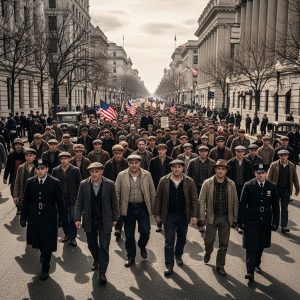
The march led by Father James Cox on January 6, 1932, in Washington D.C., offers a fascinating and potent illustration of the public’s profound discontent and the challenges facing American democracy during the early years of the Great Depression. This specific event, while one among many expressions of despair and protest, distinctively highlights the societal anxieties and populist critiques of the time, moving beyond mere generalized suffering to pinpoint specific grievances against the nation’s financial and political elites.
As the sources reveal, by early 1932, the public mood in New York and across the country was rapidly deteriorating, marked by “fights in bread lines,” people “picked through garbage,” and widespread destitution. Private relief efforts, such as the Prosser committee in New York, were running out of money, underscoring the inadequacy of non-governmental responses to the crisis. In this environment, the desperation was palpable, with a labor leader warning Congress that if the situation wasn’t adequately met, the cry might shift “from save the hungry” to “save the government”. There were visible signs of a “desire for radicalism”.
It was within this charged atmosphere that Father James Cox, a figure from Pittsburgh, emerged with his own response. Concerned about the “communist-inspired marches” that were already taking place and seeking to offer an alternative form of protest, Cox organized a march of his own. Just weeks before, in December 1931, communists had launched a “hunger march” in D.C., reportedly aiming to provoke violence to gain sympathy, though police chief Pelham Glassford opted for soup over guns to defuse that situation. Cox’s decision to lead 10,000 men to Washington on January 6, 1932, was thus both a demonstration of the sheer scale of the demand for jobs and a strategic move to channel public anger in a direction he deemed less extreme than communism.
What makes Cox’s protest particularly insightful is the directness and pointed nature of his criticism. He squarely aimed at what he perceived as the government’s inequitable financial priorities, declaring that the president was “still trying to give money to the bankers, but none to the people”. This sentiment resonated deeply with a populace that had witnessed the failure of the banking system and the perceived favoritism shown towards financial institutions. This public frustration was further fueled by revelations like those from the Pecora Commission, which, starting in January 1933, exposed the “corruption and lawlessness” of Wall Street and big business, revealing a “top-down concentrated system”. For instance, it was uncovered that banker Charles Dawes’s Chicago bank had received a significant $90 million government bailout, even as he refused to lend money to the city of Chicago for payroll, leading unpaid teachers to storm banks demanding to confront him.
Cox’s rhetorical strategy also powerfully illustrated the perceived double standards within the American system. He highlighted the apparent paradox of the government sending Al Capone to jail for $100,000 in tax evasion, while figures like John D. Rockefeller were seen as escaping a $4,000,000 inheritance tax by giving it to his son. This comparison was a potent accusation of systemic injustice, where, in the public’s eye, the rule of law seemed to be applied differently based on one’s wealth and position. It spoke to the widespread belief that “private interests” were abusing “Government credit”. The Secretary of the Treasury at the time, Andrew Mellon, a man of immense wealth himself, had controversially pushed for lower tax rates for the highest income brackets, and his administration had refused to allocate federal relief to distressed farmers. Mellon’s declining reputation, leading to him being driven “out of his office, even driven him out of the country” by populist pressure and impeachment threats, further underscores the public’s intense anger at financial elites and the perceived corruption.
In essence, Father Cox’s march was more than just a plea for jobs; it was a visible manifestation of a deep-seated populist backlash against concentrated economic power and perceived governmental indifference to the suffering of ordinary citizens. It underscored the erosion of public confidence in conventional democratic and capitalist systems, creating a fertile ground for “changes in our economic system” and ultimately contributing to the political climate that would usher in the New Deal under Franklin D. Roosevelt.