

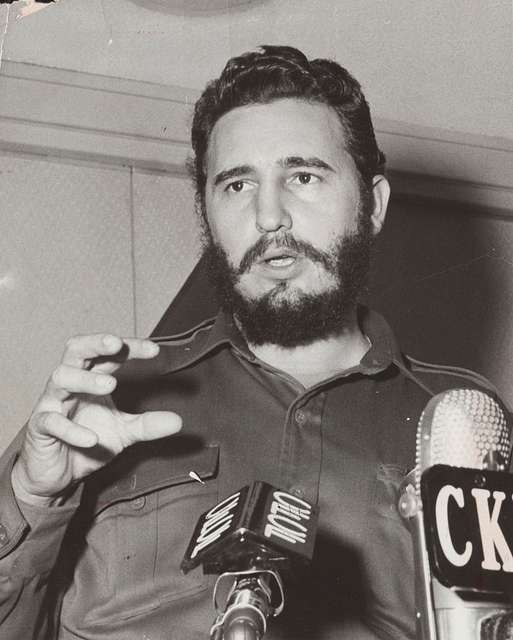
Indeed, let’s turn our gaze to 1953, a pivotal year in Fidel Castro’s revolutionary journey and, by extension, in the evolving narrative of Cuba and its relationship with the United States. You’re right to highlight the unsuccessful attack on the army barracks in Santiago and his subsequent imprisonment, as this event, though a tactical failure at the time, was a foundational moment for Castro and his movement.
The sources confirm that Fidel Castro did indeed lead an unsuccessful attack on an army barracks in Santiago in 1953, an action that led to him spending time in prison. This early foray into armed resistance by Castro and his “small band of ardent revolutionaries” was initially underestimated, seen by some as a typical government change in Latin America, perhaps “of little significance” at first. Yet, it was far from insignificant in shaping Castro’s resolve and the future trajectory of Cuba.
Following his imprisonment, Castro’s commitment to radical change would only deepen. His experiences and observations, shared by his comrades like the Argentinian revolutionary Che Guevara, profoundly influenced their approach. Che Guevara, for instance, witnessed firsthand the overthrow of Guatemala’s democratically elected government by forces aided by the United States and the United Fruit Company. This event, where “moderate reforms came up against the imperial force”, taught revolutionaries like Guevara and Castro a crucial lesson: that simply attempting reform would not suffice against entrenched powers. As Che Guevara later wrote to his mother, Celia, his resolve was to “fight for the things I believe in, with all the weapons at my disposal and try to leave the other man dead so that I don’t get nailed to a cross”. This encapsulates the determined, militarized ethos that would define Castro’s movement, ensuring it would not “share the fate of Jacobo Arbenz in Guatemala” by failing to resist with sufficient force.
It’s clear that Castro, even after this initial setback, possessed a deep-seated revolutionary conviction. By 1959, following his overthrow of Fulgencio Batista, he was still something of an enigma to the Eisenhower administration and was initially embraced by the American media. He even visited New York, making public appearances and noting his own experience of incarceration, stating, “This is like prison—I have been in prison, too”. This period, before his revolution was declared “Marxist-Leninist,” saw a perception of him as a liberator from Batista’s “gangster reign”, with figures like then-Senator John F. Kennedy initially seeing him as “part of the legacy of Bolivar”.
However, this initial American openness would quickly shift. As Castro moved to nationalize industries and transform Cuba from a “vassal state” into a “sovereign nation”, clashing with U.S. corporate interests such as the United Fruit Company, the U.S. posture hardened. The shift was also fueled by politicians like Senator Kennedy, who, to avoid being “tarred by Nixon as soft on the global Communist threat” during his campaign, adopted a more militant stance against Castro, calling his regime a “Communist menace”. This hardening of positions on both sides would lead to the escalating tensions that defined the U.S.-Cuba relationship for decades to come, moving far beyond the immediate aftermath of the unsuccessful 1953 barracks attack. That early, seemingly minor, “unsuccessful” event was truly the ignition point for a revolution that would command global attention.