

Indeed, to truly understand the fabric of American history, we must meticulously examine each thread, especially those woven through years of profound change. The year 1975 stands as a particularly significant and complex period, marking the culmination of long-standing challenges and the emergence of new directions for the United States, a true “hinge moment” in its past. It was a year where historical realities forced a national reckoning, challenging assumptions and setting the stage for future eras.
Let us delve into the pivotal events that shaped 1975:
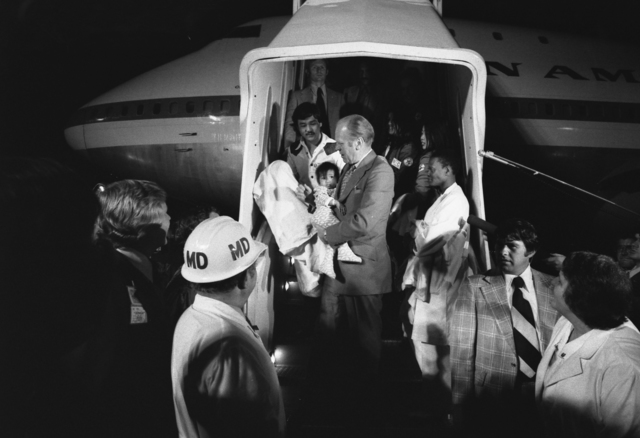
The Unceremonious End of the Vietnam War By early 1975, the Vietnam War, which had claimed some 58,000 American lives, was definitively drawing to a close. Communist forces had begun their final offensive, advancing virtually unopposed towards Saigon, and by mid-March, they controlled three-quarters of South Vietnam. On April 3, 1975, as the South Vietnamese military was being routed, U.S. officials initiated “Operation Babylift,” airlifting thousands of Vietnamese children to the United States for adoption, an effort hoped to garner congressional support for aid to the crumbling South Vietnamese regime. This action, however, came against a backdrop where faith in America’s “righteous role in the world” had waned. On April 17, Khmer Rouge troops marched into Cambodia’s capital, Phnom Penh, initiating a horrific four-year reign of terror under Pol Pot. Soon after, on April 21, South Vietnam’s President Nguyen Van Thieu resigned. The final act unfolded on April 30, 1975, when Saigon fell, leading to the helicopter evacuation of thousands, though hundreds of thousands more who had supported the U.S. were left behind.
President Gerald Ford, keen to distance the nation from the conflict, encouraged Americans to “wash its hands of Vietnam”. Just a week before Saigon’s fall, on April 23, 1975, Ford declared at Tulane University that “these events, tragic as they are, portend neither the end of the world nor of America’s leadership in the world”. He notably omitted any direct mention of the fourteen divisions encircling Saigon or the extensive American failure to prevent Vietnam’s reunification under Communist rule. His message was clear: “Today, America can regain the sense of pride that existed before Vietnam. But it cannot be achieved by refighting a war that is finished as far as America is concerned”. Even Time magazine, which had previously supported U.S. escalation, conceded in April 1975 that Vietnam was “a country seemingly fated for tragedy,” and that “the news from Indochina seems almost as much a part of past history as the rout of the redcoats at Lexington and Concord”. The realization that the nation had limits to its power and influence, coupled with the Watergate scandal, “dragged the nation down” and caused many Americans to lose pride, patriotism, and hope for the future.
The Mayaguez Affair: A Reassertion of Power? Just as it seemed the U.S. was “finished” with Indochina, on May 12, 1975, the American cargo ship SS Mayaguez was seized by the Khmer Rouge in international waters. Despite a lack of intelligence and without considering diplomatic solutions, the Ford administration moved immediately toward a military response. Secretary of State Henry Kissinger, determined to “demonstrate U.S. military power in the wake of humiliating defeat in Vietnam,” urged President Ford to “Let’s look ferocious!”. The operation, though successful in recovering the ship and crew, was “melodramatic and successful” in the eyes of some establishment figures who had previously criticized the Vietnam War. The media largely omitted the historical context of U.S. bombing campaigns in Cambodia (1969-1973), which had killed thousands, devastated the countryside, and driven many Cambodians into the arms of the Khmer Rouge. Instead, the Mayaguez coverage provided a “template for a major new American story”—one of “American victimhood,” where the nation was portrayed as an innocent target of “outrageous, inexplicable foreign assaults”.
Investigations into Intelligence Agencies and Public Distrust The period leading into 1975 saw public confidence in government plummet, with over 83% of Americans agreeing in early 1975 that “the people running this country… don’t tell us the truth”. Watergate had already tarnished the FBI and CIA by exposing their illegal activities and cooperation with Nixon. In late 1974, investigative reporter Seymour Hersh of The New York Times revealed details of the CIA’s “family jewels”—secret operations, including clandestine actions leading to the 1973 coup in Chile and surveillance of domestic anti-war protests. This revelation, a story Hersh claimed was “bigger than My Lai,” solidified a shift in the political climate.
To preempt congressional investigations and avoid “unnecessary disclosures,” President Ford announced the formation of the Rockefeller Commission on January 4, 1975, tasked with investigating CIA activities within the United States. Vice President Nelson Rockefeller, leading the commission, even suggested to CIA Director William Colby that they could be less than “fully” transparent, acknowledging the need for secrecy. The commission’s report, issued on June 11, 1975, concluded that the CIA had carried out “plainly unlawful” operations, such as spying, phone tapping, burglaries, and mail opening, but notably stated that “time did not permit a full investigation” into assassination plots against foreign leaders.
However, the more extensive Church Committee investigations in the Senate, spanning fifteen months, 126 public hearings, and reviewing over 100,000 documents, delved deeper into domestic spying and assassination plots. These investigations uncovered that the CIA, with Mafia assistance, had repeatedly attempted to assassinate Fidel Castro in the early 1960s, and that the CIA had withheld this information from President Kennedy and the Warren Commission, raising “questions about what it might have withheld on Lee Oswald and the Kennedy assassination”. Sidney Gottlieb, the CIA’s chief poison maker and director of mind control research, whose work had been “shrouded in secrecy,” was suddenly summoned to account for his deeds in 1975. Despite the public outcry and congressional interest, the senators on the Church Committee still “finished their work without coming close to understanding what MK-ULTRA had been or what Gottlieb had done”.
The Domestic Economic and Political Landscape Economically, 1975 was a year of recovery from the deep recession of 1974-1975. Inflation, which had been increasing at roughly 12 percent a year by the end of 1974 due to Vietnam War spending, an unregulated credit boom, and the 1973 oil embargo, began to fall, collapsing to 6 percent by early 1976. The Federal Reserve eased its policy “decisively” in 1975, as indicated by a rapid decline in the federal funds rate. Chairman Arthur Burns, however, initially reacted by proposing to lower the funds rate only gradually, fearing that drastic changes could be a “great mistake”. Despite this, by March 1975, President Ford stressed to Burns the importance of achieving recovery in 1975 without a new surge of inflation in 1976. The economy showed a “moderately robust” recovery in the second quarter of 1975, with 6.1 percent average real growth over the next four quarters.
The year also saw a deepening shift in American politics. The “Watergate Babies,” a large crop of angry and newly elected progressive Democrats, flooded Congress in January 1975, determined to clean up government and end the Vietnam War. They quickly moved to reorganize Congress and remove figures like Emanuel Celler, signaling a new generation focused on issues beyond traditional anti-monopolism. Congress, for example, created the Congressional Budget Office in 1974 to constrain its own taxing and spending power, headed by a “corporate technocrat”. Conservative ideas were on the ascent, exemplified by the narrow passage of a federal consumer agency bill in November 1975, losing 80 Democratic votes, indicating a “strong anti-government, anti-bureaucracy, anti–new agency phenomenon”.
New York City also faced a severe fiscal crisis in 1975, with its budget comparable to India’s. Morgan Guaranty, a key banker, spent much of the year “desperately plugging fingers into dikes” and took a $50-million write-off on its lead role with W. T. Grant, then America’s third-largest variety-store chain, which foundered in history’s largest retail failure. A plan involving a Municipal Assistance Corporation (“Big MAC”) was devised to exchange shaky city bonds for new debt, with Governor Hugh Carey’s involvement being the “critical turning point”.
Other Significant Developments In international policy, the fear of “another Vietnam” profoundly impacted decision-making. When the Soviet Union began sending Cuban troops into Angola in 1975, Secretary of State Kissinger sought aid from Congress for the U.S.-supported faction in the civil war, but Congress, seeing too many parallels to Vietnam, rejected the proposal.
Détente, a policy inherited by Ford from Nixon, struggled. While Ford met with Soviet Premier Brezhnev in Helsinki in 1975, resulting in the Helsinki Final Act, which legitimized Soviet hegemony over Eastern Europe, the agreements on human rights were never honored. This fueled a growing political opposition to détente in the United States, with concerns in the White House that Kissinger’s actions were providing a “powerful political weapon” to the Republican right. By March 1976, Ford would declare that “We are going to forget the use of the word détente”.
Culturally, 1975 saw the continued vitality of the women’s liberation movement. Feminists broadened awareness of violence against women, creating rape crisis centers and battered women’s shelters, and women appeared in public life in non-traditional occupations, sparking discussions about their roles and potential achievements. Women’s studies also grew as an academic field, responding to the historical “erasure of women’s contributions in the history books”. Additionally, 1975 marked the beginning of more active anti-apartheid activism on American campuses, with students examining their institutions’ ties to South Africa. The year also falls within a period (1975-1976) when Timothy Leary’s book Info-Psychology was written, and also a time when discussions about LSD were shifting, with scientific, objective, and rational discourse increasingly facing “neo-Inquisitorial fury”.
In summation, 1975 was far from a year where “nothing happened”. It was a year of immense transitions: the definitive end of the Vietnam War and a re-evaluation of American power, the highly publicized investigations into government intelligence agencies, a shift in economic policy and political sentiment, and the continued momentum of social movements. It was a time of “deep strains” at home and abroad, leading to a complex consolidation of the American system and a search for a new national identity.