

The unification of Germany in October 1990 stands as a monumental event, marking the formal end of a division that had shaped the geopolitical landscape for over four decades. This moment, far from being an isolated occurrence, was the culmination of a complex history of war, occupation, political maneuvering, and the surging will of people across a continent yearning for freedom and self-determination.
To truly understand 1990, one must look back to the aftermath of World War II. The Allies, including the United States, Britain, France, and the Soviet Union, occupied Germany, and agreements at conferences like Yalta determined the initial shape of postwar Europe, leading to the division of Germany and Berlin into eastern and western zones. From the outset, there were fundamental disagreements about Germany’s future. While the British and Americans recognized the necessity of an economically viable Germany for European balance, the Soviets, having suffered immensely, demanded stiff reparations and sought a weak Germany to prevent future attacks. This divergence in vision quickly led to a fragmented economy, exacerbated by currency reforms in the Western zones that the Soviets opposed. Berlin, located deep within the Soviet zone, became a constant point of contention, famously highlighted by the Berlin Blockade in 1948, where the courageous Western airlift demonstrated resolve against Soviet attempts to starve the city into submission. This struggle solidified Berlin as a symbol of freedom and the “German Question” became the “central front” of the Cold War.
Throughout the Cold War, the division of Germany remained a stark reality, embodied by the Berlin Wall erected in 1961. The North Atlantic Treaty Organization (NATO), established in 1949, played a crucial role in the Western strategy for Europe, aiming, as famously summarized, “to keep the Russians out, the Americans in, and the Germans down”. American leaders consistently emphasized their commitment to West Berlin and German freedom. President John F. Kennedy, during his 1963 visit, recognized West Berlin as an “asset, not a liability” in the broader struggle for Europe and spoke of eventual German unification, albeit acknowledging it would be “neither quick nor easy”. Later, West German Chancellor Willy Brandt’s “Ostpolitik” sought to ease tensions with East Germany and the Soviet Union. By the 1980s, American leadership, particularly under President Ronald Reagan, continued to press for change. In 1987, at the Brandenburg Gate, Reagan famously challenged Soviet General Secretary Mikhail Gorbachev to “tear down this wall!”, a powerful rhetorical moment that underscored the push for liberalization and self-determination.
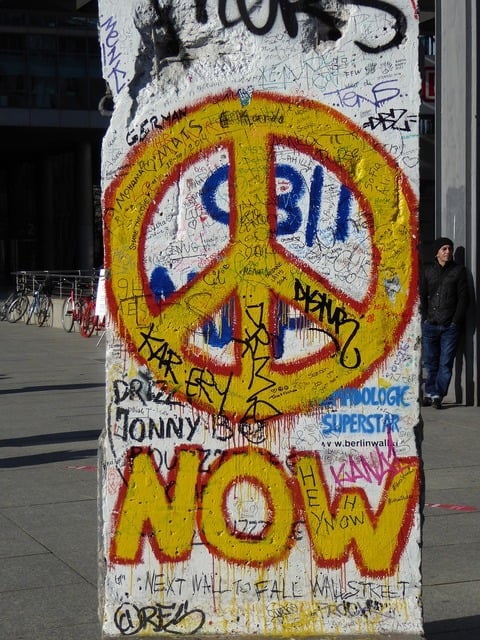
The ground for reunification was indeed prepared by the dramatic shifts occurring across Eastern Europe in 1989. Gorbachev’s decision not to interfere in the destinies of Eastern European nations effectively removed the Soviet prop holding up communist regimes. This led to a cascade of peaceful revolutions: Poland saw overwhelming victories for Solidarity in parliamentary elections, Hungary moved towards multiparty elections and crucially began removing barbed wire along its border with Austria, creating an escape valve for thousands of East Germans seeking to flee to the West. This flow of East Germans, coupled with mounting internal pressure, ultimately led East German authorities to open the border in Berlin on November 9, 1989, allowing crowds to flood across and jubilantly begin tearing down the Wall.
In response to these rapid changes, President George H. W. Bush and his administration adopted a strategy of alliance leadership, prioritizing a united, democratic Germany’s integration within NATO and the European Community (later the European Union). Bush’s vision was articulated in his “Partners in Leadership” speech in Mainz, Germany, where he called for “a Europe whole and free” and even welcomed the idea of German unification, a significant overture that freed Germans to pursue their dream. Despite initial hesitation from leaders like Margaret Thatcher of Britain and François Mitterrand of France, who feared the power of a united Germany and worried about destabilizing Gorbachev, Bush skillfully navigated the diplomatic currents. Through personal diplomacy and the “Two Plus Four” talks (involving the two Germanys and the four wartime victors), Bush cajoled and negotiated. Crucially, Gorbachev, facing his own domestic pressures, eventually dropped all objections to German reunification and even agreed to allow united Germany to remain within NATO, despite the immense sacrifices the Soviet Union had made in World War II. This paved the way for the formal reunification of Germany on October 3, 1990, achieved through Article 23 of the West German Basic Law, essentially a “takeover, not a merger,” that preserved West Germany’s governmental system and international obligations.
The reunification of Germany solidified the end of the Cold War, a fact President Bush declared at the Malta summit in December 1989. This marked a profound shift in global affairs, leading to discussions about a “peace dividend” and a reevaluation of U.S. foreign policy. NATO’s role began to transition, eventually expanding eastward to include former Warsaw Pact nations. The collapse of the Soviet Union in 1991 further underscored the triumph of liberal democracy and capitalism, reinforcing Francis Fukuyama’s widely discussed “End of History” thesis, which posited that liberal democracy combined with open market economics had become the “only model a state could follow”.
While the unification brought immense freedom and opportunity, it also brought new challenges. The post-Cold War era, rather than being a peaceful utopia, revealed suppressed regional, social, religious, nationalist, and ethnic conflicts that had been held in check by the Cold War’s bipolar structure, as seen in the breakup of Yugoslavia. Nevertheless, October 1990 remains a powerful symbol of a deeply divided nation finding unity, and a testament to how shifting global dynamics, persistent diplomacy, and the aspirations of people can fundamentally reshape the world. Germany, by virtue of its size, economic power, and geography, continues to play a decisive role in Europe’s future.