

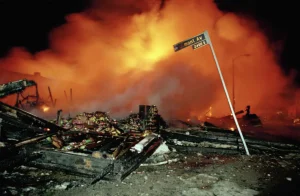
The 1992 Rodney King riots, or insurrections as they are sometimes known, represent a stark and tragic chapter in American history, marking one of the most violent urban outbreaks since World War II. These events, unfolding in Los Angeles, were not merely isolated incidents but the culmination of deep-seated racial tensions, economic disparities, and a history of perceived injustice that had simmered for decades across the nation.
The immediate fuse for the 1992 unrest was the brutal beating of Rodney King by Los Angeles police officers in March 1991. This disturbing episode was captured on video by a bystander, and the footage, shown repeatedly on national news reports, ignited widespread outrage across the country. The officers involved were subsequently indicted for using excessive force. However, the trial was moved from multiracial Los Angeles to the predominantly white suburb of Simi Valley. In May 1992, a jury composed of ten white individuals, one Asian, and one Hispanic acquitted two of the policemen and convicted the third on only a minor charge. Within minutes of this verdict, South-Central Los Angeles erupted in chaos.
The city plunged into widespread looting, fires, and violent assaults. One particularly brutal beating of a white truck driver, also caught on helicopter footage, was repeatedly shown in news reports, amplifying the sense of anarchy. Many Korean-owned businesses became targets of destruction, seen by some as symbols of success within struggling Black communities. While the fundamental cause of the riots was the perception of deep-seated racial injustice, many participants exploited the ensuing chaos for looting and destruction. The involvement of Hispanic individuals in the looting also sparked new calls for increased immigration restrictions.
The unrest continued for six days, leaving a devastating toll: fifty-three people were killed, with several individuals gunned down at random, and hundreds more were injured. The city suffered nearly $500 million in property damage. To restore order, federal troops and the National Guard were brought in. Ultimately, almost twelve thousand people were arrested, most for looting or receiving stolen property. The following year, in a federal trial in Los Angeles, two of the four officers were found guilty of violating Rodney King’s civil rights. The deployment of the National Guard in Los Angeles during these riots marked the last time a U.S. president ordered such a domestic military presence. Local officials, including Mayor Tom Bradley, had anticipated the city’s reaction to the verdict and had the National Guard on standby, calling them in immediately when the violence erupted.
The Rodney King riots, while singular in their immediate trigger, were profoundly rooted in a long and painful history of racial inequality and systemic violence in the United States. Across the nation, particularly in Northern cities, Black political protests against police brutality—like those in Watts, Los Angeles, and Harlem, Manhattan—were routinely labeled as “riots” by the media. This narrative often depicted Black resistance as “deviant, criminal, and irrational,” contrasting it with uprisings by white people, which were frequently cast as heroic.
The Watts Rebellion in 1965, another spectacular six-day riot in Los Angeles, resulted in thirty-four deaths, over a thousand injuries, and required fourteen thousand National Guardsmen and fifteen hundred policemen to bring under control. This unrest began just five days after President Lyndon Johnson signed the Voting Rights Act, leaving him astonished at the continued volatility. Similarly, the Detroit uprising in 1967, one of the most violent urban disorders of the 1960s, stemmed from fierce inequalities and a long history of institutional racism, discrimination, and police brutality. It led to forty-three deaths and devastated large sections of the city.
These outbreaks prompted the Kerner Commission report in 1968, which directly blamed “white racism” for the disorders, asserting that the nation was “moving toward two societies, one black, one white—separate and unequal”. The report recommended significant federal initiatives to improve services, schools, and job opportunities in Black communities to address the “explosive mixture” of rage and despair. However, these recommendations were largely ignored, and instead, a “law and order” response, famously championed by President Richard Nixon, gained traction. This approach laid the groundwork for the “War on Drugs” and subsequent mass incarceration in the 1980s and 1990s, policies that disproportionately affected Black communities.
Indeed, the Reagan administration’s policies, including cuts to social services and a focus on building more jails, exacerbated the precarious living conditions in inner cities, where poverty, inadequate services, and job discrimination persisted. This era also saw the devastating rise of crack cocaine, a phenomenon that ravaged South-Central Los Angeles neighborhoods starting in the early 1980s. The sources link the genesis of the L.A. crack market to Nicaraguan “freedom fighters” (Contras) who funneled drug profits through a CIA-linked network. The spread of crack from Los Angeles gangs to other urban areas across the nation contributed to the perceived criminality of Black urban youth and fueled calls for harsh policing.
The 1992 Los Angeles riots underscored that despite civil rights advancements, the fundamental issues of racial injustice and economic inequality remained deeply entrenched. The rate of unemployment among Black youths, for instance, had risen above 50 percent during the Reagan years, and racial income disparities in the 1990s remained disturbingly similar to those in the 1950s. These continued hardships, coupled with ongoing police violence, often sparked desperate acts of rebellion.
Comparing the 1992 riots to other historical incidents of domestic violence in America reveals a recurring pattern of societal frustration boiling over. The New York City Draft Riots of 1863, for example, resulted in a greater loss of life than any other incident of domestic violence in American history. Other instances, such as the Astor Place Opera House riot of 1849, the Haymarket Affair’s class conflict in 1886, or the violence against striking sugar laborers in Thibodaux in 1887, illustrate a long history of volatile social unrest in the United States. The Rodney King riots, like these earlier events, highlighted the deep-seated anger and frustration that can accumulate when systemic issues of injustice and inequality are left unaddressed. The perception that “white rage” often drove “white backlash” against advances in racial justice, leading to increased policing and punitive measures, continued to perpetuate this cycle.
In essence, the 1992 Rodney King riots served as a potent, painful reminder that the fight for genuine equality and justice in America was far from over, even after significant civil rights legislation. The events forced a national reckoning with the persistence of systemic racism and the devastating consequences of unaddressed social and economic disparities, laying bare the ongoing need for fundamental change in American society.